
You are preparing a project plan to fine-tune a pre-trained Large Language Model (LLM) on your organization's domain-specific documentation. What is the primary technical and infrastructural challenge you must address during this process?
Select an answer to reveal the explanation.
Short Explanation
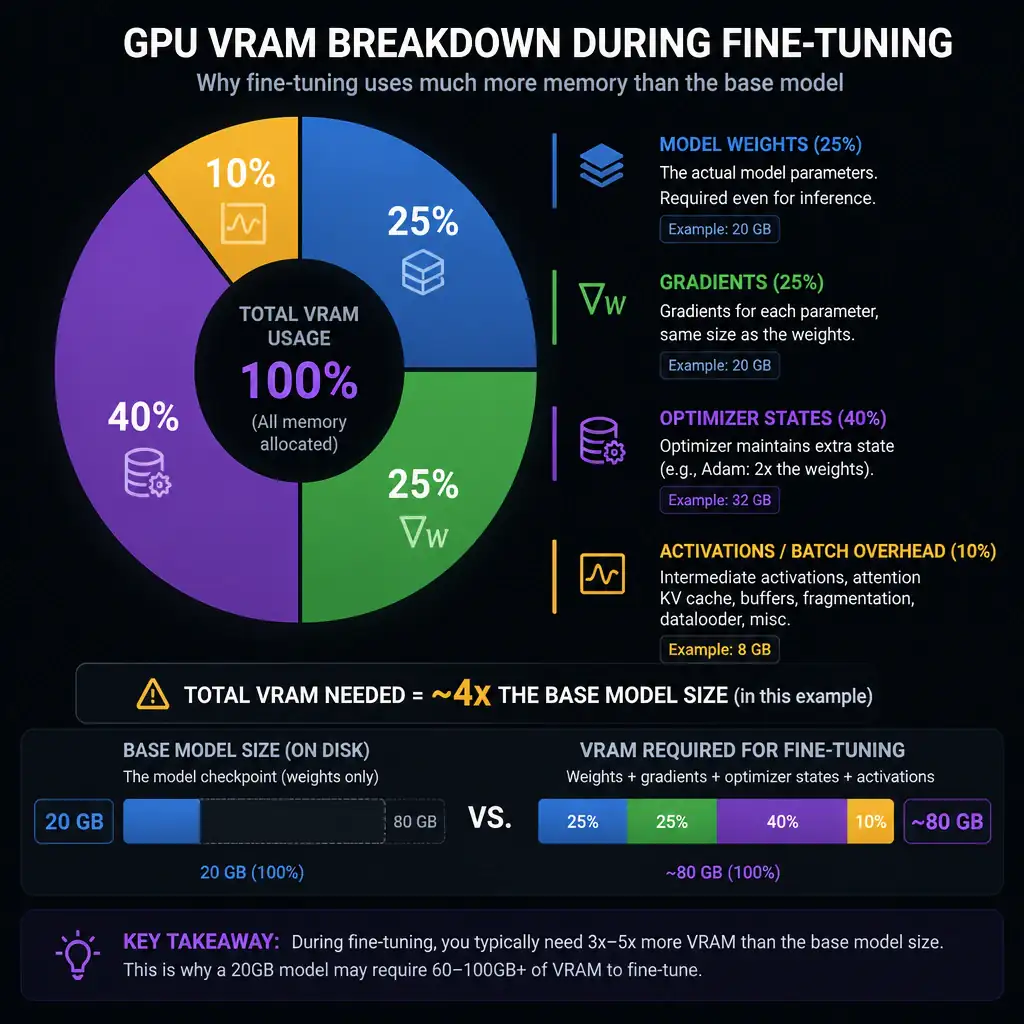
Here's the deal: fine-tuning an LLM is heavy lifting. Your GPU has to hold the model weights, gradients, and optimizer states at once, so you need serious VRAM or you'll hit out-of-memory errors.
Full Explanation
Fine-tuning a pre-trained large language model (LLM) involves continuing the training process on a smaller, labeled dataset to adapt the model to a specific task or domain. The primary engineering challenge of this process is the high computational and memory requirement.
During backpropagation, the system must keep several large arrays in GPU memory (VRAM): 1. Model parameters (weights): the actual parameters of the model. 2. Gradients: the calculated derivatives for each parameter, which are of equal size to the model parameters. 3. Optimizer states: for common optimizers like AdamW, the system tracks running averages of gradients and their squares, requiring up to twice the memory of the model parameters themselves. 4. Activations: the intermediate outputs of each layer stored during the forward pass so they can be reused during the backward pass.
For example, fine-tuning a 7-billion parameter model using 16-bit precision requires a minimum of 14 GB of VRAM just to load the model, but actually training it with standard AdamW optimization can easily require 80 GB or more of VRAM. This is why techniques like parameter-efficient fine-tuning (PEFT) and low-rank adaptation (LoRA) have become industry standards to reduce the memory footprint.
The claim that the model architecture is typically too small and requires manually designing and appending extra layers before tuning is incorrect because pre-trained models are already extremely large and complex; there is no need to manually add layers to them.
The assertion that fine-tuning is computationally trivial and the main bottleneck is the lack of specialized CPU instruction sets is incorrect because fine-tuning is computationally demanding and cannot be run efficiently on standard consumer CPU hardware.
The assertion that fine-tuning requires massive quantities of unlabeled raw data, making data curation and scraping the primary bottleneck, is incorrect because fine-tuning typically uses smaller, high-quality, labeled datasets (supervised fine-tuning) rather than massive volumes of unlabeled data, which are reserved for the initial pre-training phase.