
When building a search index or text analysis pipeline, you need to identify which words carry the most unique information in a single document compared to your entire collection of documents. Which metric is specifically designed to calculate this?
Select an answer to reveal the explanation.
Short Explanation
Check this out: when you're analyzing text, you don't just want to count words, because common terms like 'the' and 'is' dominate and tell you nothing. TF-IDF checks how often a word appears in one document but balances that against how common it is across the whole collection, so rare-but-frequent terms get flagged as important. That's the metric you want when you need unique information in a single document compared to your corpus.
Full Explanation
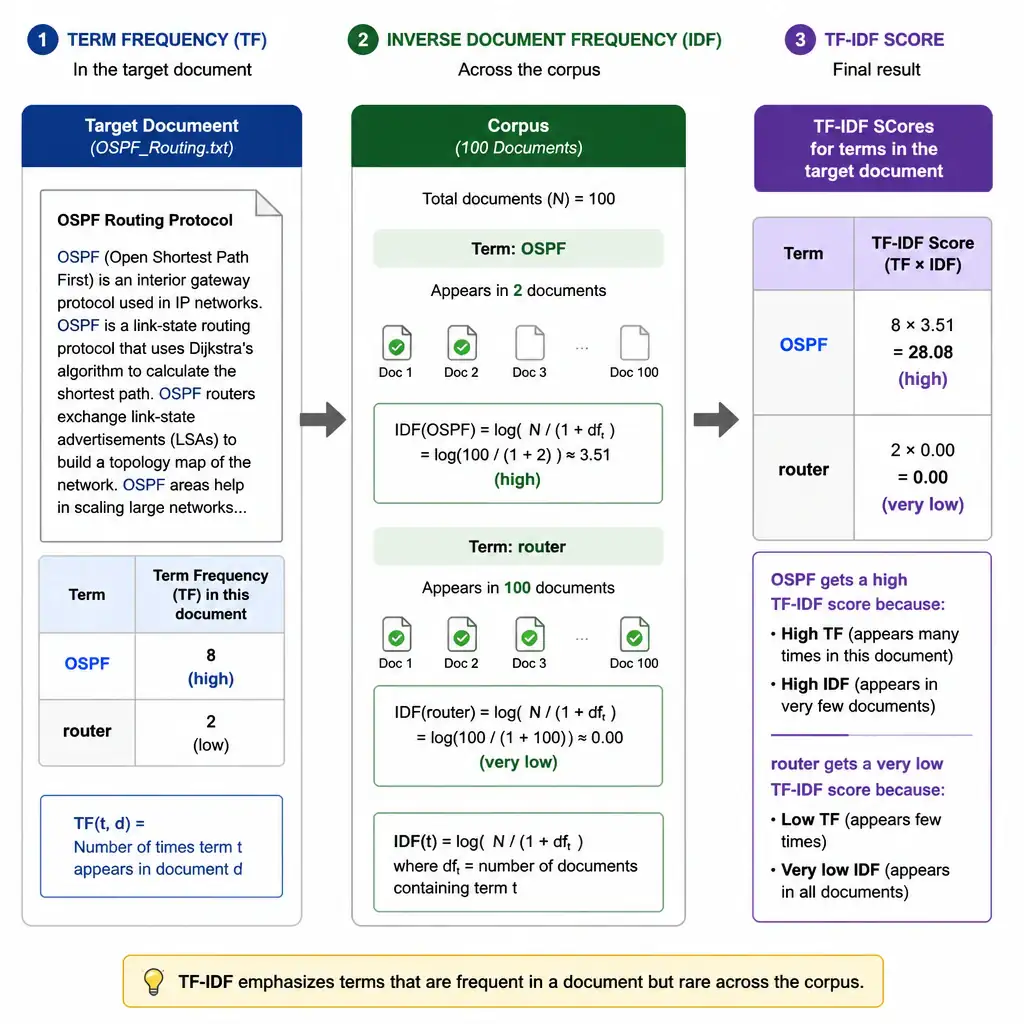
Term Frequency-Inverse Document Frequency (TF-IDF) is a statistical metric used to evaluate how relevant a word is to a document in a collection or corpus. This technique is widely utilized in natural language processing (NLP), search engine indexing, and information retrieval.
The metric is calculated as the product of two components: Term Frequency (TF): Measures how frequently a term occurs in a specific document. The simplest form is a raw count, though logarithmic scaling is often applied. Inverse Document Frequency (IDF): Measures how common or rare a term is across the entire document corpus. It is calculated by dividing the total number of documents by the number of documents containing the term, and then taking the logarithm of the quotient.
By multiplying these two terms, TF-IDF highlights words that are highly descriptive of a particular document's content (high TF) while penalizing terms that appear frequently across many documents (low IDF), such as stop words or corpus-specific jargon.
The simple word count or bag-of-words approach is incorrect because counting the most frequent words (a simple Term Frequency or Bag of Words approach) fails to discount words that are universally common across all documents, which leads to noisy and less useful representations. Stop-word filtering is incorrect because stop-word removal is a preprocessing step that deletes common words like 'the' and 'and' to reduce noise, whereas TF-IDF is a weighting metric that assigns numerical scores to terms based on their statistical uniqueness. Latent Dirichlet Allocation (LDA) is incorrect because LDA is an unsupervised generative statistical model used for topic modeling that groups documents based on hidden topic structures, not a direct term-weighting metric like TF-IDF.