
A developer utilizes a library like spaCy to apply part-of-speech (POS) tagging to a series of documents. What is the direct output of this operation?
Select an answer to reveal the explanation.
Short Explanation
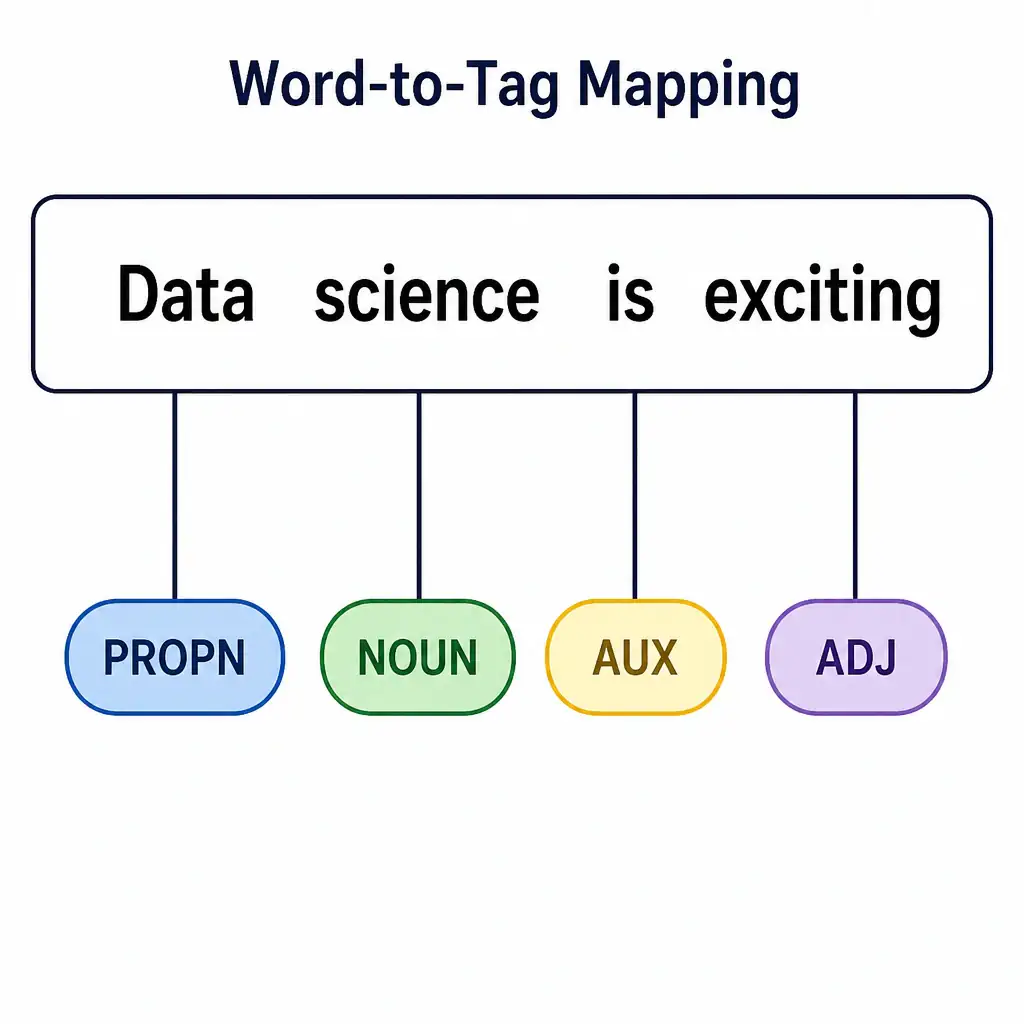
When you hear POS tagging, think back to middle school English class. You feed spaCy a sentence, and it returns the grammatical role of every token, like noun, verb, or adjective. It's not summarizing, scoring sentiment, or embedding the whole sentence.
Full Explanation
Part-of-Speech (POS) tagging is a primary task in natural language processing (NLP) that involves assigning grammatical categories to each word (or token) within a sentence. Common grammatical categories include nouns, verbs, adjectives, adverbs, pronouns, prepositions, conjunctions, and interjections.
When a developer uses a modern NLP library such as spaCy, NLTK, or Stanza to perform POS tagging, the library uses a statistical or neural network-based model to analyze the text. Crucially, POS taggers do not look at words in isolation; they analyze surrounding context to resolve ambiguities. For example, in the phrase 'He runs a fast race,' 'runs' is tagged as a verb and 'race' is tagged as a noun. However, in the phrase 'She entered the race and runs daily,' the grammatical context shifts, yet the model correctly tags them based on structural patterns. The output is typically a list or key-value mapping where each word is paired with a specific tag (such as 'NN' for noun, 'VB' for verb, or 'JJ' for adjective). POS tagging is essential for downstream applications like dependency parsing, syntactic parsing, and named entity recognition.
Understanding the incorrect descriptions: - The compressed summary capturing the main themes of the input text describes text summarization, which condenses long passages and is not the result of POS tagging. - The single numeric value indicating whether the overall text is positive or negative describes sentiment analysis, which determines emotional tone (such as polarity scores between -1 and +1). - The high-dimensional vector representation of the entire sentence for semantic search refers to sentence vectorization or embeddings (using models like Sentence-BERT), which maps whole sentences to continuous dense vectors, rather than tagging individual words grammatically.