
A team is using a pre-trained BERT model for an advanced semantic search tool. What architectural characteristic of BERT allows it to understand the meaning of a word based on both its preceding and succeeding text?
Select an answer to reveal the explanation.
Short Explanation
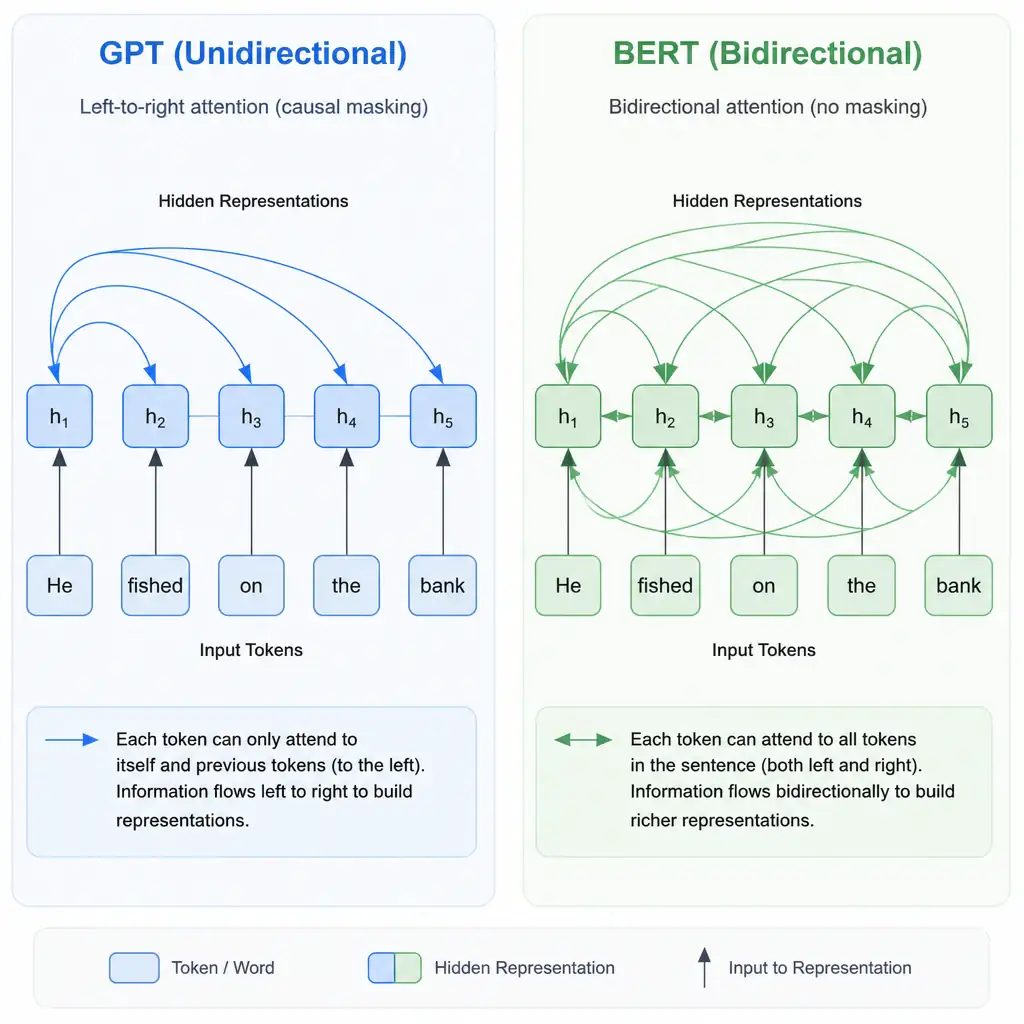
Here's the deal: BERT's 'B' stands for Bidirectional, and it uses a Transformer encoder with bidirectional self-attention to look at words on both sides at once. That lets you figure out context like 'river bank' versus 'money bank' instead of reading left-to-right only.
Full Explanation
BERT, which stands for Bidirectional Encoder Representations from Transformers, revolutionized NLP by introducing a truly bidirectional training methodology. Before BERT, models like ELMo combined separate left-to-right and right-to-left recurrent networks, which did not capture deep bidirectional context simultaneously. BERT, however, uses the Transformer encoder architecture, where all tokens in an input sequence are analyzed at the same time.
The core feature of BERT's architecture is its bidirectional self-attention mechanism. Unlike decoder-only models like GPT that use a masked or causal attention mechanism to hide future tokens and predict the next word, BERT does not restrict the attention flow. It allows each word to attend to every other word in the sentence, both before and after it. This makes it incredibly powerful for understanding the context of a word within its sentence. For instance, in the sentences 'He went to the bank to deposit cash' and 'They fished on the muddy bank of the river,' the word 'bank' has identical spelling but completely different meanings. BERT resolves this ambiguity by analyzing the context on both sides of the word. Remember for the exam: BERT looks both ways!
The recurrent neural network structure that processes tokens sequentially in both directions is incorrect because BERT is not a Recurrent Neural Network. RNNs process data sequentially, which makes them slow and limits their ability to capture long-range context compared to Transformers.
The generative decoder-only design that employs masked causal attention is incorrect because it describes decoder-only architectures like GPT, which are designed for auto-regressive generation and look only at past tokens using masked attention.
The feed-forward network that uses static word embeddings without any attention mechanism is incorrect because BERT relies heavily on dynamic attention mechanisms rather than static word embeddings like Word2Vec to capture context-dependent word meanings.