
An e-commerce platform wants to automatically categorize user-submitted reviews as positive, neutral, or negative to gauge customer satisfaction. Which natural language processing (NLP) task should they implement?
Select an answer to reveal the explanation.
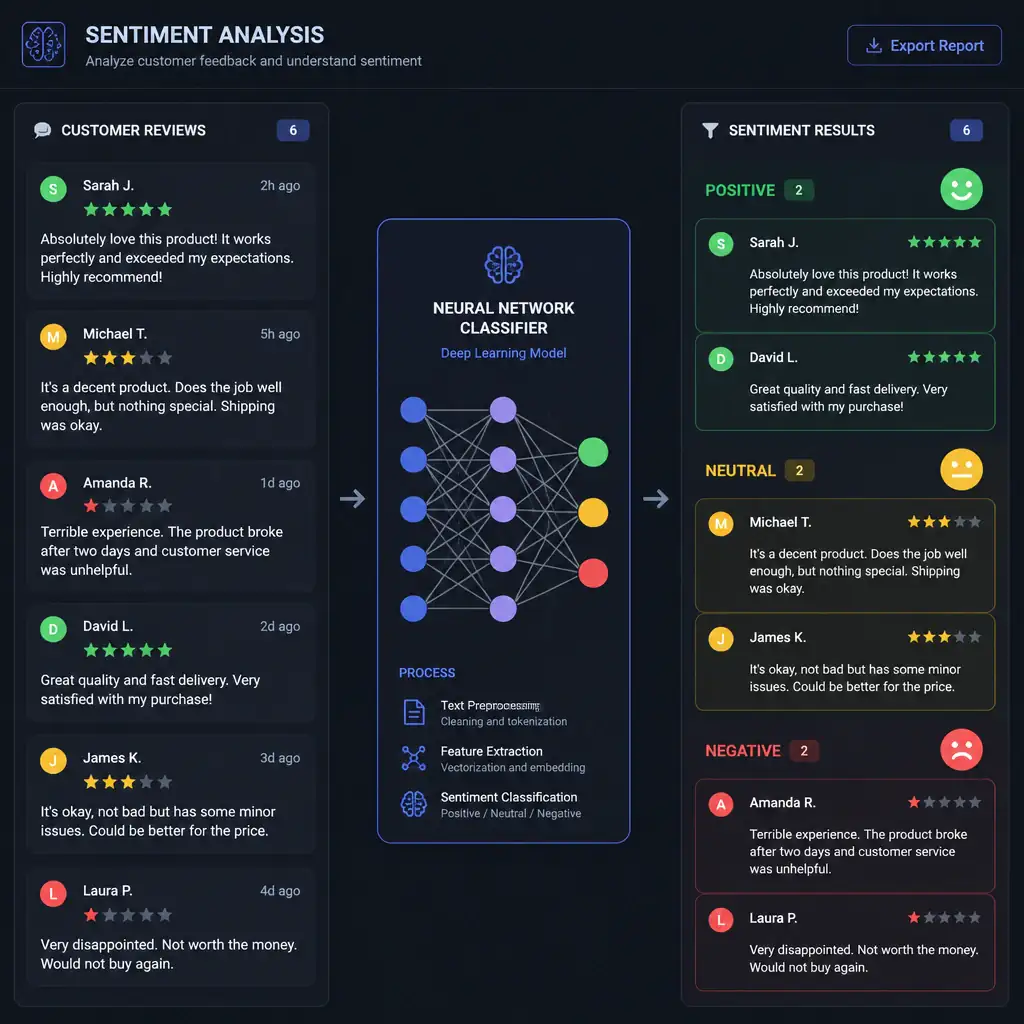
Short Explanation
When you've got thousands of reviews and need to know if customers are happy, neutral, or angry, you're not going to read them all yourself. You use sentiment analysis to read the emotional tone and sort each review into those buckets. Summarization shrinks text, named entity recognition extracts names or places, and translation changes language.
Full Explanation
Sentiment analysis, also referred to as opinion mining, is a key natural language processing (NLP) task aimed at determining the emotional tone or subjective attitude expressed within a text. In business and software engineering, this is heavily utilized to analyze customer feedback, monitor social media channels, and process product reviews at scale. By classifying text into predefined categories such as positive, negative, or neutral (and sometimes extracting specific emotional states like anger or joy), organizations can automatically detect customer dissatisfaction and respond proactively.
While early sentiment analysis systems relied on rule-based approaches and lexicon dictionaries (where words had fixed polarity scores, like 'excellent' = +1), modern solutions use machine learning and deep learning models. These advanced models process the contextual meaning of phrases, allowing them to handle linguistic nuances such as double negatives, context-dependent words, and sarcasm, which would confuse basic rule-based systems.
The other options are incorrect because they solve different NLP problems. Named Entity Recognition (NER), the option focused on identifying entities, is designed to identify and extract specific entities within a text, such as names of people, organization names, physical locations, dates, or product codes. It does not evaluate the overall tone or opinion of the document. Text Summarization, the option focused on condensing content, is the process of condensing a long piece of text into a shorter summary while retaining the most important informational points. Machine Translation, the option focused on converting language, is the task of translating text from one natural language to another, preserving semantic meaning across different tongues but not analyzing the user's emotional disposition.