
You are tasked with designing a machine translation pipeline to convert technical manuals from English to Portuguese. Which of the following architectures is most commonly selected for this type of sequence-to-sequence language processing?
Select an answer to reveal the explanation.
Short Explanation
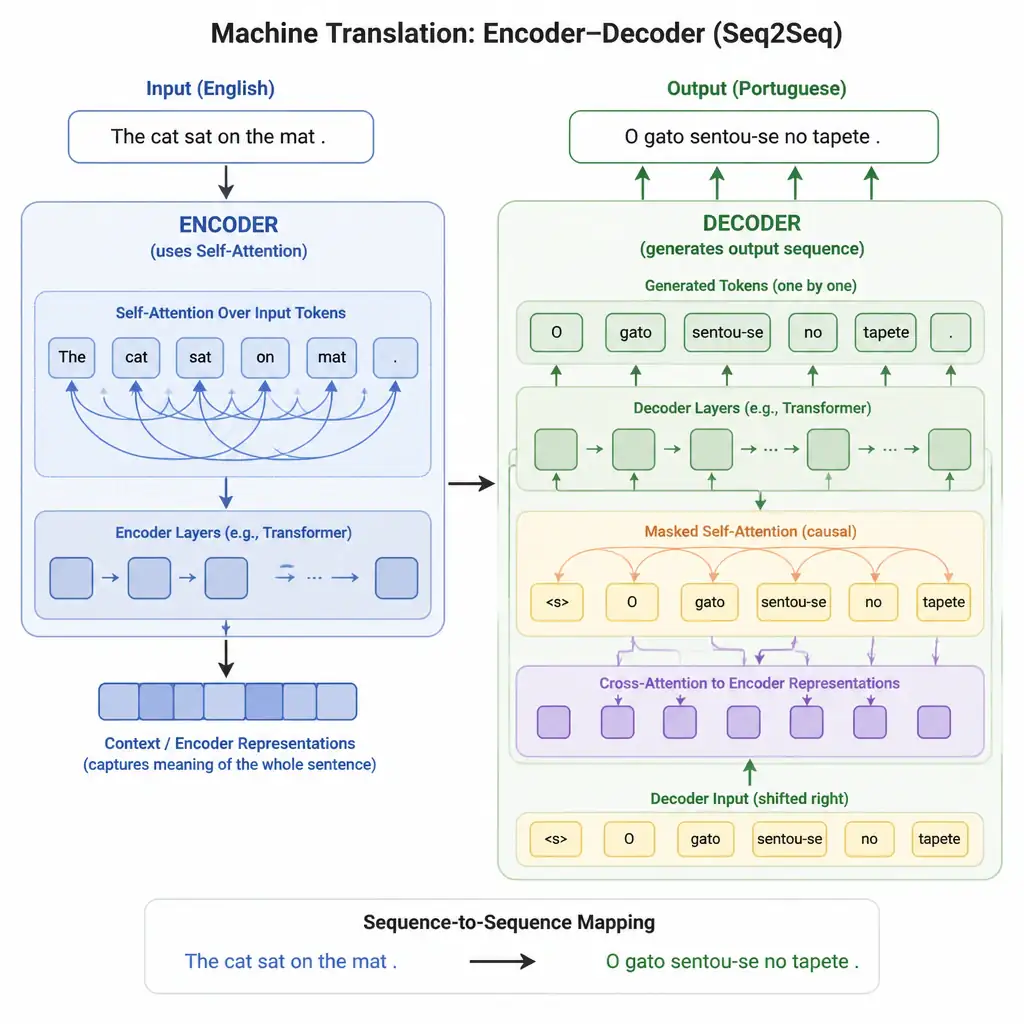
If your boss asks you to translate whole technical manuals, you don't want old-school models. You need a Transformer-based model with self-attention, because it looks at the whole sentence at once and catches relationships across long distances. CNNs are for images, decision trees are for tabular data, and K-Means is for grouping data.
Full Explanation
Machine translation is a sequence-to-sequence task that requires mapping an input sequence of words in a source language to an output sequence of words in a target language. To do this successfully, a model must capture long-range dependencies, syntax, grammar, and contextual relationships across entire sentences. Modern NLP systems rely almost exclusively on Transformer-based architectures, such as T5, BART, or GPT models, for translation tasks. The Transformer-based model utilizing self-attention mechanisms is the most commonly selected architecture for this kind of sequence-to-sequence language processing. Transformers, introduced in the seminal paper 'Attention Is All You Need,' replaced older recurrent architectures like LSTMs and GRUs. The key innovation of the Transformer is the self-attention mechanism, which allows the model to process all tokens in a sequence simultaneously rather than sequentially. This parallelization dramatically increases training efficiency and enables the model to weigh the importance of different words in a sentence relative to one another, capturing complex contextual nuances across long distances. For example, when translating, the model can look at a pronoun at the end of a sentence and immediately relate it to its subject at the beginning. The other architectures are incorrect for this task. The deep Convolutional Neural Network optimized for spatial processing is designed for grid-like data and excels at capturing spatial hierarchies in images, making it unsuitable for sequential and contextual text generation. The K-Means clustering algorithm designed for grouping semantic patterns is an unsupervised clustering algorithm used to group numerical data points into clusters, which cannot handle sequence-to-sequence mappings or generate language. The Random Forest classifier utilizing decision-tree ensembles is an ensemble machine learning classifier built on decision trees, primarily used for tabular classification or regression, and lacks the capability to model the sequence dynamics of human languages.