
You are building a chatbot with the spaCy library and configure it to perform dependency parsing on incoming user queries. What is the primary purpose of conducting dependency analysis on a sentence?
Select an answer to reveal the explanation.
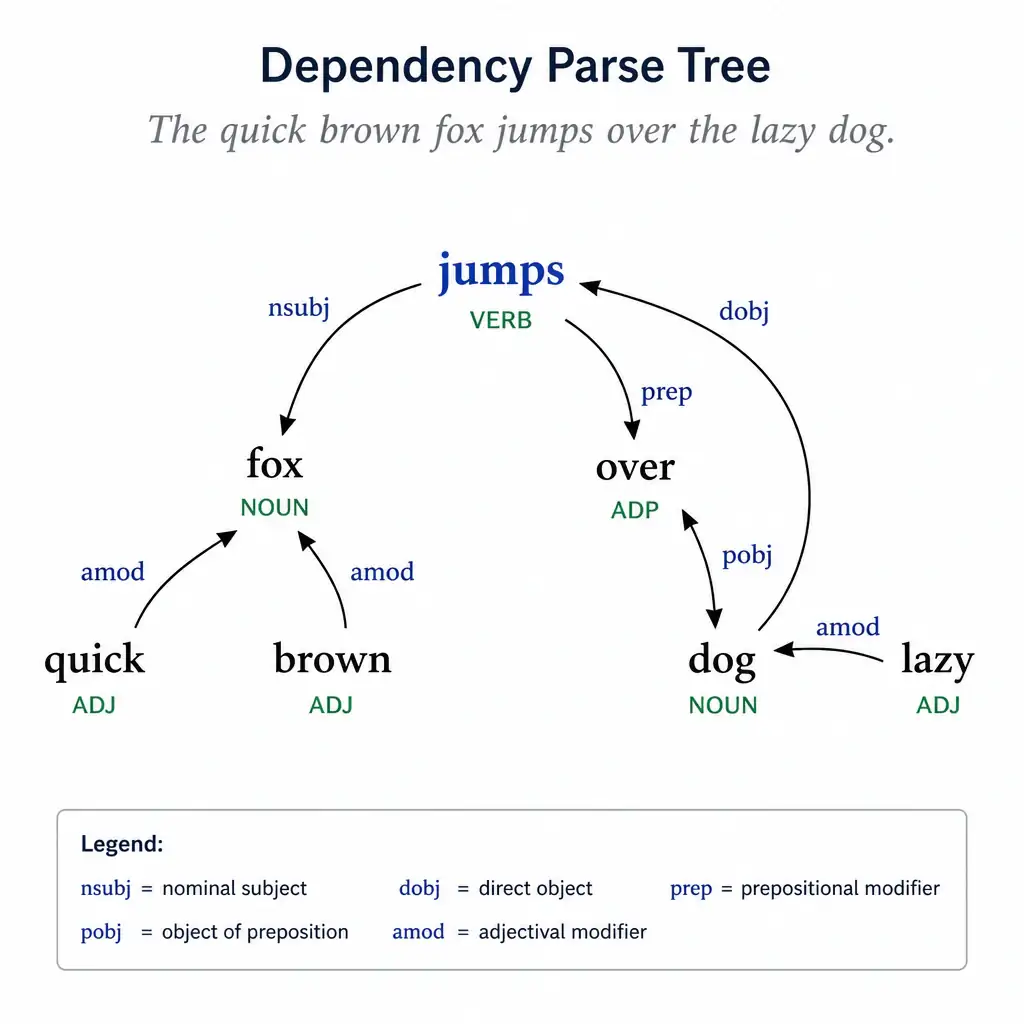
Short Explanation
Check this out: dependency parsing maps how words depend on each other, so you can see the subject, object, and modifiers in a user's query. It's not grammar checking, similarity scoring, or lemmatization.
Full Explanation
Dependency parsing is the process of analyzing the syntactic structure of a sentence to determine how words are grammatically linked to one another.
The correct choice is the one that says dependency analysis identifies the grammatical structure of the sentence and establishes relationships such as subject, object, or modifier between words. Dependency parsing establishes directed, labeled relationships between a head word, such as a verb, and its dependents, such as nouns or adjectives. These relationships are labeled with syntactic functions such as nominal subject (nsubj), direct object (dobj), or adjectival modifier (amod), forming a dependency tree that maps sentence syntax.
The choice about checking the user's sentence for grammatical errors and rejecting input that violates formal syntax rules is incorrect. Dependency parsers do not validate grammatical correctness; they will construct a parse tree for any input sentence regardless of whether it violates syntax rules.
The choice about computing semantic similarity between two sentences using cosine similarity is incorrect. Semantic similarity is computed using word or sentence embeddings, not dependency parsing.
The choice about resolving inflected words back to their dictionary base lemma forms is incorrect. Converting words to their base forms is lemmatization, handled by spaCy's lemmatizer via token.lemma_, not dependency analysis.