
A development team wants to deploy a state-of-the-art text generation model in their application. Why would they choose to use the Hugging Face Transformers library for this project?
Select an answer to reveal the explanation.
Short Explanation
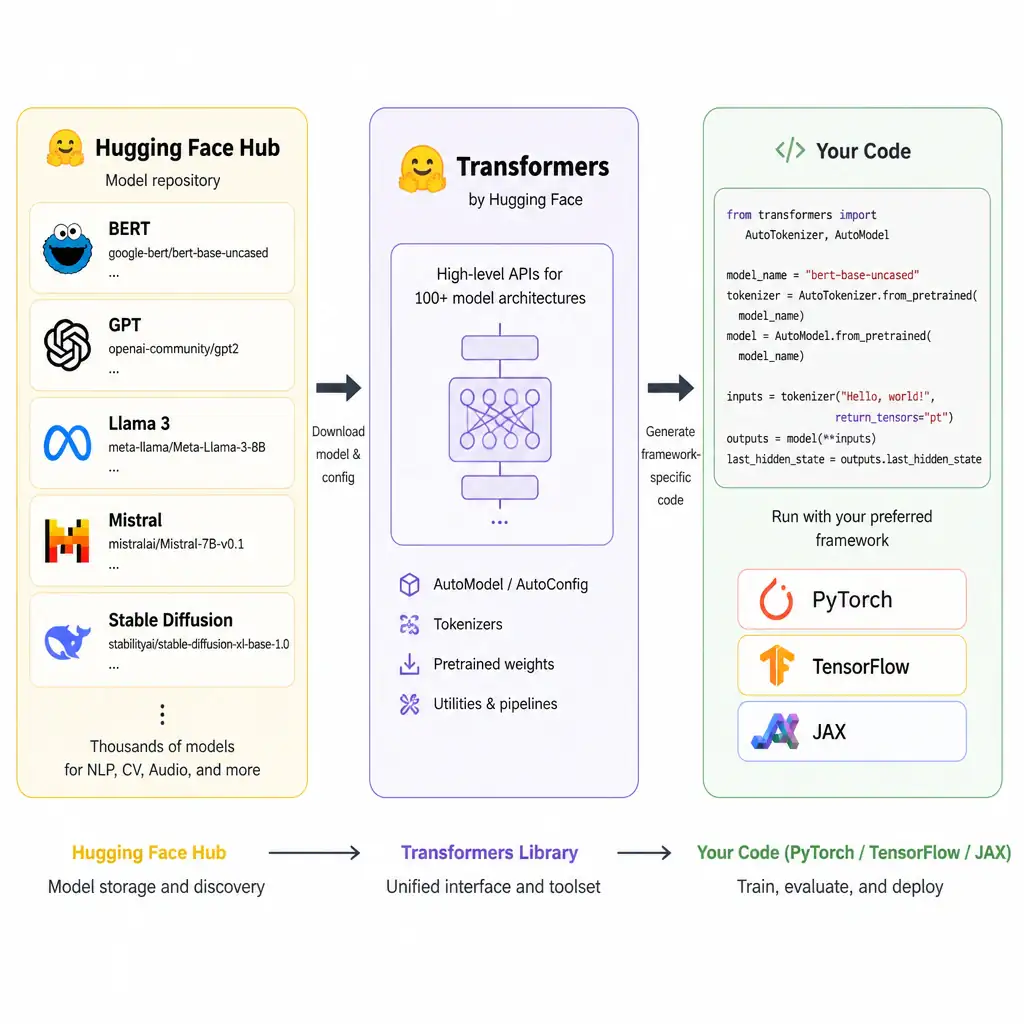
You'd pick the unified API and hub because it lets you download, customize, and deploy thousands of pre-trained transformer models without writing everything from scratch. It's like an app store for modern AI models, and it works with PyTorch, TensorFlow, and JAX. That saves you a mountain of work.
Full Explanation
The correct answer is the option describing a unified API and hub that makes it easy to download, customize, and deploy thousands of pre-trained state-of-the-art transformer models. The Hugging Face Transformers library is a highly popular open-source library that provides APIs and tools to easily download and train state-of-the-art pre-trained models. Its main advantage is that it simplifies the adoption of complex transformer architectures by offering a centralized model hub and a unified programming interface. This interface abstractly handles tokenization, modeling, and pipeline execution for NLP, vision, and audio tasks. The option claiming it is a legacy framework designed to convert obsolete statistical language models into basic classification trees is incorrect because Hugging Face Transformers is not a legacy library; it is a modern, actively maintained framework at the cutting edge of deep learning. The option describing it as a single monolithic model that executes all natural language tasks locally without external dependencies is incorrect because Hugging Face is not a single model, but a library and repository that hosts thousands of different model architectures from various research teams. The option saying it restricts developers to using the TensorFlow ecosystem exclusively is incorrect because the library is famously framework-agnostic, supporting PyTorch, TensorFlow, and JAX, which allows developers to use their preferred ecosystem.