
A developer prompts a Large Language Model (LLM) to perform sentiment classification on a product review. The prompt contains only the review and the instruction to classify it, without any examples of classified reviews or task-specific fine-tuning. What term describes this capability?
Select an answer to reveal the explanation.
Short Explanation
Think of it like this: you've got general knowledge but no motorcycle-specific training, and you still nail the first try. That's zero-shot learning. You don't give the model any examples, just the task, and it uses pre-trained knowledge to get it done.
Full Explanation
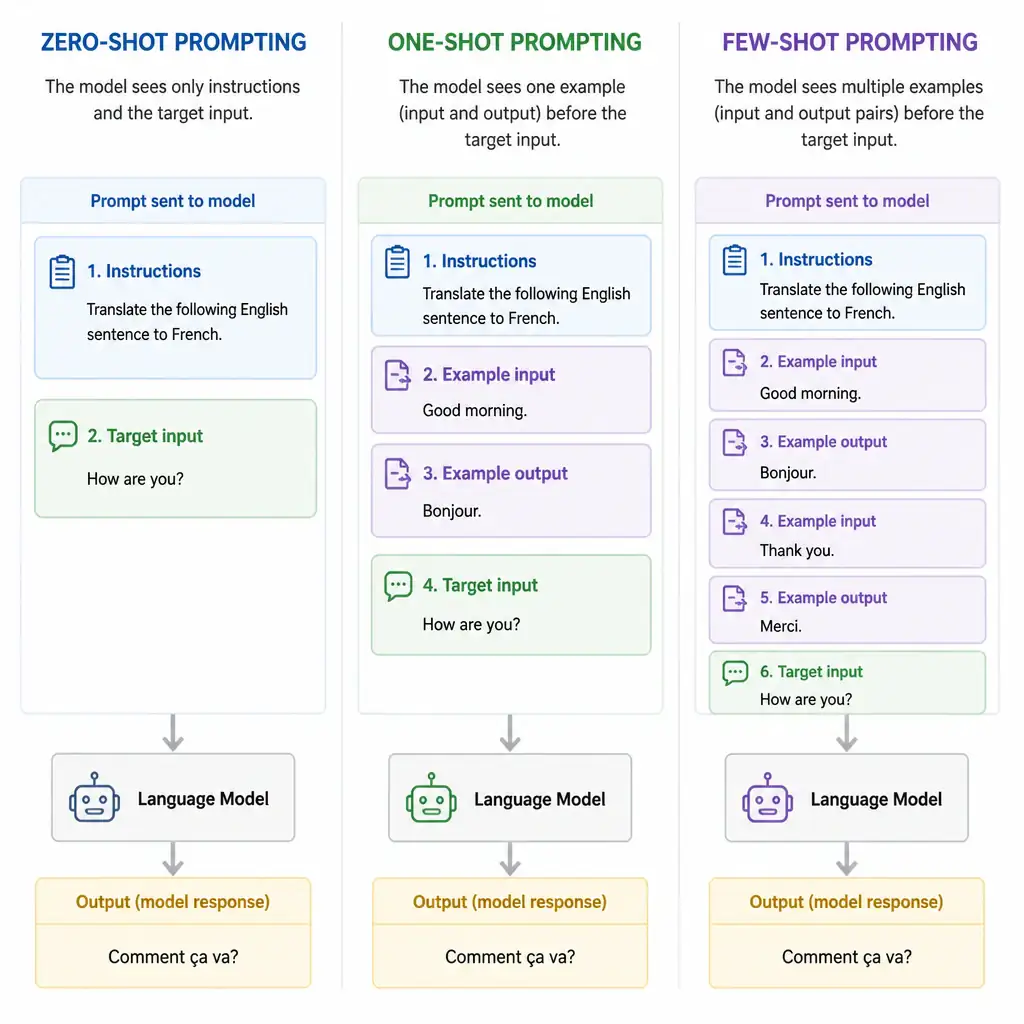
Zero-shot learning (or zero-shot prompting) in the context of large language models refers to the model's ability to perform a task on the first attempt without having received any task-specific training data, examples, or gradient-based parameter updates. The correct capability is zero-shot learning because the prompt contains only the review and the instruction to classify it, with no examples of classified reviews or task-specific fine-tuning, so the model relies entirely on its pre-existing, general-purpose representations and linguistic capabilities acquired during pre-training to comprehend the instructions and generate the correct output. The 'Zero-parameter optimization' choice is incorrect because it's a fictitious term; models require parameters (weights and biases) to function and learn. The 'Cold-start validation' choice is incorrect because cold-start is a term from recommendation systems describing the challenge of making recommendations for new users or items with no historical interaction data. The 'One-shot learning' choice is incorrect because one-shot learning involves providing exactly one example of the desired task (input-output pair) within the prompt text to guide the model's generation.