
A software engineer is implementing a sentiment analysis model using a pre-trained BERT architecture instead of training a custom neural network from scratch. Why is fine-tuning a pre-trained model generally more effective than training from scratch?
Select an answer to reveal the explanation.
Short Explanation
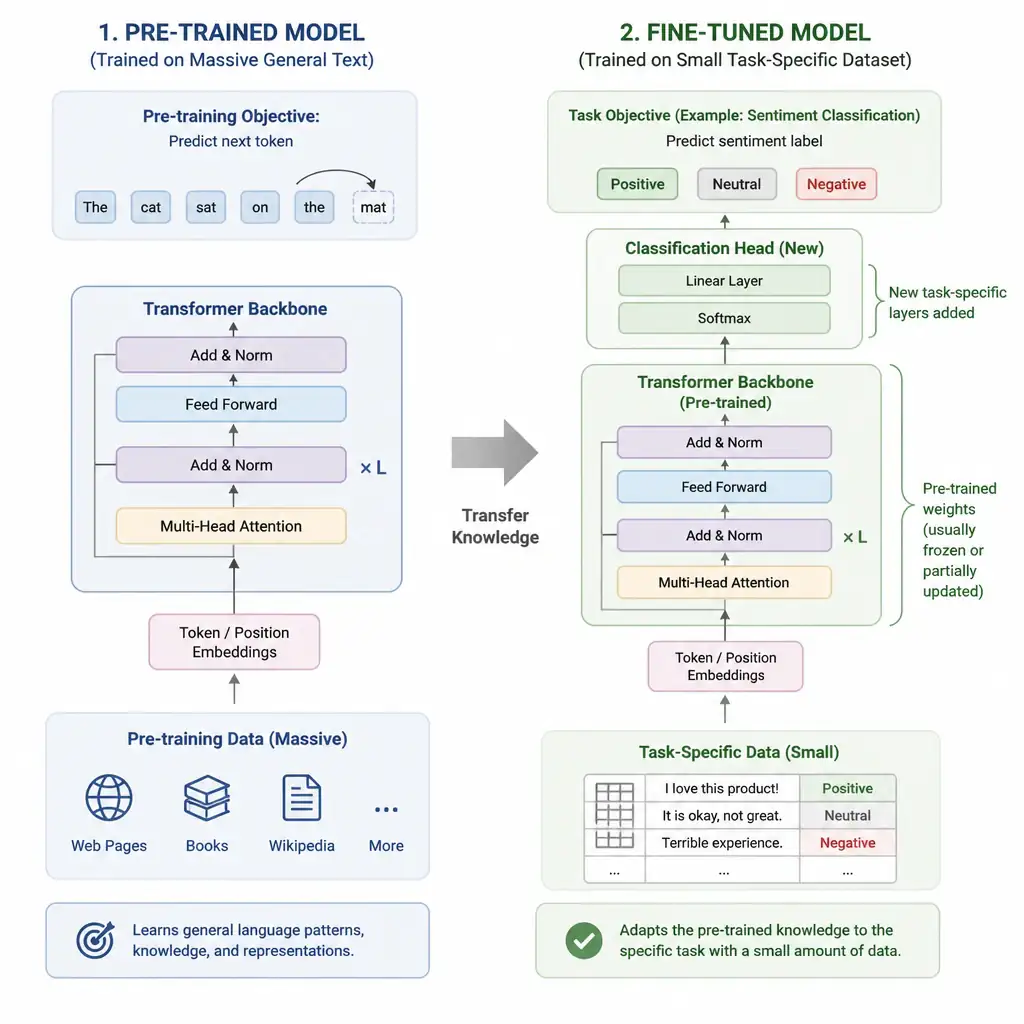
Think of it like hiring someone who already speaks fluent English and knows computers, then teaching them your specific task. A pre-trained BERT model already learned grammar, context, and vocabulary from massive data, so you can fine-tune it for sentiment analysis with less data, time, and money. Training a giant transformer from scratch is usually a waste unless you've got huge budgets.
Full Explanation
Transfer learning is the dominant paradigm in modern natural language processing. In this approach, a model is pre-trained on a massive unlabeled text corpus, often using self-supervised tasks like masked language modeling, and then fine-tuned on a smaller, labeled dataset for a specific downstream task. The correct explanation is that the model has already learned rich language representations from a massive general dataset, allowing it to adapt to a specific task with less data and training time. During pre-training, a model like BERT learns general linguistic features, syntax, semantics, and context. Fine-tuning leverages that pre-existing knowledge, allowing the model to adapt to a task such as sentiment classification with far less labeled training data and fewer computational resources. The claim that pre-trained models require much larger custom-labeled datasets to correct their pre-training biases is incorrect because fine-tuning actually requires much smaller datasets, not larger ones, since the model does not need to learn language from scratch. The claim that bidirectional models like BERT are mathematically impossible to train from scratch due to gradient explosion is incorrect because training a BERT model from scratch is computationally expensive but mathematically possible and is frequently done by organizations with large budgets. The claim that fine-tuning restricts parameter updates to the embedding layer, preventing overfitting, is also incorrect because standard fine-tuning updates all or most of the model's parameters, though typically with a very small learning rate, not just the embedding layer.