
A developer is building an application that reads long technical white papers and generates concise, fluent executive summaries. What is the standard neural network architecture and approach used for this type of generative text summarization?
Select an answer to reveal the explanation.
Short Explanation
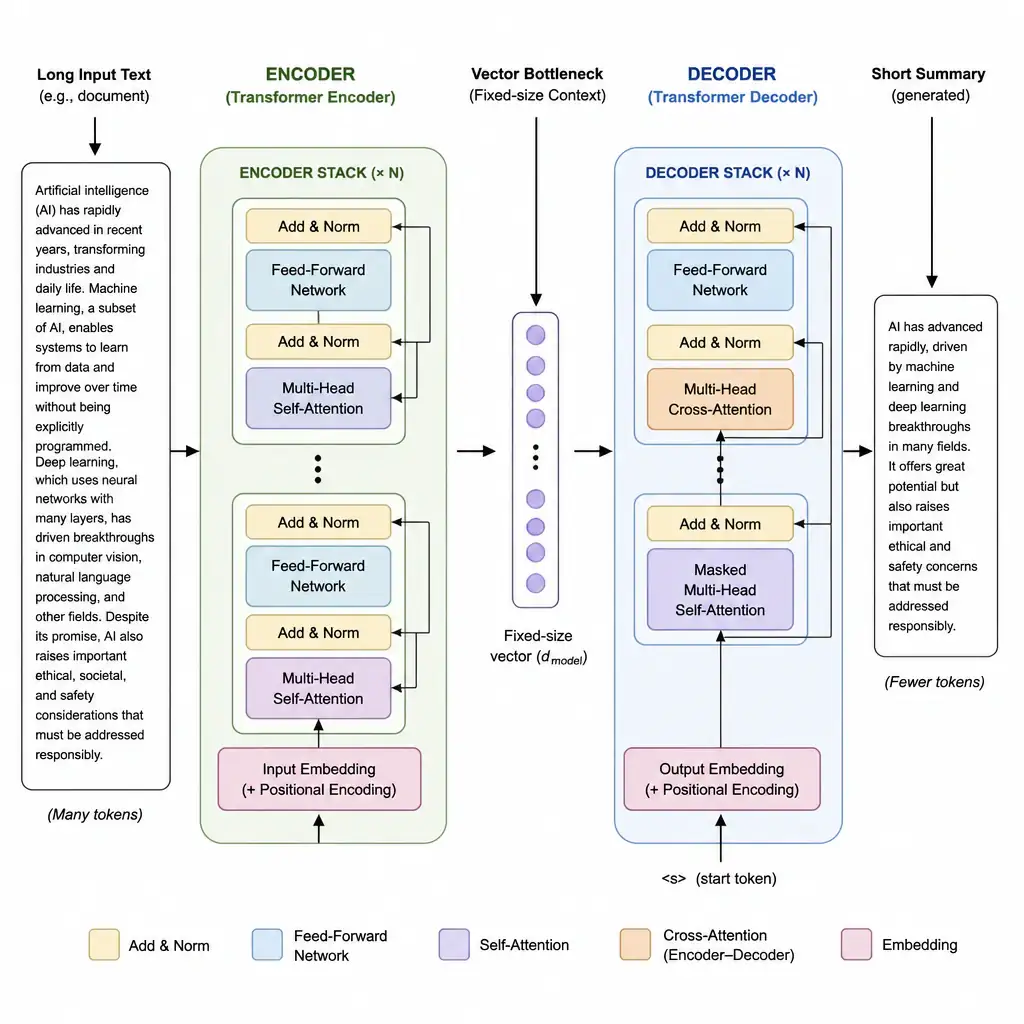
Think of it like an interpreter: you feed in a long speech, the model builds meaning, then it writes a shorter summary. The encoder reads the whole document, and the decoder generates the summary word by word, which is why an encoder-decoder Transformer setup is the standard for fluent abstractive summarization. If you try simple regression or clustering for this, you'll end up with a complete mess.
Full Explanation
Text summarization can be abstractive, generating new sentences, or extractive, selecting existing sentences. High-quality, human-like abstractive summarization requires mapping an input sequence of arbitrary length to an output sequence of a different length. This is typically achieved using a sequence-to-sequence encoder-decoder architecture. The correct approach is an encoder-decoder architecture, typically based on Transformers, where the encoder processes the source text and the decoder generates a condensed summary. Such models, often based on Transformers such as BART or T5, map the input text to a contextual vector space, and the decoder generates the summary token-by-token based on this contextual representation. Today, these are almost always built on top of Transformer models because they're incredibly good at handling long-range context. The unsupervised clustering approach that groups paragraphs by similarity and selects a representative centroid paragraph is incorrect. Clustering algorithms can be used for basic extractive summarization by grouping sentences, but they cannot generate new sentences or form coherent, fluent abstractive summaries. The simple linear regression model that calculates sentence importance scores and filters out low-scoring sentences is incorrect. Linear regression is a simple statistical method for predicting continuous numerical values and cannot process the complex semantic and grammatical structures required to generate text. The binary classification model that labels individual words as either important or unimportant is incorrect. A binary classification model can classify words or sentences, but it cannot generate new, rephrased, and cohesive summary text.