
You are designing an autocomplete feature for a messaging application that suggests the most likely next word as the user types. Which type of machine learning model is specifically designed to perform this task by predicting the next token in a sequence?
Select an answer to reveal the explanation.
Short Explanation
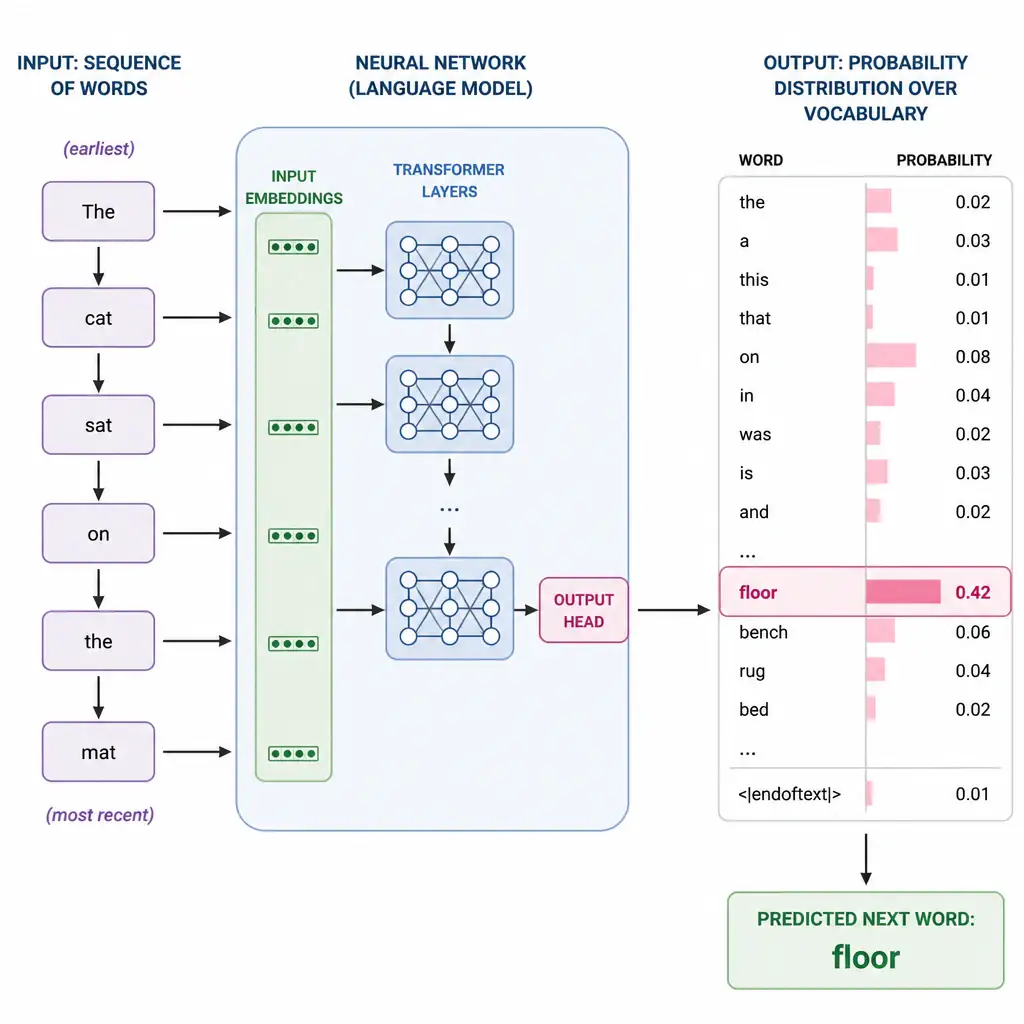
Here's the deal: when your messaging app guesses the next word, that's a language model doing next-token prediction. It reads what you've typed and estimates the probability of the next token, and it's the foundation of today's large language models. Sweet.
Full Explanation
Predicting the next word in a sequence is the fundamental task of a language model. Language modeling involves estimating the probability distribution of words or tokens given the preceding text context. Modern language models leverage deep learning architectures, such as transformer architectures including generative pre-trained transformer models, to capture long-range dependencies and generate coherent text.
The language model is correct, because it is trained on text sequences to predict the next word or token based on the context of preceding tokens.
The clustering model is incorrect, because clustering models are unsupervised learning techniques used to group unlabeled data points into clusters based on feature similarity, such as k-means, and they do not predict sequences or tokens.
The regression model is incorrect, because regression models are designed to predict continuous numerical targets, such as sales forecasting or temperature, based on input features, not discrete tokens in a sequence.
The dimensionality reduction model is incorrect, because dimensionality reduction techniques, such as principal component analysis or t-distributed stochastic neighbor embedding, are used to project high-dimensional data into a lower-dimensional space and cannot model natural language sequences.