When training complex deep learning models, selecting the correct optimizer is critical for training efficiency. Which popular optimization algorithm adjusts the learning rate individually for each parameter by utilizing both momentum (the exponentially decaying average of past gradients) and RMSprop (the exponentially decaying average of past squared gradients) to achieve fast convergence?
Select an answer to reveal the explanation.
Short Explanation and Infographic
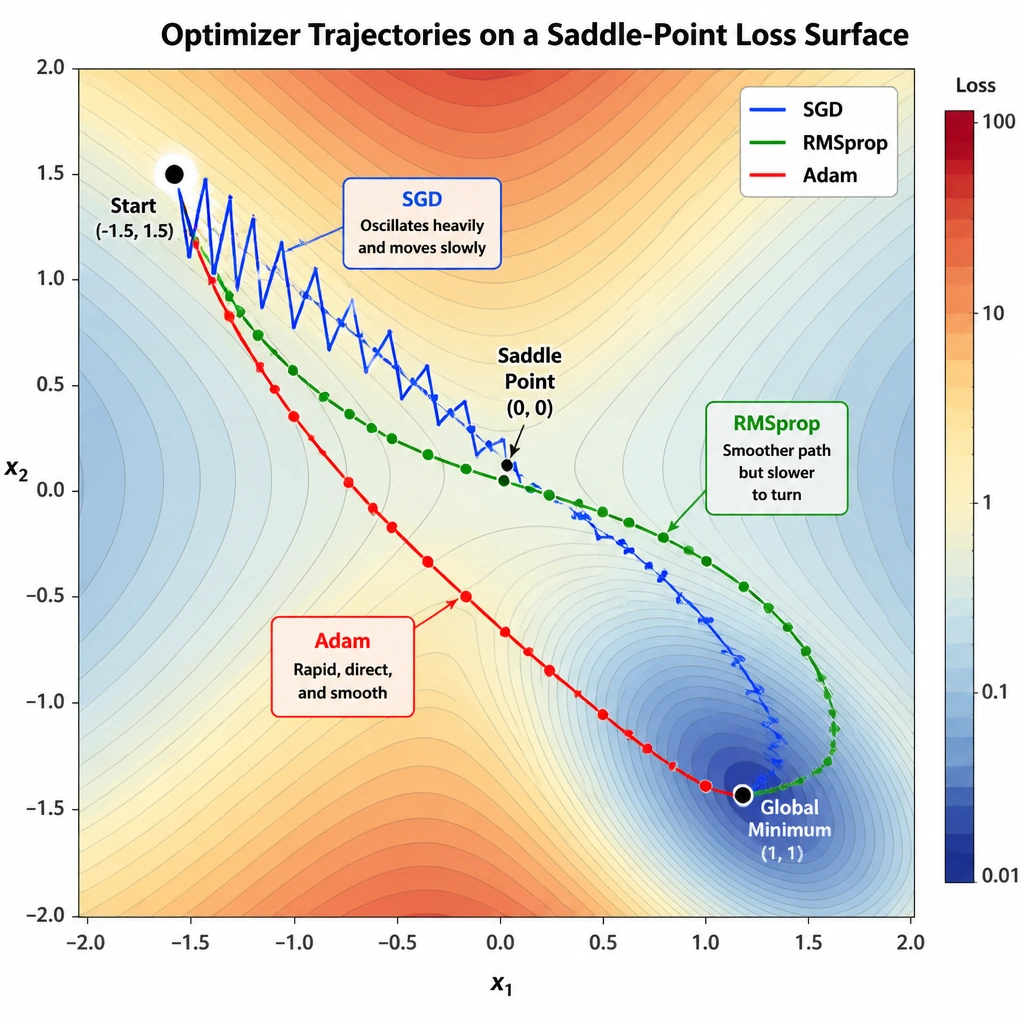
Here's the deal: standard Stochastic Gradient Descent (SGD) is like walking down a hill with blinders on—you just take steps of a fixed size in whatever direction is steepest. If your terrain has lots of sudden ravines or flat plains, SGD is going to take forever or bounce wildly off the walls. That's where advanced optimizers come to the rescue! Adam, which stands for Adaptive Moment Estimation, is the heavyweight champion here. Think of it as a smart hiker who remembers their recent speed—that's the momentum part, or the first moment—and also tracks how rough the ground has been—that's the RMSprop part, or the second moment. By combining these two tricks, Adam adjusts the learning rate for every single parameter dynamically. If a parameter has sparse or tiny gradients, Adam boosts its step size. If a parameter is jumping all over the place, Adam dials it back. Trust me, in production, Adam is the go-to default for most deep learning projects because it just works, saving you tons of time tuning manual learning rates!
Full explanation below image
Full Explanation
Optimization algorithms are fundamental to training neural networks because they define how model weights are adjusted in response to the computed gradients of the loss function. The primary goal is to reach the global minimum of the loss surface efficiently.
Stochastic Gradient Descent (SGD) uses a fixed learning rate across all parameters, which can lead to slow convergence, particularly in regions where the gradient is consistently small or when navigating steep ravines (which can cause oscillation). To address this, adaptive optimizers were developed.
Adam (Adaptive Moment Estimation) combines the principles of two other popular optimization techniques: 1. Momentum (First Moment): It computes an exponentially decaying average of past gradients. This helps accelerate the optimizer in the right direction and dampens oscillations, similar to a heavy ball rolling down a hill. 2. RMSprop (Second Moment): It computes an exponentially decaying average of past squared gradients. This scales the learning rate for each parameter based on the magnitude of its recent gradients, dividing the gradient by a running average of its root mean square.
By combining both the first and second moments, Adam adapts the learning rate for each parameter individually. Parameters with frequent and large updates receive smaller learning rate adjustments, while parameters with sparse or infrequent updates receive larger adjustments, enabling stable and rapid convergence.
Let's look at the distractors: - Stochastic Gradient Descent (SGD): Updates weights using a single learning rate applied uniformly across all parameters. It lacks adaptive learning rates and momentum unless explicitly added as hyperparameters. - RMSprop: Adapts learning rates using the second moment (squared gradients) but does not natively include the first-moment momentum term that Adam uses. - Adagrad: Adapts learning rates based on the sum of all historical squared gradients. However, because it keeps accumulating positive terms, the learning rate shrinks continually and eventually becomes infinitesimally small, halting learning before convergence.