You have defined a deep neural network's architecture using TensorFlow's Keras API, adding your layers sequentially. Before you can pass your training data to the model via model.fit(), you need to configure the optimization algorithm, define the loss function, and specify the performance metrics you want to track. Which Keras model method must you call to bind these training configurations to your model?
Select an answer to reveal the explanation.
Short Explanation and Infographic
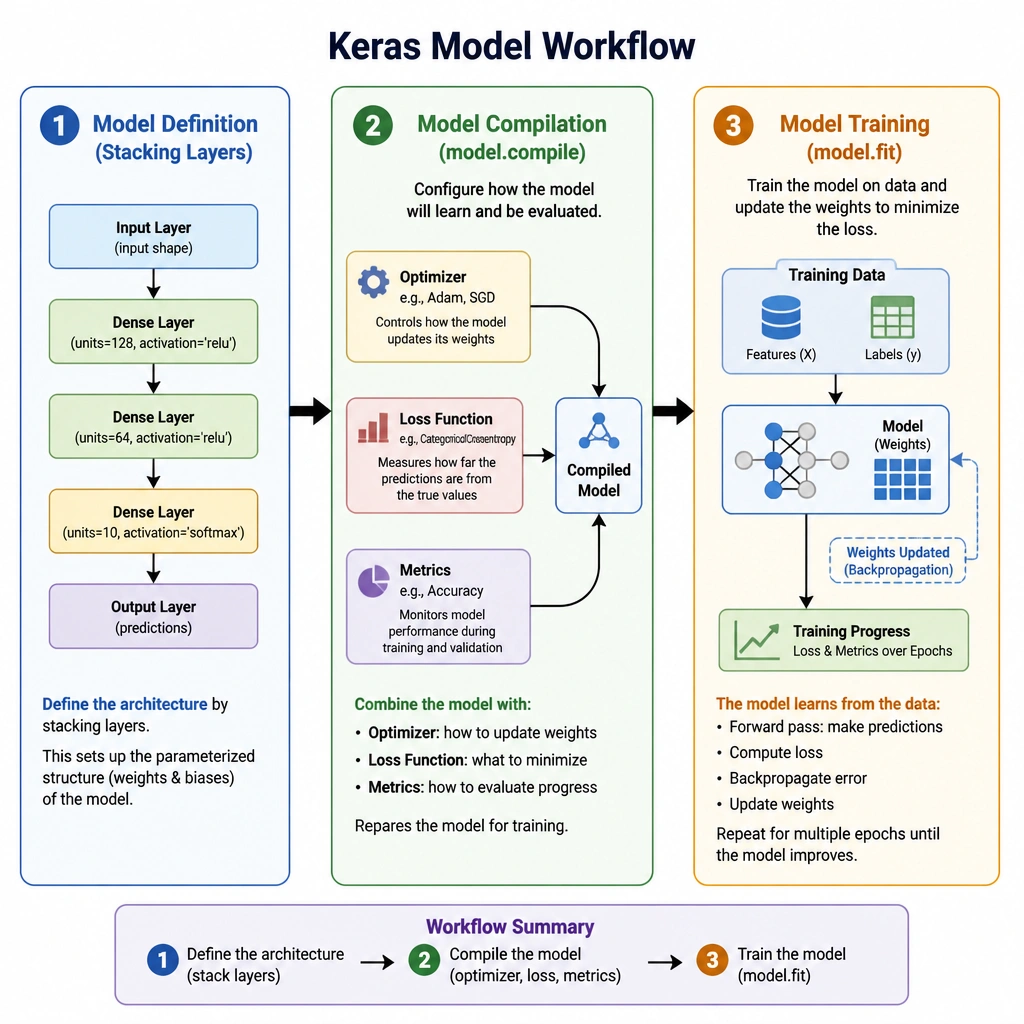
Check this out: building a neural network is a lot like assembling a high-performance race car. Stacking your layers is just putting the engine and wheels together. But before you take that beast out on the track (which is what model.fit() does), you've got to dial in the tuning parameters. You need to tell it how it's going to steer—that's your optimizer—and how it's going to measure how far off course it is—that's your loss function. In the TensorFlow and Keras world, that's exactly what model.compile() is for. Think of it as the setup phase where you tell the model: 'Here is how we are going to learn, here is how we'll measure our mistakes, and here is how we'll track our success.' If you try to jump straight to training without compiling first, TensorFlow is going to throw a red flag and stop you right there. Trust me on this, this setup step is crucial, and it's a favorite topic for exam writers because it sits right between building your architecture and running your data.
Full explanation below image
Full Explanation
In TensorFlow's Keras API, the workflow for preparing and training a deep learning model follows a structured sequence: definition, compilation, fitting, and evaluation. Once the layers of a model have been defined (e.g., using keras.Sequential or the Functional API), the model exists as an architecture without a defined learning strategy. The model.compile() method is the essential bridge that configures the model's behavior for training by specifying three primary parameters: the optimizer, the loss function, and the evaluation metrics.
1. Optimizer: This defines the algorithm used to update the weights of the neural network during training, such as Adam, RMSprop, or Stochastic Gradient Descent (SGD). The optimizer determines how the gradient of the loss function is used to adjust network parameters to minimize error. 2. Loss Function: This calculates the difference between the model's predictions and the actual target values. It acts as the mathematical guide that the optimizer seeks to minimize (e.g., categorical cross-entropy for multiclass classification or mean squared error for regression). 3. Metrics: These are performance measures used to monitor training and validation progress (e.g., accuracy, precision, or recall). Unlike the loss function, metrics are purely for human evaluation and do not directly affect the optimization process.
Let's analyze the incorrect options: - model.fit() is the method that actually executes the training loop. It takes the training data, feeds it through the network in batches, calculates the loss, performs backpropagation, and updates the weights over a specified number of epochs. It cannot run without a prior call to model.compile(). - model.summary() is a diagnostic tool that prints a text summary of the network's layers, output shapes, and the number of trainable and non-trainable parameters. It does not configure training parameters. - model.build() is used to construct the model's weights dynamically based on a specified input shape if they were not defined during initialization. It does not bind optimizers or loss functions.