You are designing a Convolutional Neural Network (CNN) for an image recognition task. As the feature maps pass deeper into the network, the computational complexity and memory usage increase rapidly. You decide to insert pooling layers (such as Max Pooling) after your convolutional layers. What is the primary operational benefit of incorporating pooling layers in this architecture?
Select an answer to reveal the explanation.
Short Explanation and Infographic
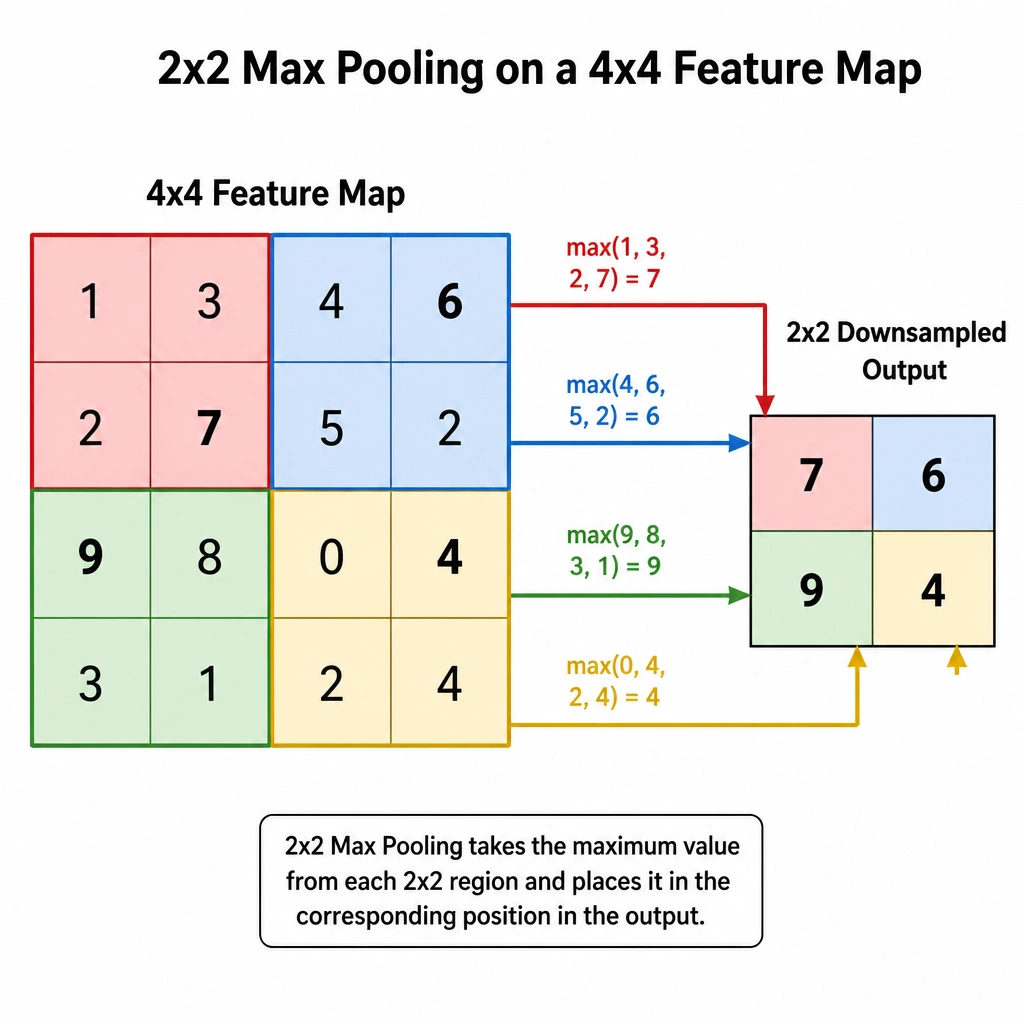
Check this out: when you run a convolution filter over an image, you're extracting features, but you're also generating a massive amount of data. If you just pass that raw, high-resolution data straight to the next layer, your network is going to choke on the math, and it'll probably overfit. That's where pooling layers come into play. Think of a pooling layer—like Max Pooling—as a summary writer. If you look at a 2x2 grid of pixels, Max Pooling says, 'Hey, what's the largest, most important number in this group?' It grabs that one value and throws the other three away. By doing this, you're slashing the height and width of your feature maps by half, which saves you a ton of computing power down the line. But here is the cool part: it also gives you 'translation invariance.' That's a fancy way of saying that if a feature (like a cat's ear) shifts slightly to the left or right in your image, the pooling layer still catches it. It makes your model way more robust because it doesn't care exactly where the feature is, just that it exists. Note that pooling layers have zero trainable parameters—they just compute, they don't learn!
Full explanation below image
Full Explanation
In Convolutional Neural Networks (CNNs), pooling layers are inserted periodically between successive convolutional layers to manage the dimensions of the feature maps. The two most common types of pooling are Max Pooling (which selects the maximum value in a given window) and Average Pooling (which computes the average value).
Pooling layers offer several key benefits: 1. Dimensionality Reduction: By downsampling the feature maps, pooling reduces the spatial dimensions (height and width) while keeping the depth (number of channels) unchanged. For example, a 2x2 max pooling operation with a stride of 2 reduces the spatial area of a feature map by 75%. 2. Computational Efficiency: Reducing the spatial resolution decreases the number of inputs to subsequent layers. This significantly lowers the computational budget and memory footprint required for training and inference. 3. Translation Invariance: Pooling makes the network less sensitive to minor translations, rotations, or distortions of features within the input image. If a specific feature is detected by a convolutional filter, the exact pixel coordinates become less critical because the pooling operation summarizes the region. 4. Prevention of Overfitting: By summarizing local features and discarding precise spatial details, pooling acts as a form of regularization, preventing the model from memorizing exact pixel configurations.
Let's examine the incorrect options: - They introduce trainable weight parameters... Pooling layers have no weights or parameters to train. They perform a fixed mathematical operation (maximum or average) over a local region. - They expand the depth (number of channels)... Pooling layers do not alter the number of channels; they only reduce the spatial height and width. Channel expansion is typically performed by modifying the number of filters in a convolutional layer. - They apply non-linear activation functions... This is the role of activation layers (like ReLU, Tanh, or Sigmoid), which are applied element-wise to introduce non-linearity, whereas pooling is a spatial aggregation step.