
If you are building an image classification network and want to reduce the spatial size of the feature maps to lower computational complexity while retaining the most prominent features, which layer type should you insert after a convolutional layer?
Select an answer to reveal the explanation.
Short Explanation
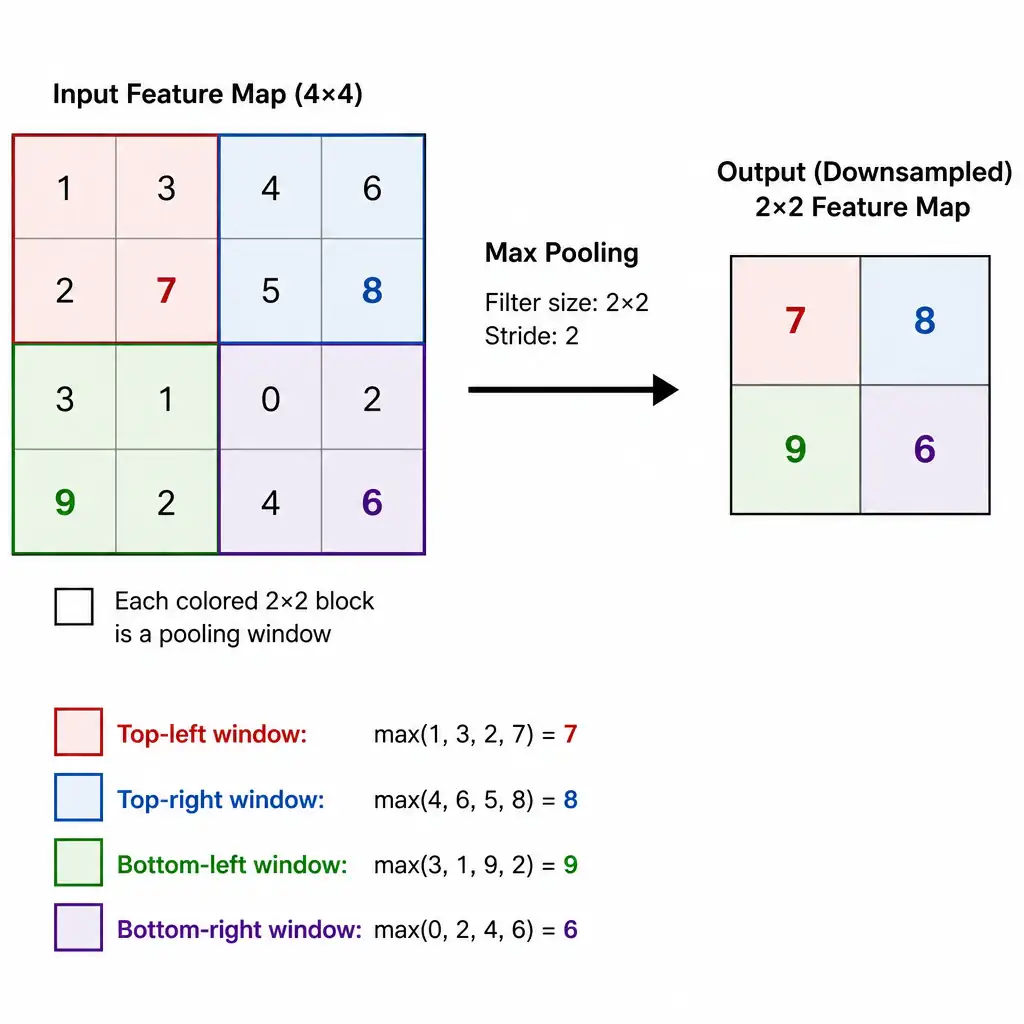
You've got a huge, high-resolution feature map after your convolutional layer, and processing it through the rest of the network runs your GPU hot and slows things down. You need to shrink the data without losing the important stuff, so you use a pooling layer—like Max Pooling—to take a small window, say 2x2 pixels, and keep only the highest number. That cuts your data size by 75% but keeps the strongest signals, making it the best fit.
Full Explanation
In Convolutional Neural Networks designed for tasks like image classification, managing the spatial dimensions of feature maps is critical to prevent overfitting and control computational overhead. The standard architectural approach to address this is the insertion of a pooling layer, most commonly Max Pooling or Average Pooling, after a convolutional layer. Pooling operations downsample the feature maps by applying a sliding window, such as 2x2 with a stride of 2, across the width and height of the input. Max pooling extracts the maximum value within each window, which represents the most prominent feature activation in that local region. This reduces the total number of parameters and computation in the subsequent layers of the network. Furthermore, pooling provides translation invariance, meaning the network can still recognize a feature even if its position in the image shifts slightly. Let's evaluate the distractors: Recurrent layers are incorrect because they are designed to process sequential or time-dependent data, not to downsample spatial feature maps, and they do not provide the spatial reduction needed after a convolutional layer. The convolutional layer itself does not inherently downsample unless configured with a high stride, and it typically increases computational complexity, so it is not the dedicated mechanism for this task. Dense (fully connected) layers are incorrect because they are used at the end of the network for classification and would catastrophically increase the parameter count if connected directly to a high-resolution feature map. Dropout layers are incorrect because they are a regularization technique that randomly deactivates neurons during training to prevent overfitting, but they do not downsample or reduce the spatial dimensions of feature maps. For the exam, associate pooling layers with dimensionality reduction, downsampling, and spatial feature retention.