
Which of the following best describes the core mechanism of the backpropagation algorithm during the training of a neural network?
Select an answer to reveal the explanation.
Short Explanation
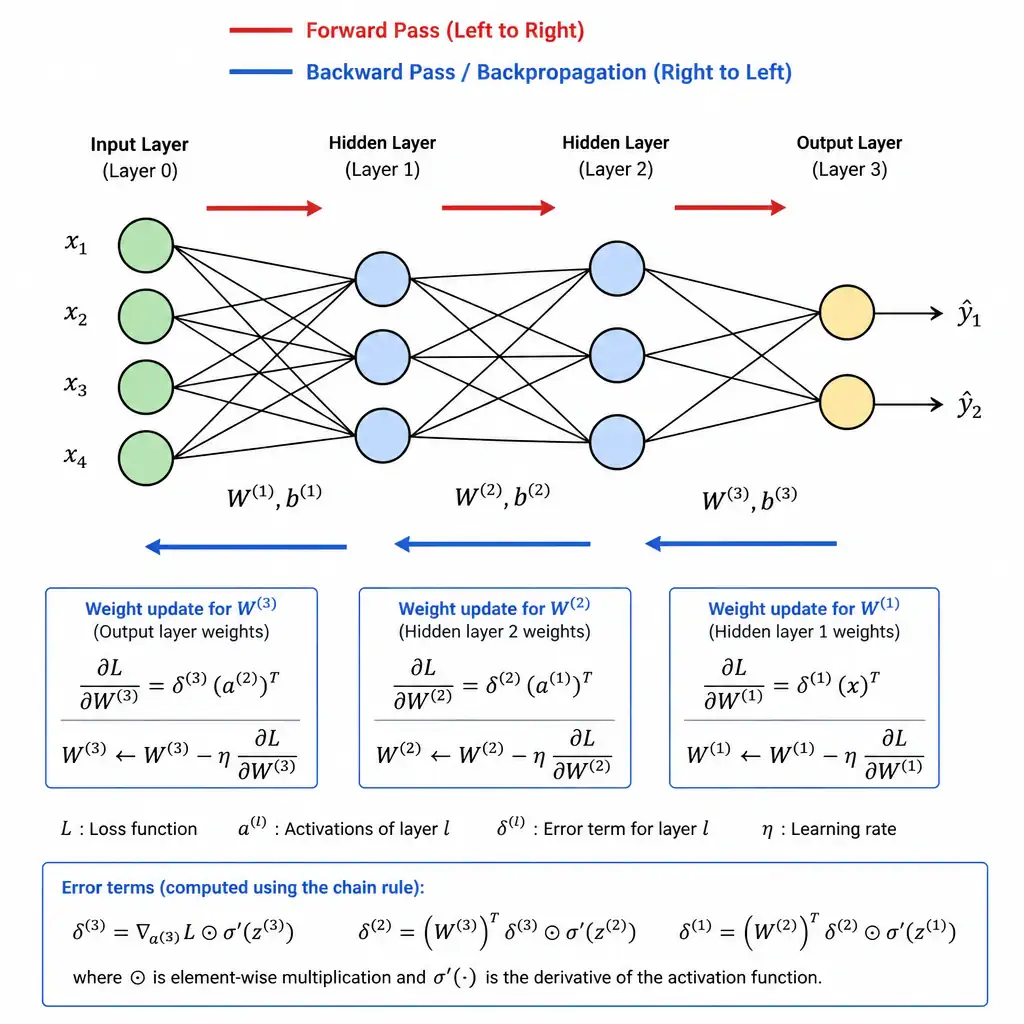
Here's the deal: when your neural network makes a guess, backpropagation takes the error and traces it backward through the network, layer by layer, to see how much each weight and bias contributed. You use the chain rule to calculate those gradients, then the optimizer adjusts the parameters to reduce the loss.
Full Explanation
Backpropagation (short for backward propagation of errors) is the fundamental algorithm used to train artificial neural networks. Its purpose is to calculate the gradient of the loss function with respect to each weight and bias in the network, which is then used by an optimization algorithm (such as gradient descent) to update the parameters. The process works as follows: a forward pass propagates input data through the network's layers to produce an output prediction, and a loss function calculates the error between the prediction and the target. Then the backward pass starts at the output layer, calculating the derivative of the loss with respect to the output activations. Using the calculus chain rule, the algorithm recursively computes the gradients of the loss with respect to the weights, biases, and activations of each preceding layer, moving backward from the output layer to the input layer. Once these gradients are calculated, the optimizer subtracts a fraction of the gradient (scaled by the learning rate) from the current weight values to minimize the loss. The description that maps input features directly to the output layer in a single feedforward pass to generate initial predictions describes forward propagation, which is the feedforward pass used to make predictions, not calculate gradients. The description that randomly perturbs the network's weights until the loss function falls below a predefined threshold describes random search or random weight perturbation, which is highly inefficient and not how backpropagation operates. The description that establishes initial values for the weights and biases using predefined distributions before training begins refers to weight initialization, which is a setup step performed before backpropagation begins. For the exam, associate backpropagation with the calculation of gradients using the chain rule to allow parameter updates.