Generative Adversarial Networks (GANs) utilize a dual-network training dynamic (a generator and a discriminator). Which of the following tasks is a primary and common application of GANs?
Select an answer to reveal the explanation.
Short Explanation and Infographic
Think of a GAN like a master art forger and an art detective playing a game of cat and mouse. The generator (the forger) tries to create fake paintings, and the discriminator (the detective) tries to spot them. As they train, they both get incredibly good at their jobs. The result? The generator becomes capable of producing mind-blowing, realistic new images from scratch. That's why GANs are the go-to for image generation, style transfer, and photo synthesis. They aren't meant for sorting emails or forecasting stock prices—they're all about creating brand new, realistic visual data. Pretty cool, right?
Full explanation below image
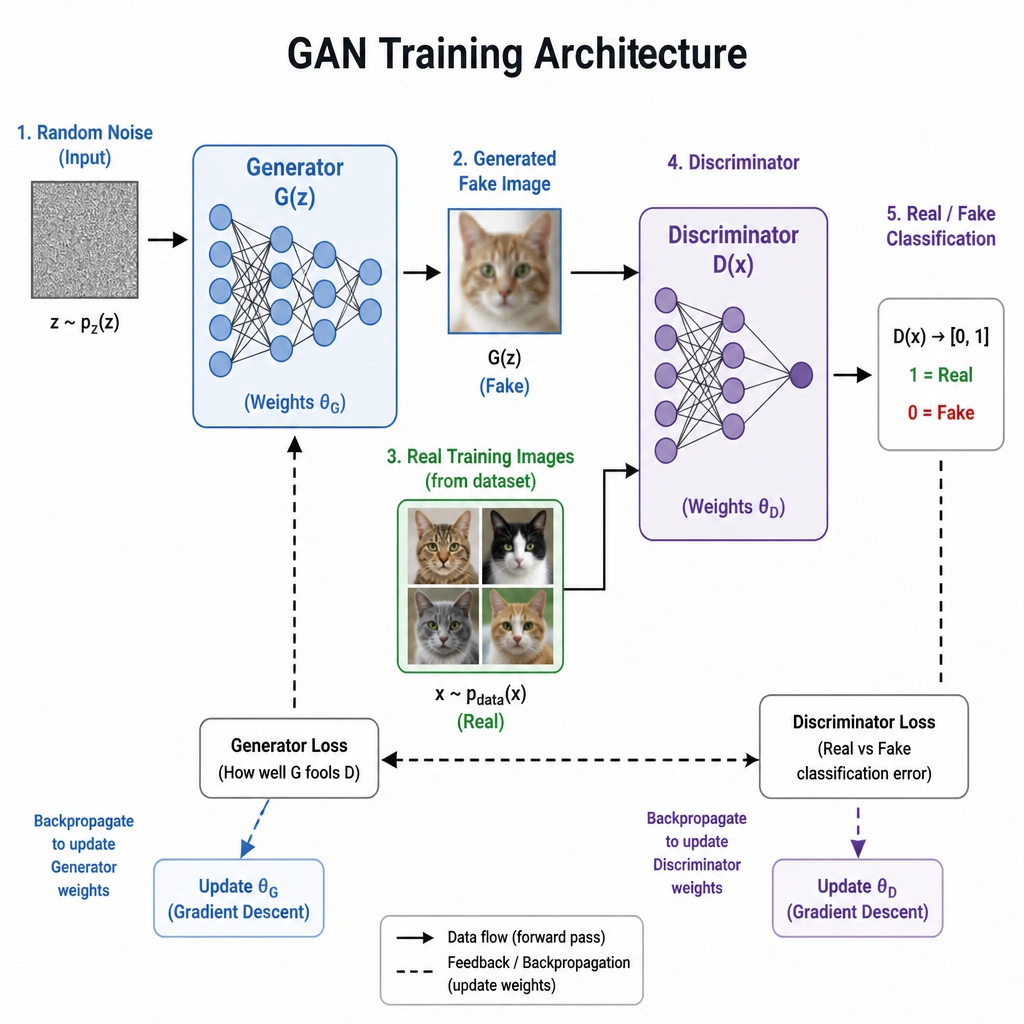
Full Explanation
Generative Adversarial Networks (GANs) belong to the class of generative machine learning models. Introduced by Ian Goodfellow and his colleagues in 2014, GANs are composed of two neural networks that compete against each other: 1. The Generator: Learns to create realistic data (e.g., synthetic images) starting from random noise. 2. The Discriminator: Learns to distinguish between real data (from the training set) and fake data (produced by the generator).
Through this adversarial training process, both networks improve iteratively. The generator's objective is to maximize the probability of the discriminator making a mistake. Consequently, GANs are highly effective for tasks involving image generation, super-resolution (increasing image quality), text-to-image synthesis, and style transfer (e.g., transforming a photo into the style of a painting).
In practice, training GANs can be notoriously unstable, requiring careful tuning of hyperparameters to avoid issues like mode collapse, where the generator produces only a limited variety of outputs. Despite these challenges, their ability to synthesize novel and highly realistic high-dimensional data makes them the dominant choice for creative visual applications, whereas traditional models struggle to generate sharp, realistic images.
Let's review the incorrect options: - Option A (Unsupervised grouping/customer segmentation) is a typical application of clustering algorithms, such as K-Means or hierarchical clustering, not generative adversarial networks. - Option B (Time series forecasting) is generally addressed using recurrent neural networks (RNNs), LSTMs, Transformers, or traditional statistical models like ARIMA. - Option D (Spam classification) is a classic supervised binary classification problem solved using algorithms like Naive Bayes, Support Vector Machines (SVMs), or standard Feedforward networks, not generative models.