When choosing between Gated Recurrent Units (GRUs) and Long Short-Term Memory (LSTM) networks for sequence modeling, what is the primary structural distinction between these two architectures?
Select an answer to reveal the explanation.
Short Explanation and Infographic
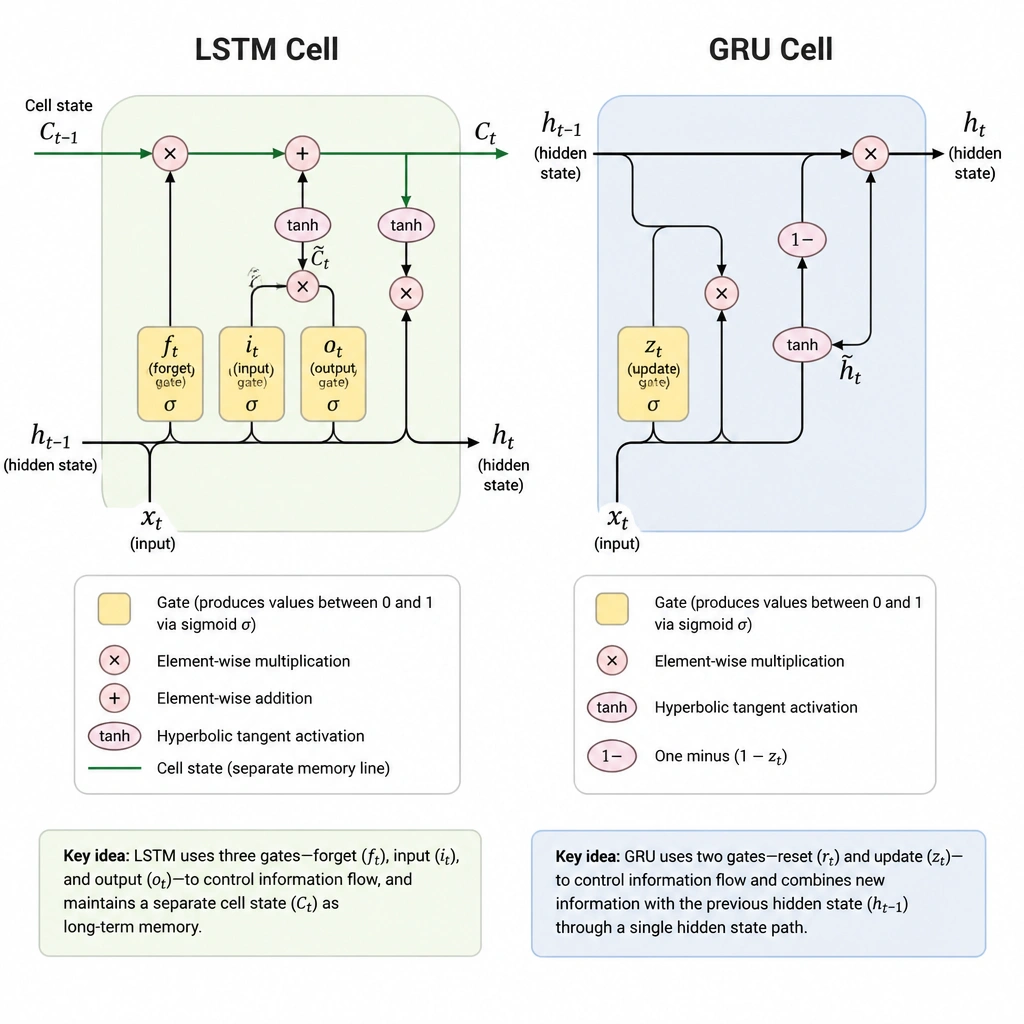
Let's dive into LSTMs and GRUs. Both are recurrent neural network architectures built to handle sequential data, like text or time series, without losing their memory over long distances. But here's the difference: LSTMs are the heavy-duty option. They use three gates—input, forget, and output—plus a special "cell state" to carry that long-term memory. It works great, but it's computationally heavy. GRUs, on the other hand, are the streamlined version. They dump the separate cell state and merge everything into just two gates: update and reset. This makes GRUs simpler, faster to train, and often just as effective. If you need speed, try GRUs first!
Full explanation below image
Full Explanation
Both Long Short-Term Memory (LSTM) and Gated Recurrent Unit (GRU) networks are specialized forms of Recurrent Neural Networks (RNNs) designed to solve the vanishing gradient problem in long sequence processing. The key difference lies in their gating mechanisms and state management.
An LSTM network manages sequence memory through a cell state ($C_t$) and a hidden state ($h_t$). To control the flow of information, it relies on three gates: - Forget Gate: Decides how much of the past cell state to discard. - Input Gate: Decides which new information to store in the cell state. - Output Gate: Decides what the next hidden state should be based on the updated cell state.
A GRU network simplifies this architecture by combining the cell state and hidden state into a single hidden state ($h_t$). It uses only two gates: - Reset Gate: Determines how to combine new input with the previous hidden state (similar to the forget gate). - Update Gate: Controls how much of the old information to keep and how much new information to write (combining the roles of input and forget gates).
Because GRUs have one less gate and no separate cell state, they have fewer parameters to train. This makes them computationally more efficient and faster to train than LSTMs, while often delivering comparable performance on many sequence tasks.
Looking at the incorrect options: - Option A is incorrect because it reverses the structure; LSTMs have the cell state, and GRUs are the ones that rely on a reset gate and lack a separate cell state. - Option C is incorrect because both GRUs and LSTMs can be implemented in bidirectional configurations; there is no restriction of this nature. - Option D is incorrect because GRUs have fewer parameters than LSTMs (roughly 25% fewer weights), which speeds up training rather than slowing it down.