If you attempt to use a standard feedforward neural network (FNN) to process sequential data, such as natural language text or sensor telemetry over time, which fundamental architectural limitation will you encounter?
Select an answer to reveal the explanation.
Short Explanation and Infographic
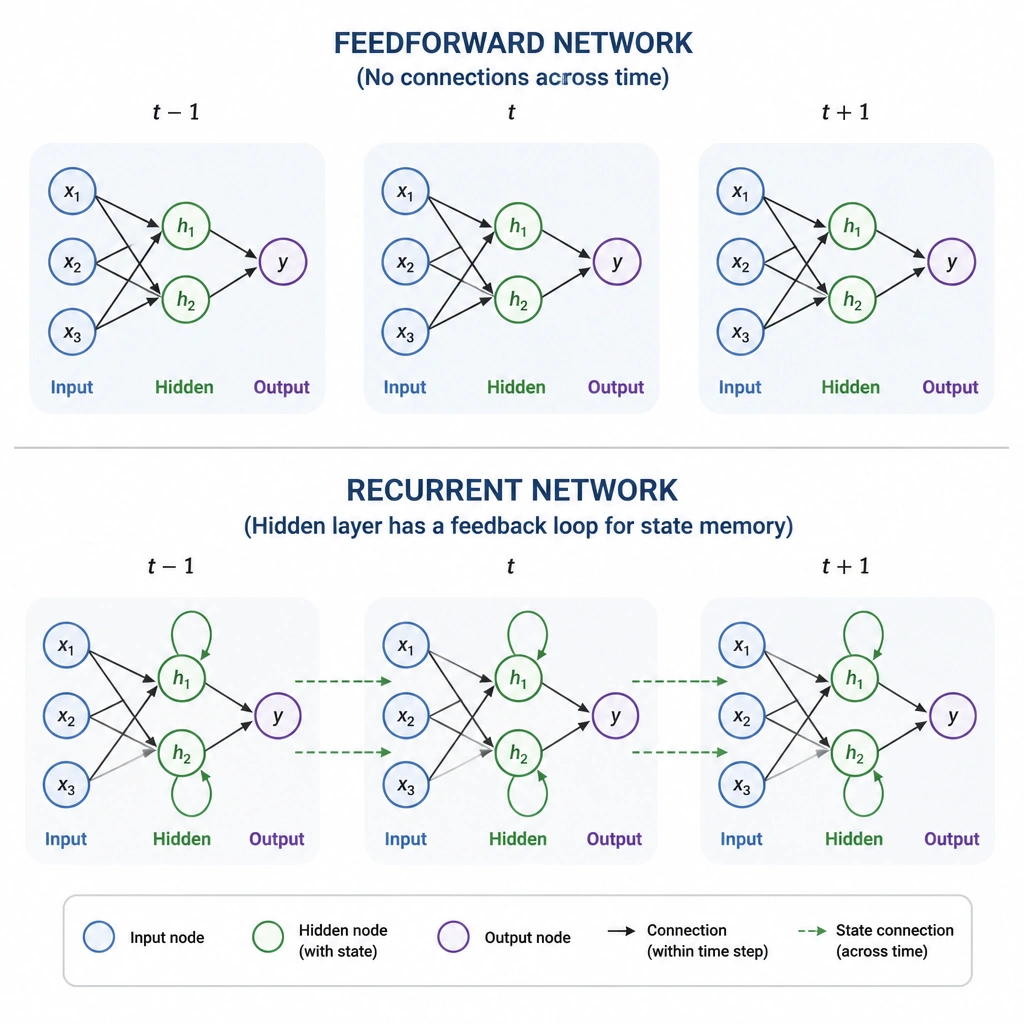
Imagine you're reading a book, but every time you read a word, your brain completely wipes its memory of the words you just read. You wouldn't make it past the first sentence! That's exactly how a standard feedforward neural network handles data. It treats every single input as completely independent of the one before it. It has no memory, no feedback loops, and no concept of time or order. For sequences like sentences or stock prices, where the order of words or numbers is everything, a feedforward network is basically blind. That's why we have to upgrade to RNNs or LSTMs when order matters. Trust me on this!
Full explanation below image
Full Explanation
Standard feedforward neural networks (FNNs), such as Multilayer Perceptrons (MLPs), process inputs in a single direction—from the input layer, through hidden layers, directly to the output layer. A key assumption of feedforward architectures is that all inputs are independent of one another.
When dealing with sequential data (e.g., speech, text, time series, or video), the order of the inputs is crucial to understanding their meaning. In natural language processing, the word "not" changes the entire context of the words that follow it. Because a standard FNN has no internal memory or feedback loops, it processes each element of a sequence in isolation. It cannot retain information about prior inputs, meaning it has no concept of time or sequence order.
To resolve this limitation, architectures with recurrent connections—like Recurrent Neural Networks (RNNs), Long Short-Term Memory (LSTM) networks, and Transformers—were developed. These architectures maintain internal states (hidden states) that persist information across sequence steps, allowing them to capture temporal dependencies.
Analyzing the incorrect options: - Option B is incorrect because feedforward networks can perform regression, multi-class classification, and structured outputs; they are not restricted to binary classification. - Option C is incorrect because the computational complexity of an FNN is governed by its weights and layer sizes. While processing long sequences with an FNN requires flattening the input (which increases the input layer size), it does not scale exponentially or cause immediate memory failure. - Option D is incorrect because neural networks routinely process zero inputs; sparse data is handled fine by FNNs, though it may require specific optimization techniques.