
What is the main role of the loss function during the execution of the backpropagation algorithm?
Select an answer to reveal the explanation.
Short Explanation
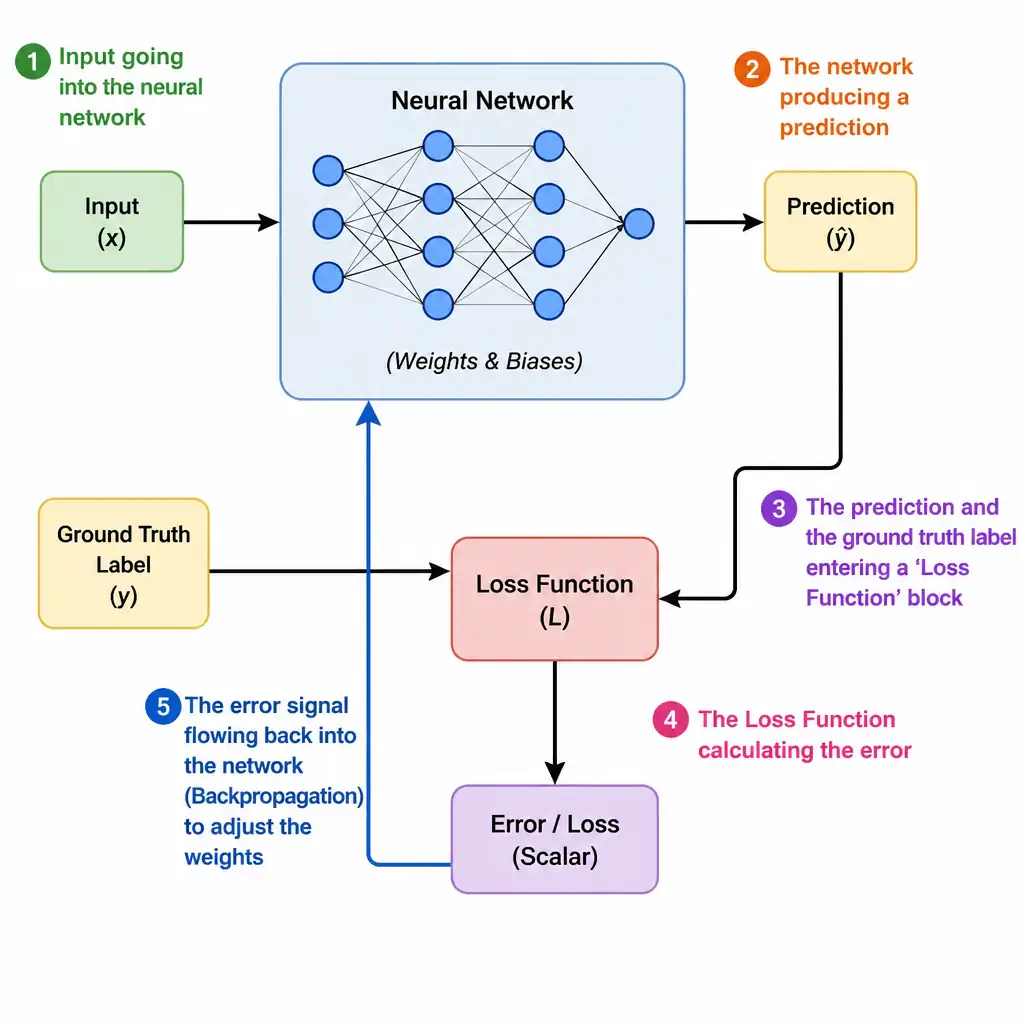
Think of the loss function as your feedback loop. It tells you exactly how far the network's prediction is from the true label by turning that mistake into one error number. Backpropagation then uses that number to figure out how to adjust the weights.
Full Explanation
The backpropagation algorithm is the core mechanism used to train artificial neural networks. It works by computing the gradient of a loss function with respect to the network's weights, allowing the optimizer to update those weights in a direction that minimizes error.
The loss function, also known as a cost or objective function, plays a critical role as the starting point of this process. During the forward pass, the network processes input data and outputs a prediction. The loss function compares this prediction to the actual target label, or ground truth, and computes a scalar value representing the prediction error. Common examples include Mean Squared Error (MSE) for regression and Cross-Entropy Loss for classification. During the backward pass, backpropagation applies the chain rule of calculus starting with the derivative of this loss value. The resulting error signal propagates backward through the network layers to calculate the partial derivatives for every weight and bias, guiding the optimization step.
The choice that says it introduces non-linearity into the network, enabling the model to learn complex decision boundaries, is incorrect because adding non-linearity is the role of activation functions such as ReLU, Sigmoid, or Tanh, not the loss function. The choice that says it reduces the dimensionality of the input features to speed up gradient calculations is incorrect because dimensionality reduction is typically performed by specific layers such as pooling layers or strides in CNNs, or techniques like Principal Component Analysis, not the loss function. The choice that says it acts as a scheduler that dynamically scales down the learning rate as training progresses is incorrect because adjusting the learning rate is handled by learning rate schedulers or optimization algorithms such as Adam or SGD with momentum, not the loss function.