
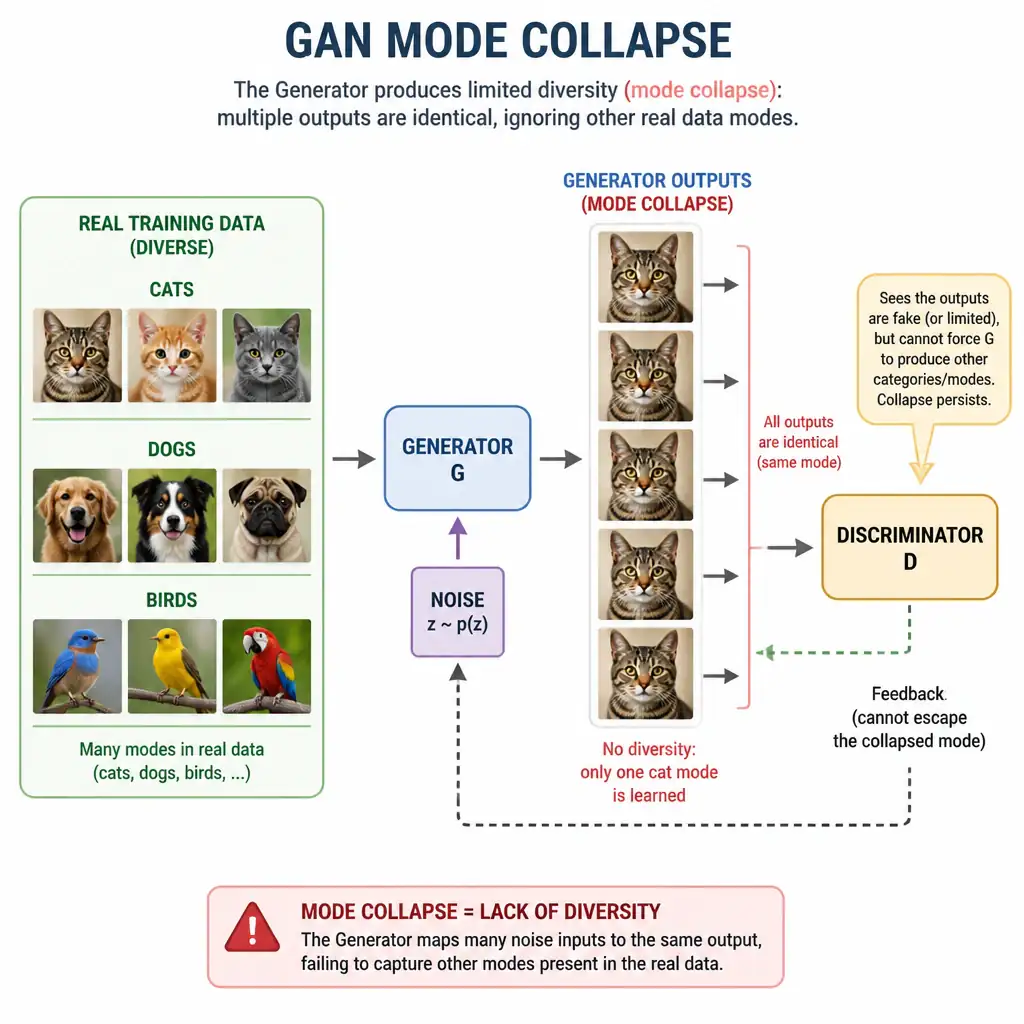
While developing a Generative Adversarial Network (GAN) to generate synthetic training images, your generator begins outputting identical or highly similar images repeatedly, failing to capture the full diversity of the training dataset. What is this classic GAN training failure mode called?
Select an answer to reveal the explanation.
Short Explanation
If you've ever trained a GAN, you know it's like balancing a marble on a knife-edge. The generator found one trick that fools the discriminator, so it keeps printing the same image instead of learning the whole dataset. That's mode collapse, and it's a classic sign of severe adversarial training instability.
Full Explanation
Generative Adversarial Networks (GANs) consist of two neural networks—the Generator (which creates fake data) and the Discriminator (which evaluates data for authenticity)—trained simultaneously in a zero-sum, adversarial game. This unique setup makes GANs notoriously difficult to train compared to standard feedforward networks. The correct answer is mode collapse and severe training instability during the adversarial game. The two most prominent and interconnected issues in GAN training are training instability and mode collapse. Training instability occurs because the two networks update their weights dynamically in response to each other, so they can enter non-convergent cycles where the loss functions oscillate wildly instead of reaching a stable Nash equilibrium. Mode collapse occurs when the Generator discovers a small subset of outputs, a single mode, that consistently fools the Discriminator. Instead of learning the full diversity of the target distribution, such as generating all digits from 0 to 9, the Generator outputs identical or highly similar samples repeatedly, such as only generating a specific style of the digit 8.
The vanishing-gradient explanation is incorrect because vanishing, or disappearing, gradients are a general deep learning problem related to deep networks and activation functions; it is not the specific, defining adversarial failure mode of GANs, though it can occur in GANs and is mitigated by choosing appropriate loss functions like Wasserstein GAN. The excessive-memory explanation is incorrect because excessive memory consumption when scaling to batch sizes greater than 16 is a resource constraint rather than an algorithmic failure mode of the training process itself. The high-latency explanation is incorrect because high latency during real-time inference on edge TPU hardware is a hardware or optimization concern, not a training failure mode of GANs.