
You are handed a large database of unstructured customer transaction logs with no labels or pre-defined categories. Your goal is to identify distinct shopping patterns and group similar customers together. Which machine learning task does this represent?
Select an answer to reveal the explanation.
Short Explanation
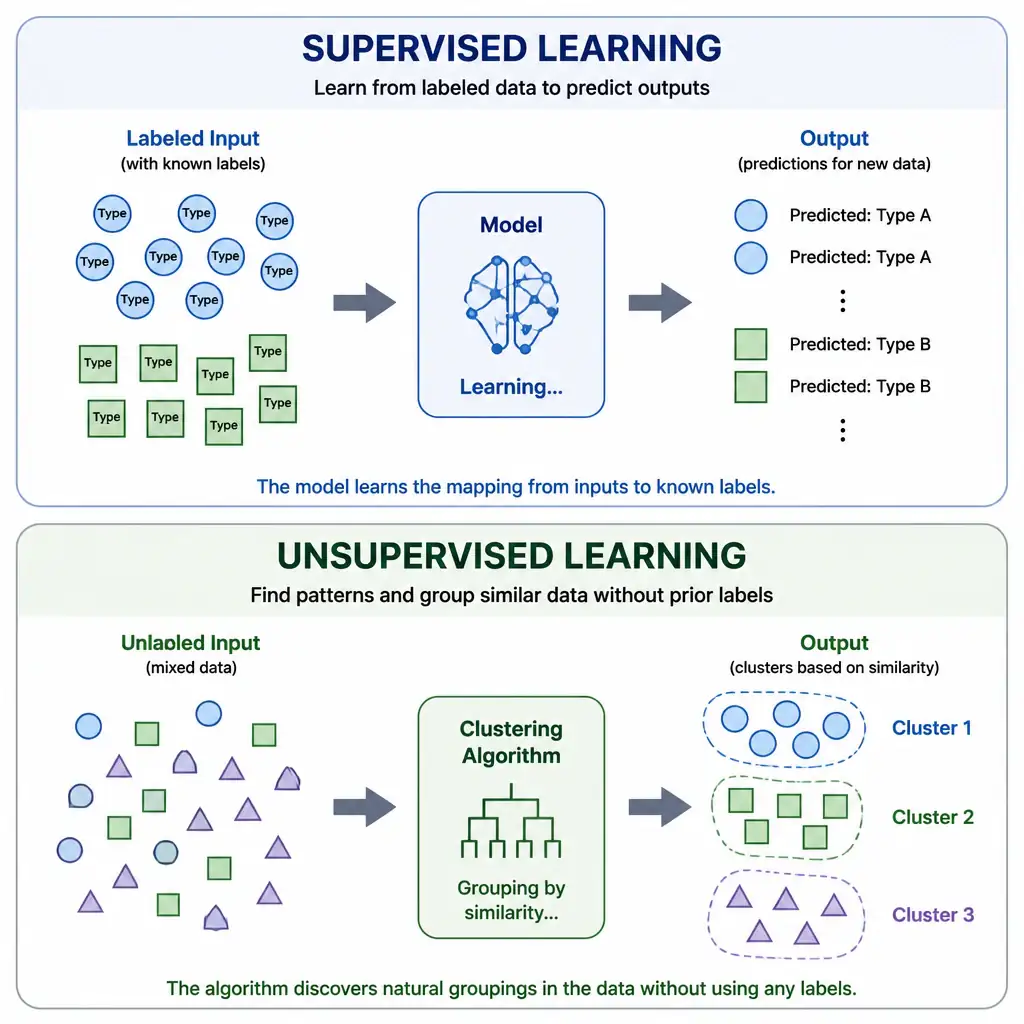
Think of it like this: supervised learning is like having a teacher who points to a picture of a cat and says "that's a cat." But what if you don't have any labels? You just have a massive pile of customer data and want to group them by how they shop, so you let the algorithm find natural groups on its own; grouping retail customers into distinct cohorts based on purchasing behaviors without prior labels is the classic unsupervised clustering example.
Full Explanation
Machine learning is broadly categorized into supervised and unsupervised learning based on the presence of labels in the training data.
1. Supervised Learning: The algorithm is trained on a labeled dataset, meaning each input is paired with its corresponding correct output. The model learns a mapping function from inputs to outputs. Examples include image classification, speech/voice recognition, and spam detection. 2. Unsupervised Learning: The algorithm is provided with unlabeled data and must discover hidden structures, relationships, or patterns on its own. The primary tasks are: - Clustering: Grouping data points so that points in the same group are more similar to each other than to those in other groups (e.g., customer segmentation based on purchasing behavior). - Dimensionality Reduction: Simplifying data without losing critical information (e.g., PCA). - Association Rule Learning: Finding interesting relationships between variables in large databases (e.g., market basket analysis).
The correct task is grouping retail customers into distinct cohorts based on purchasing behaviors without prior labels because the transaction logs are unstructured and unlabeled, and the goal is to discover natural customer groups. Identifying whether a chest X-ray shows signs of pneumonia using a dataset labeled by radiologists is supervised because the model requires labeled images, such as 'pneumonia' or 'normal', to learn. Converting spoken audio signals into text transcripts using pre-recorded and transcribed speech data is supervised because it trains on audio inputs mapped to specific text transcriptions or speaker labels. Filtering incoming emails into 'Spam' or 'Inbox' categories using historical email reports is supervised because it requires a dataset of emails labeled as 'spam' or 'ham' to train its classifier.