
During the machine learning development lifecycle, you partition your raw dataset into training, validation, and test subsets. What is the specific and primary role of the test set?
Select an answer to reveal the explanation.
Short Explanation
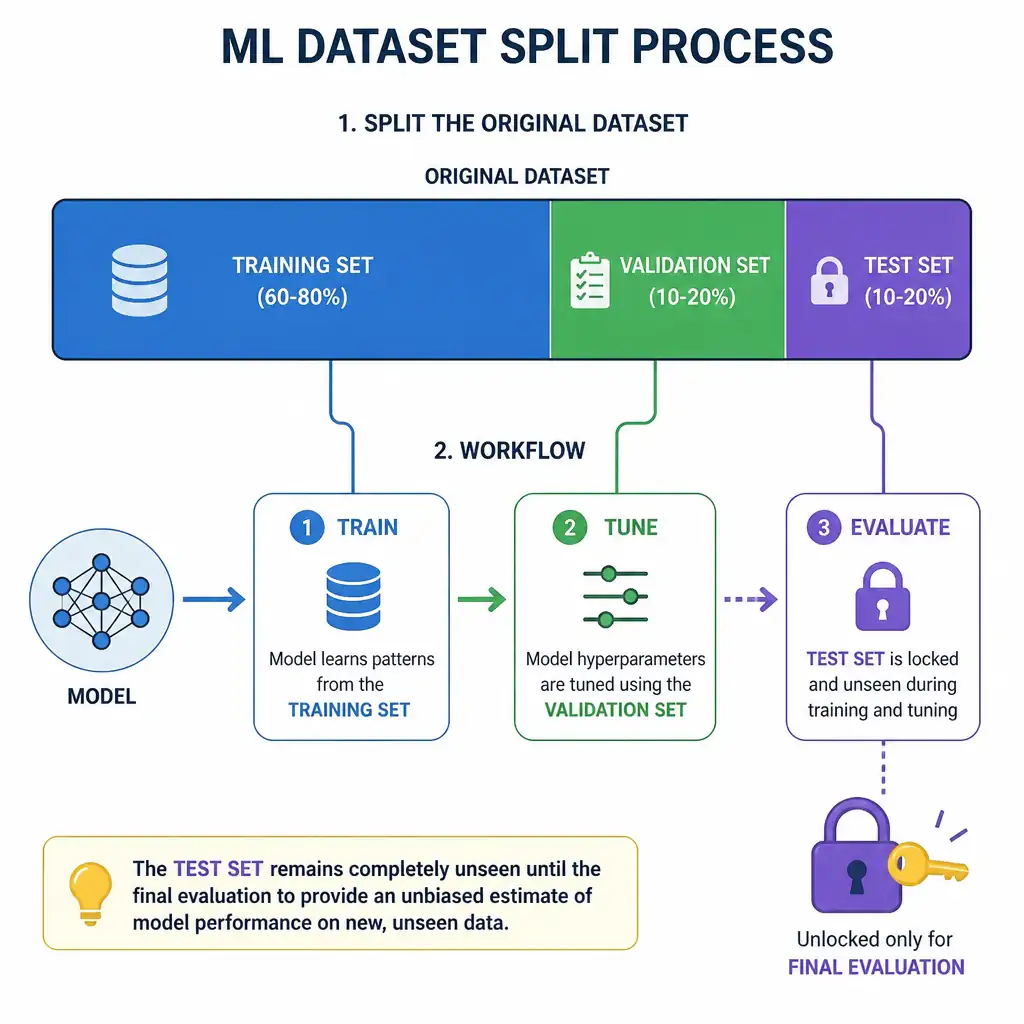
Trust me, you never want to grade your model on the same data it studied. The test set is your final exam: it stays hidden until training and tuning are done, then gives you an honest measure of how the model performs on completely unseen data.
Full Explanation
In machine learning, data partitioning is critical to prevent overfitting and ensure the model generalizes well to new data. Typically, a dataset is split into three parts: the training set, the validation set, and the test set.
1. Training Set: Used by the algorithm to learn the underlying patterns and adjust model weights. 2. Validation Set: Used during the development phase to tune hyperparameters, such as learning rate or network depth, and monitor for overfitting. 3. Test Set: Used only after the training and tuning processes are fully complete. Its sole purpose is to provide an unbiased evaluation of the final model's generalization capability on completely unseen data.
If you use the test set during training or parameter tuning, you introduce data leakage, which leads to overly optimistic performance estimates that won't hold up in production.
- The choice describing iterative adjustment of the internal weights and biases of the model during training epochs is incorrect because that is the function of the training set. - The choice describing scaling and preprocessing raw input features to have a mean of zero and standard deviation of one is incorrect because normalizing input data is a preprocessing step applied to the entire dataset, using statistics derived from the training portion, to scale features, not the purpose of the test set. - The choice describing selection of the optimal number of hidden layers and activation functions during model tuning is incorrect because tuning hyperparameters is the purpose of the validation set or cross-validation folds.