
As an AI systems architect deploying an automated loan-approval model, you must evaluate the project for ethical risks before pushing it to production. Which of the following represents a primary ethical concern directly related to the behavior of deployed AI systems?
Select an answer to reveal the explanation.
Short Explanation
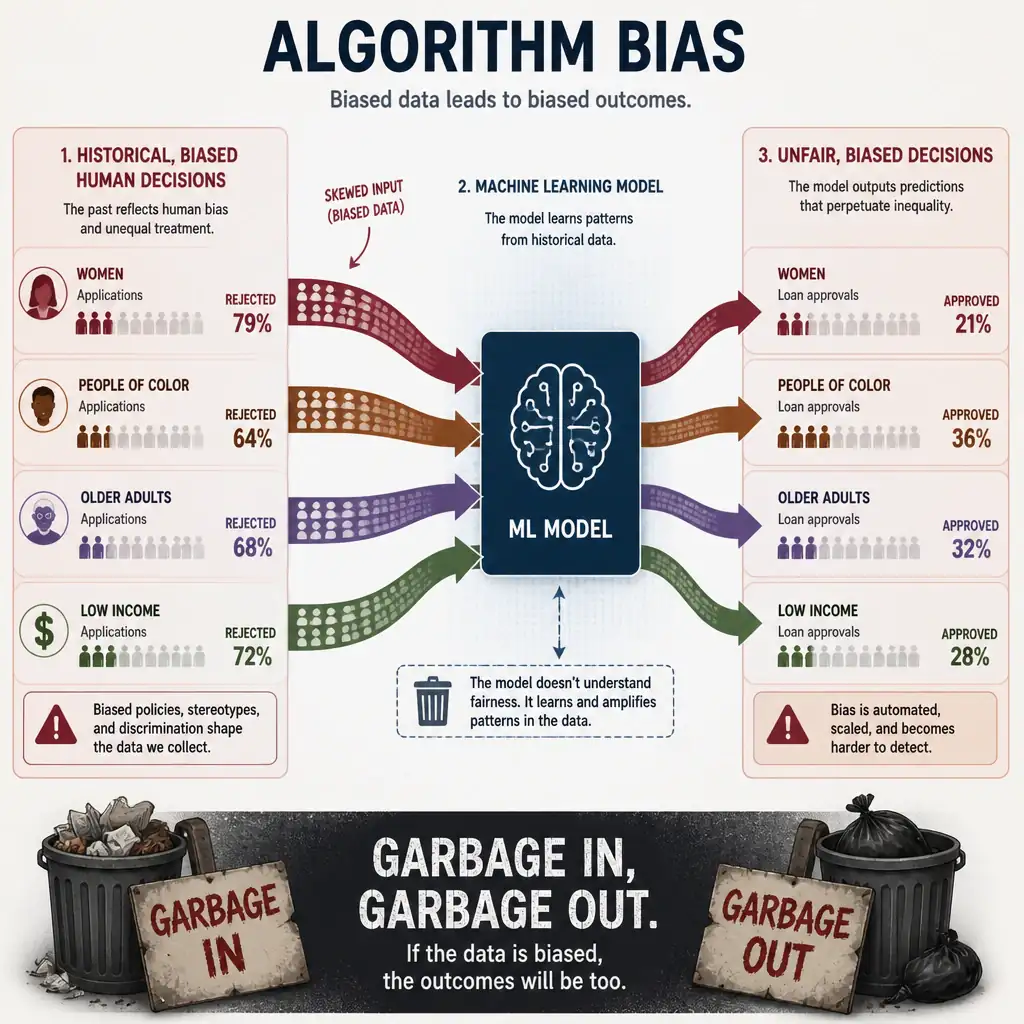
Here's the deal—when you train a loan-approval model on historical data, it can learn and amplify human bias. That's a direct ethical risk because it can discriminate against applicants. Power, connectivity, and edge-device overhead are technical or resource problems, not the core ethical behavior issue.
Full Explanation
Algorithmic bias represents one of the most significant and widely recognized ethical concerns in the field of Artificial Intelligence. Because AI models learn patterns from historical training datasets, any existing societal or human biases embedded in that data will be absorbed, propagated, and potentially amplified by the system. This can lead to discriminatory decisions in critical areas such as hiring, loan approvals, criminal justice risk assessments, and facial recognition access control. Addressing bias requires active intervention, including diverse dataset collection, fairness auditing, and bias mitigation techniques.
The perpetuation and amplification of societal biases present in historical training data is the correct concern because it directly affects the behavior of a deployed loan-approval model and can produce unfair, discriminatory outcomes.
The high electrical power consumption required to run massive GPU clusters is wrong because high computational cost is an infrastructure, environmental, or budgetary challenge, not a primary social or ethical concern regarding system behavior and fairness. The inability of neural networks to run without active internet connections is wrong because connectivity is a technical deployment or operational constraint, not an inherent ethical harm in the model's decision-making behavior. The computational overhead of running inference on low-power edge devices is wrong because it is a performance or resource constraint, not a direct ethical concern about fairness or discrimination.
Related points from the original reasoning are worth keeping in mind: lack of interpretability, often called the 'black box' problem, is a major technical and trust challenge, but the direct potential for discrimination and unfair treatment is the most prominent, direct ethical harm. The necessity of large datasets is also a technical limitation and data collection challenge, not an inherent ethical concern in itself, though how data is sourced or consented to can be ethical; the mere need for data is a technical requirement.