
You are designing a machine learning pipeline and need to decide between using a regression algorithm or a classification algorithm. What is the fundamental difference in the target outputs of these two supervised learning tasks?
Select an answer to reveal the explanation.
Short Explanation
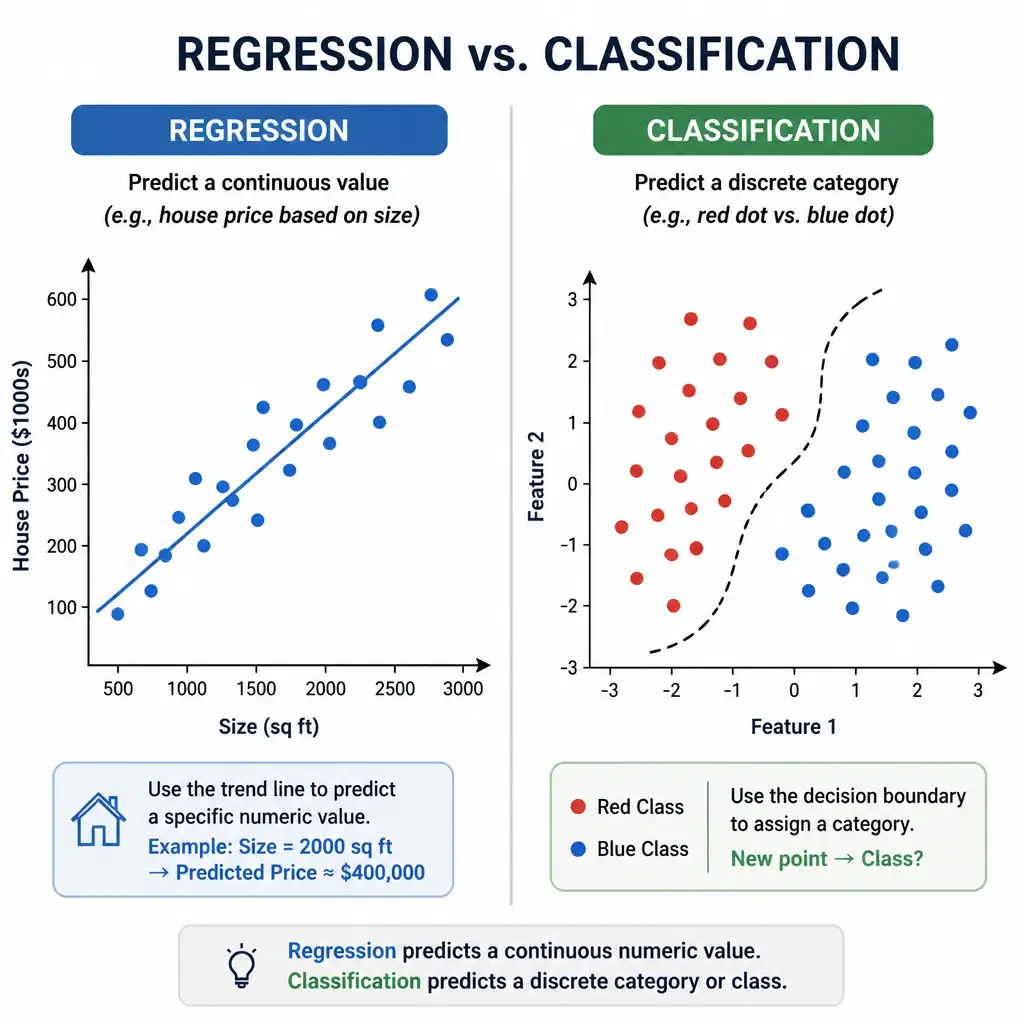
Let's dive in. You use regression when the target is a continuous number, like price or latency, and classification when the target is a discrete label, like healthy or failed. Both are supervised, but regression measures and classification sorts.
Full Explanation
Supervised machine learning is fundamentally divided into regression and classification based on the nature of the output variable.
1. Regression: The objective is to predict a continuous numerical value. The target variable is on a continuous scale, meaning there are infinite possible values within a range. Examples include predicting housing prices, estimating network latency in milliseconds, or forecasting temperature. 2. Classification: The objective is to predict a discrete class label or category. The target variable belongs to a predefined set of categories. If there are two classes, such as spam versus ham or transaction approved versus denied, it is binary classification. If there are more than two classes, such as classifying animal species or handwritten digits, it is multi-class classification.
Both regression and classification are supervised learning techniques, meaning they train on labeled datasets where the input features map to a known target output. They can both utilize linear or nonlinear models; for instance, Logistic Regression, despite its name, is a classification algorithm, and Decision Trees can be used for both.
The claim that regression is designed exclusively for unsupervised clustering while classification is used only in supervised anomaly detection is incorrect because both regression and classification are supervised learning tasks and require labeled training data. The claim that regression requires a linear relationship between features while classification can only be performed using non-linear neural networks is incorrect because both tasks can use either linear models, such as Linear Regression and Logistic Regression, or nonlinear models, such as Random Forests and Neural Networks. The claim that regression is applied only to unstructured image data while classification is reserved for structured database tables is incorrect because neither task is restricted to a specific data format; both can be applied to numerical, tabular, text, image, or audio data. Exam caveat: do not confuse the output type with the data format or the learning paradigm.