
Why do machine learning engineers add a regularization term (such as L1 or L2) to a model's loss function?
Select an answer to reveal the explanation.
Short Explanation
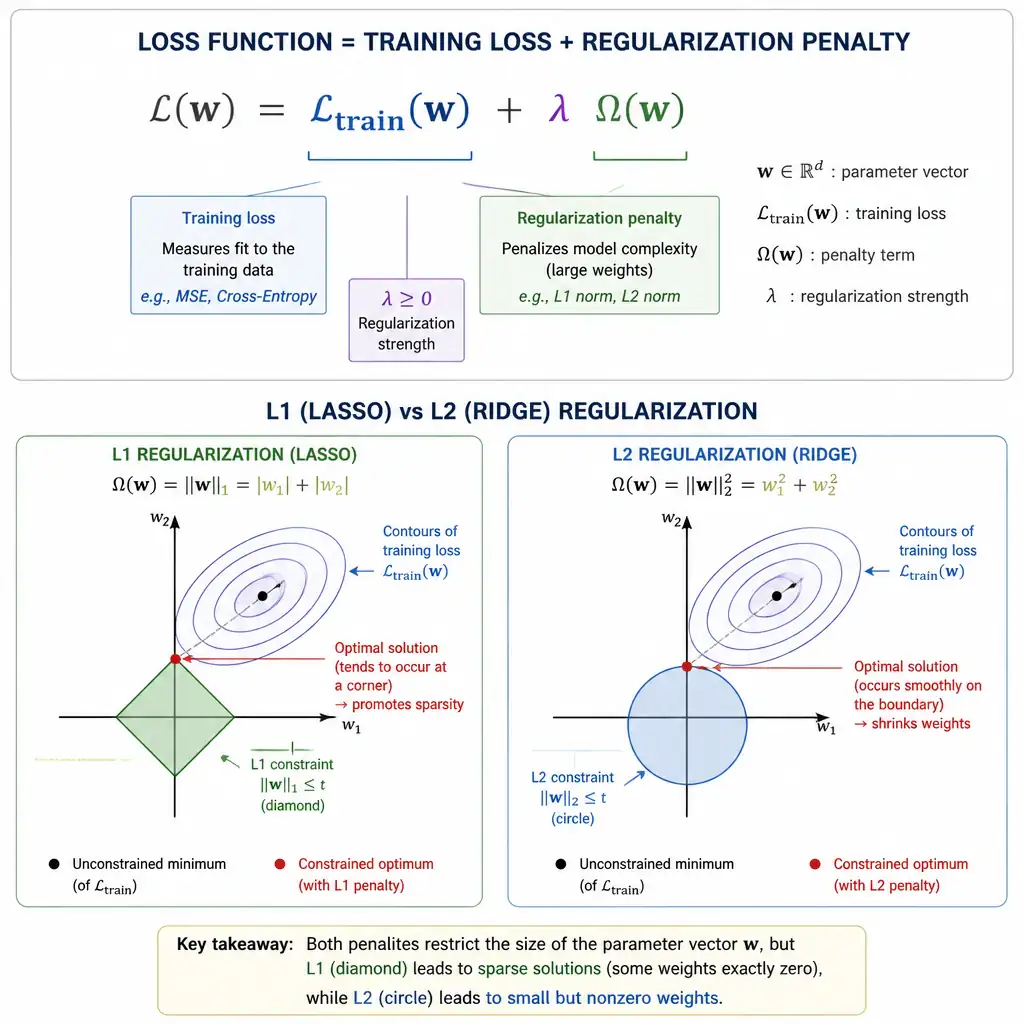
Think of regularization like a speed limit that keeps a high-performance model from spinning out of control. When you train a model, it can let weights get huge to fit noise, so regularization says, 'If you make them too big, it's going to cost you.' That keeps the model simple and honest, so it performs better in production.
Full Explanation
Regularization is a technique used to prevent overfitting by discouraging models from becoming overly complex. In linear models, neural networks, and other algorithms, high complexity is often characterized by very large weight values, which allow the model to fit small fluctuations and noise in the training dataset. By adding a regularization penalty term to the loss function, the optimization objective becomes: Total Loss = Training Loss + lambda * R(w), where lambda is the regularization strength hyperparameter, and R(w) is the penalty function. L1 Regularization (Lasso) uses the absolute values of the weights (R(w) = sum(|w_i|)); it promotes sparsity by driving some weights exactly to zero, which can also act as a feature selection mechanism. L2 Regularization (Ridge) uses the squared values of the weights (R(w) = sum(w_i^2)); it shrinks all weights toward zero but does not set them to zero, distributing the impact across features. The statement that regularization penalizes large weights and reduces model complexity to prevent overfitting is therefore the right one. The claim that regularization ensures the optimization algorithm always converges to the absolute global minimum is incorrect because optimization algorithms like gradient descent find local or global minima; regularization shifts the loss surface and can actually make finding the global minimum of the original training loss harder, though it results in a more generalizable model. The claim that regularization increases the degree of the model's polynomial features and captures more complex non-linear patterns is incorrect because regularization decreases the effective complexity of the model, rather than increasing it. The claim that regularization accelerates the convergence speed of gradient descent during training is incorrect; regularization does not speed up training and can sometimes slow down convergence due to the added constraints. In summary, regularization trades a small amount of performance on training data for a significant increase in generalization accuracy on unseen validation and test data.