
Although both the classic Perceptron and Logistic Regression are linear binary classifiers, how do they differ in their outputs?
Select an answer to reveal the explanation.
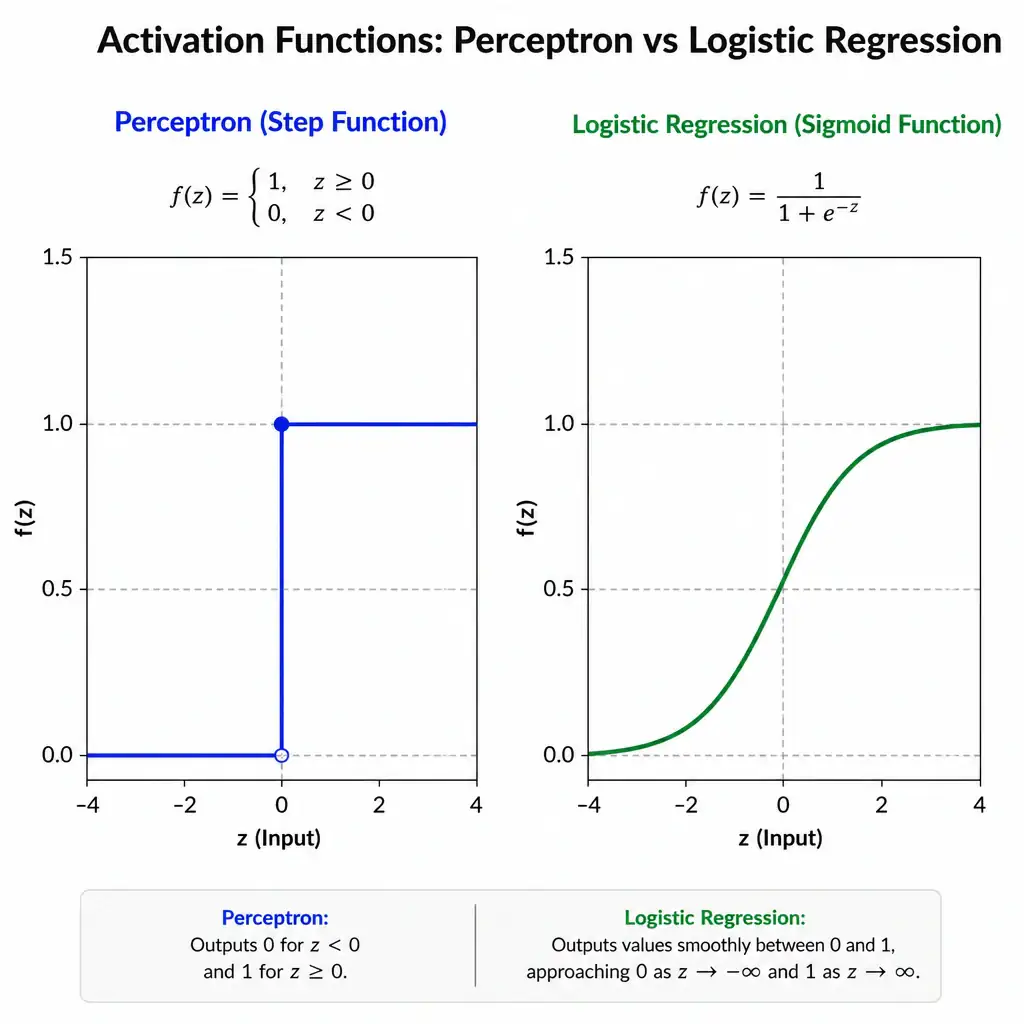
Short Explanation
Check this out: both draw a line to separate two classes, but they talk to you differently. The Perceptron is blunt: it uses a step function and gives you a hard 0 or 1. Logistic Regression uses a sigmoid to give you a probability between 0 and 1, so you can see how confident the prediction is.
Full Explanation
The Perceptron (developed by Frank Rosenblatt) and Logistic Regression are both linear classifiers that compute a weighted sum of inputs plus a bias: z = w^T x + b. However, they differ fundamentally in the activation function applied to this sum and the resulting output. The Perceptron applies a step function (Heaviside step function): if z >= 0, the output is 1; if z < 0, the output is 0 (or -1). This produces a hard binary classification with no intermediate values or measure of confidence. Logistic Regression applies the logistic sigmoid function: sigma(z) = 1 / (1 + e^-z). This maps the linear combination to a continuous value between 0 and 1, which represents the probability that the given input belongs to the positive class (P(y=1|x)). To address the distractors: the reversed-output choice is wrong because it swaps the two activation functions, claiming the Perceptron outputs a probability and Logistic Regression outputs a hard binary decision. The regression/clustering choice is wrong because both models are classification algorithms, and neither is used for clustering. The hidden-layer choice is wrong because both the basic Perceptron and Logistic Regression are single-layer models without hidden layers. Logistic regression's output of probabilities is highly advantageous because it allows practitioners to establish custom decision thresholds and compute loss functions like binary cross-entropy, which supports gradient-based optimization better than the non-differentiable step function of the Perceptron.