
What is the fundamental difference between the datasets used in supervised learning versus unsupervised learning algorithms?
Select an answer to reveal the explanation.
Short Explanation
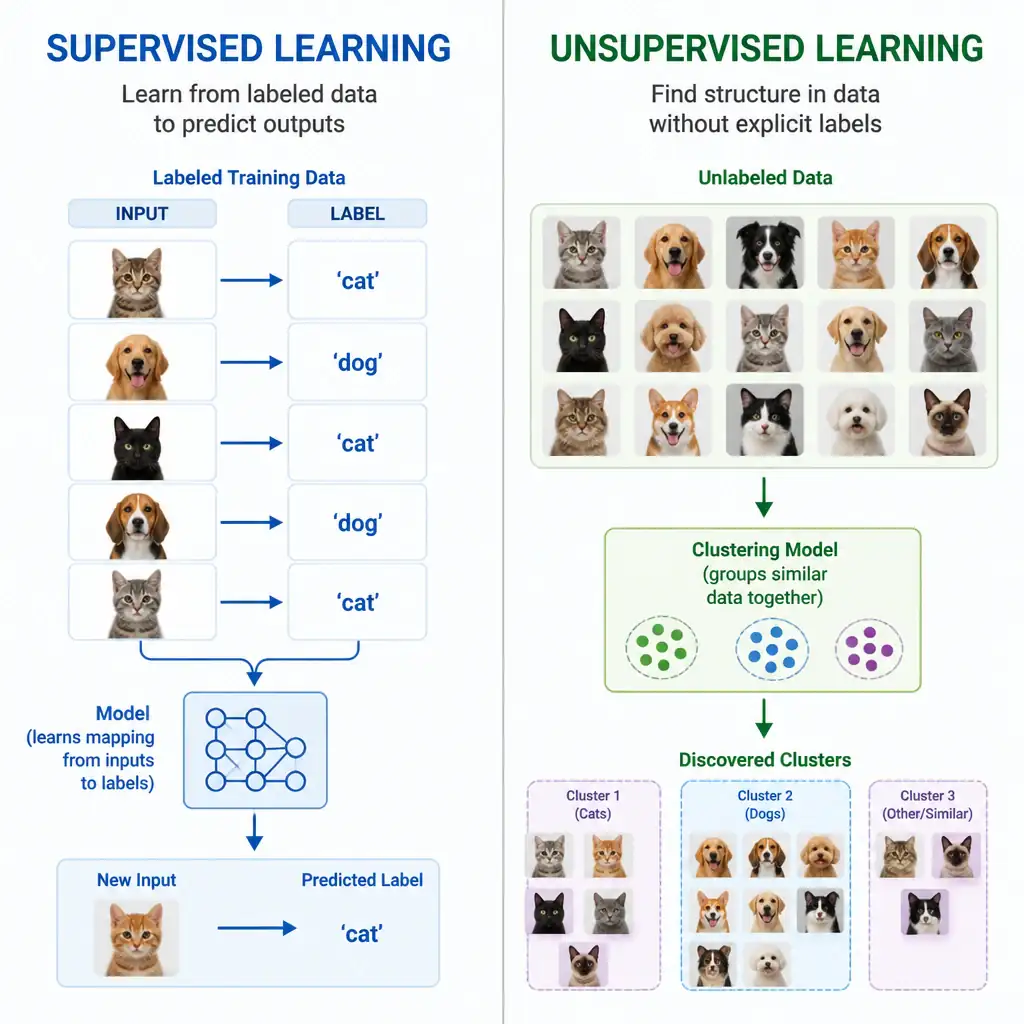
Here's the deal: supervised learning gives you labeled input-output pairs, so the model learns from the answers. Unsupervised learning gives you unlabeled data, so you find hidden patterns without a cheat sheet.
Full Explanation
The primary distinction between supervised and unsupervised learning lies in the structure of the training data and the objective of the learning process:
1. Supervised Learning: The training dataset consists of input-output pairs, commonly expressed as (x_i, y_i). Each input instance is paired with a corresponding label (ground truth) provided by human annotators or external processes. The model learns a mapping function from inputs to outputs to predict labels for new, unseen inputs. Typical tasks include classification (e.g., email spam detection) and regression (e.g., house price prediction). 2. Unsupervised Learning: The dataset contains only inputs, x_i, without corresponding target labels. The objective is to discover underlying structures, patterns, or groupings within the data. Typical tasks include clustering (e.g., customer segmentation using k-means), dimensionality reduction (e.g., PCA), and anomaly detection.
To address the distractors: - The claim that supervised learning models are trained strictly on numerical data while unsupervised models operate on categorical data is incorrect because both supervised and unsupervised models can handle numerical and categorical data. - The claim that supervised learning relies on historical data while unsupervised learning requires real-time data streaming is incorrect because real-time versus historical data refers to the timing of data delivery, which is independent of the learning paradigm. - The claim that supervised learning processes structured tabular formats whereas unsupervised learning only processes unstructured image formats is incorrect because supervised and unsupervised learning can both run on structured tabular data, unstructured text, or images.