
Which of the following best describes the structural design and operational dynamic of a Generative Adversarial Network (GAN)?
Select an answer to reveal the explanation.
Short Explanation
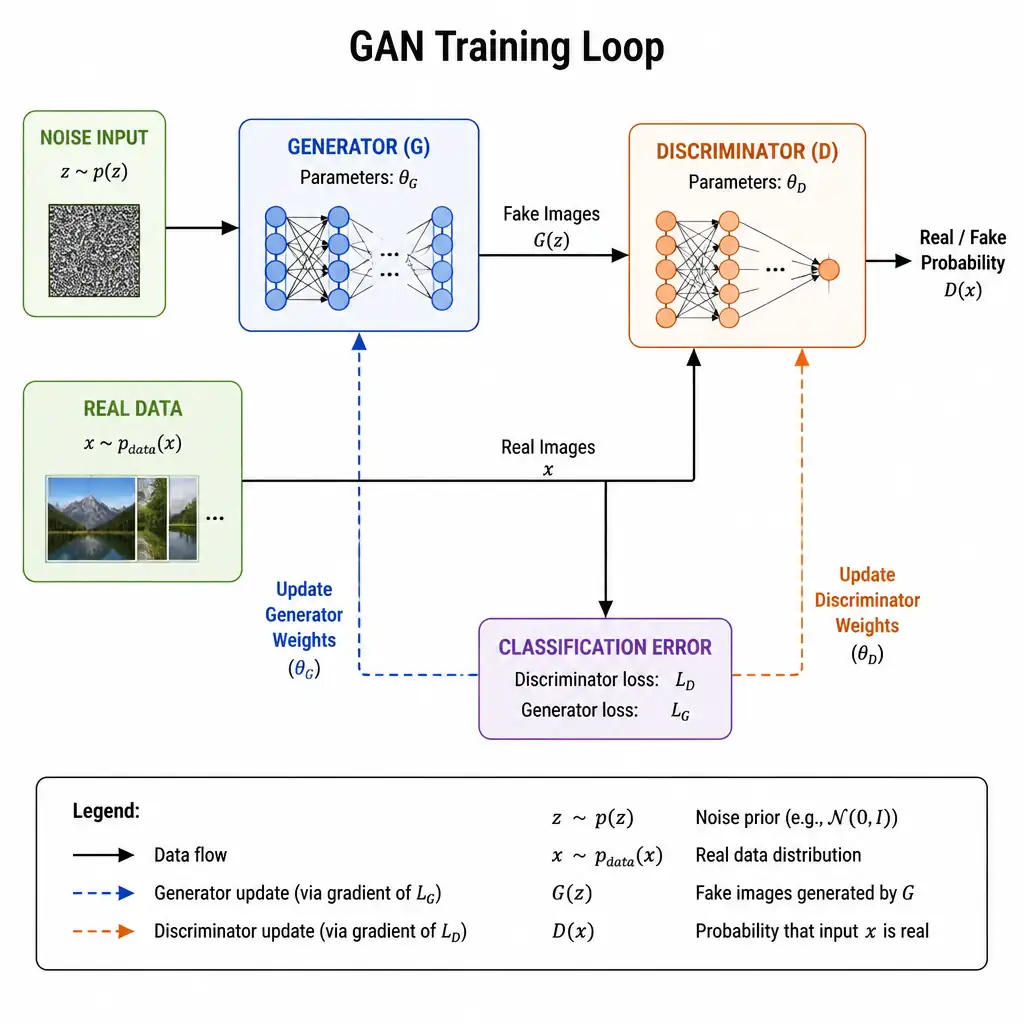
Think of a GAN as a cat-and-mouse game between an art forger and an art detective. You have a generator making fake data and a discriminator trying to spot it, and they keep competing until the fakes look real. Pretty cool, right?
Full Explanation
A Generative Adversarial Network (GAN) is a class of machine learning frameworks designed by Ian Goodfellow and his colleagues in 2014. The best description is the dual-network setup where a generator creates synthetic data and a discriminator tries to distinguish it from real data. It consists of two neural networks trained simultaneously in a zero-sum game: the generator takes random noise as input and attempts to generate synthetic data, such as images, that mimic the training distribution, while the discriminator takes both real data from the training set and synthetic data from the generator and attempts to classify them as 'real' or 'fake'. During training, the generator's goal is to maximize the probability that the discriminator makes a mistake, while the discriminator's goal is to minimize that probability. This adversarial competition drives both networks to improve until the generated data is high-quality and realistic. The single deep neural network that uses recurrent layers to predict sequential data points step-by-step describes recurrent architectures, such as recurrent neural networks and long short-term memory networks, which are typical for sequential tasks like language modeling. The feedforward network that relies on regression to map inputs to continuous numerical targets refers to regression models, which predict continuous quantities and do not involve adversarial training or generative modeling of distributions. The encoder-decoder architecture that translates input sequences into different output modalities describes the encoder-decoder framework commonly found in sequence-to-sequence models, such as machine translation, which does not use the adversarial generator-discriminator paradigm. GANs are widely used for image synthesis, super-resolution, style transfer, and generating synthetic training data.