
Imagine you are training a machine learning model to predict home prices. You feed it two input variables: the number of bedrooms (ranging from 1 to 5) and the square footage of the lot (ranging from 500 to 10,000). During training, your model is performing poorly and taking an excessive amount of time to converge because the optimization algorithm is highly sensitive to changes in the lot size but barely registers the number of bedrooms. What preprocessing step should you implement to resolve this imbalance?
Select an answer to reveal the explanation.
Short Explanation
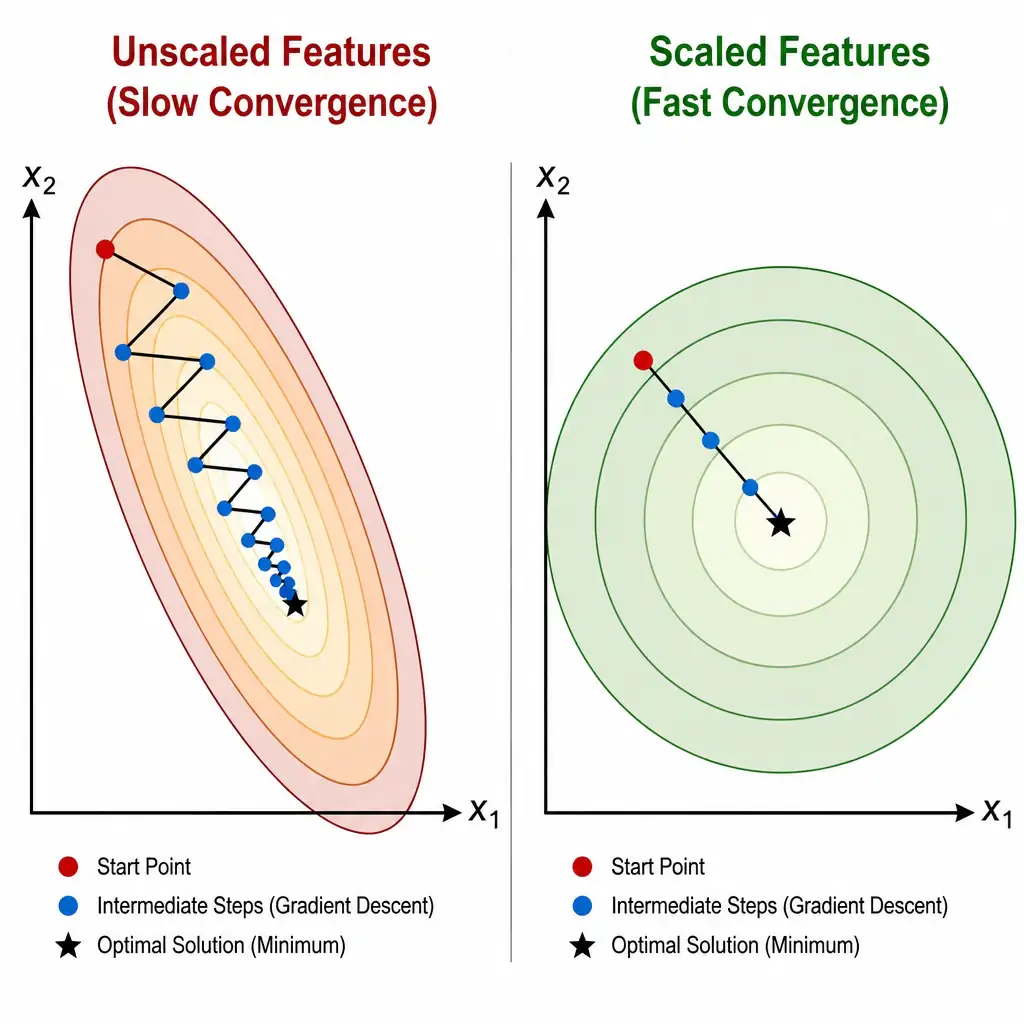
Here's the deal—when you feed a model one input ranging from 500 to 10,000 and another from 1 to 5, the big numbers dominate the optimization. Scale the features so they share a common range, and you'll let gradient descent converge faster without treating lot size as more important than bedrooms.
Full Explanation
In machine learning, feature scaling is a critical preprocessing step used to normalize the range of independent variables or features of data. Many machine learning algorithms—specifically those that rely on distance calculations (like K-Nearest Neighbors, Support Vector Machines, and K-Means clustering) or gradient descent optimization (like linear regression, logistic regression, and neural networks)—are highly sensitive to the scale of the input data.
When features have widely differing scales, the objective function will be dominated by the features with larger absolute values. For example, in gradient descent-based optimization, the gradient updates can oscillate wildly, leading to extremely slow convergence or failure to find the global minimum. Scaling features ensures that the step sizes taken by gradient descent are uniform across all dimensions, making the optimization process significantly faster and more stable.
Let's break down why the other approaches are incorrect: - The feature selection approach is the process of identifying and selecting a subset of relevant features for use in model construction. While it reduces overfitting and training time, it does not address the issue of scale differences among the remaining features. - The outlier removal approach is a data cleaning technique designed to filter out anomalous data points that could skew the model's predictions. While feature scaling can be affected by outliers (particularly Min-Max scaling), scaling itself does not remove them. - The feature imputation approach is used to handle missing data by replacing null values with statistically derived values (like the mean, median, or mode). It does not alter the scale of the existing features.
Therefore, feature scaling is the correct preprocessing method to ensure all features contribute proportionately to the model's learning process.