
To ensure your machine learning model generalizes well to unseen data and does not suffer from overfitting, you want to evaluate its performance robustly. Instead of relying on a single train-test split, which process partitions the data into multiple subsets, training and testing the model multiple times so that every data point is used for both training and validation?
Select an answer to reveal the explanation.
Short Explanation
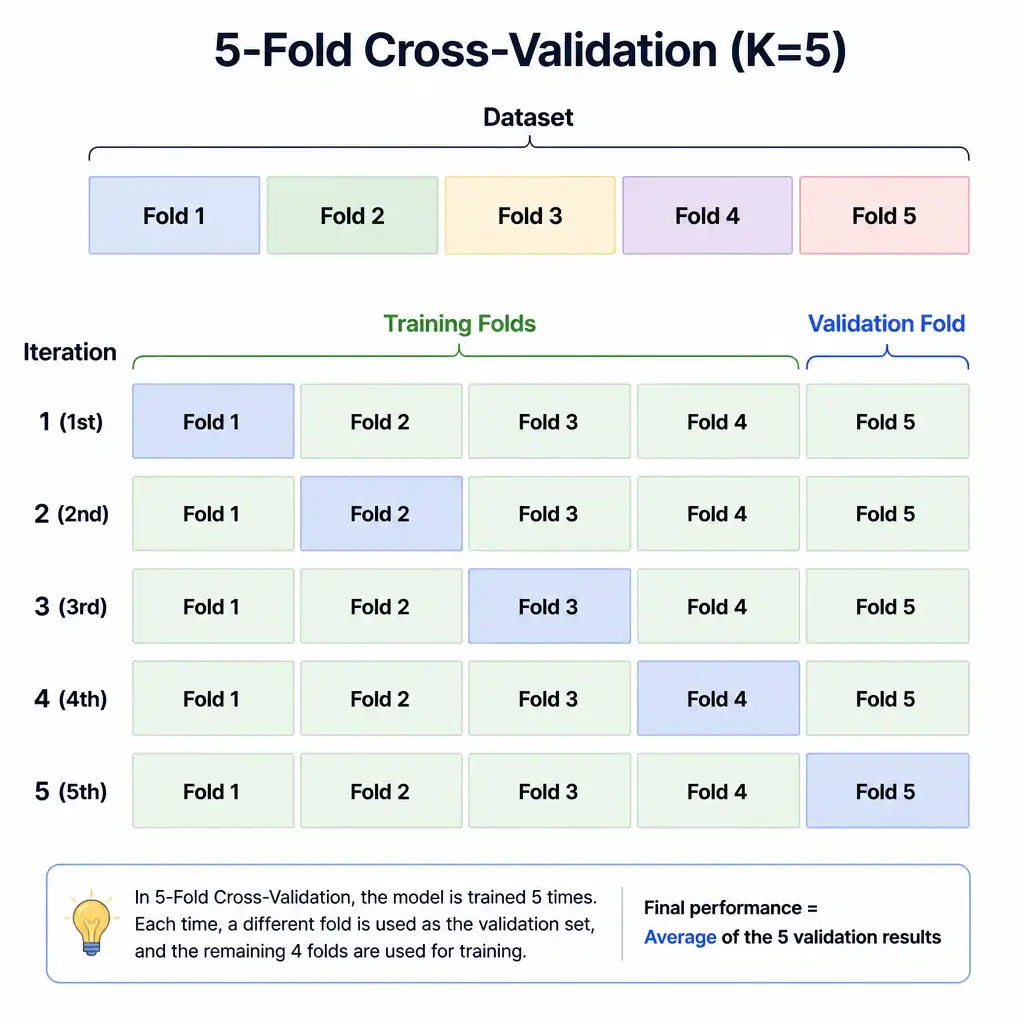
Check this out: if you split your data once, you might get lucky or unlucky depending on the shuffle. You use cross-validation, like K-fold cross-validation, to train and test multiple times so every data point gets a turn in the validation set. Then you average the scores for a rock-solid, honest evaluation.
Full Explanation
Cross-validation is a statistical method used to estimate the performance and generalization capability of machine learning models. Cross-validation, such as K-fold cross-validation, involves partitioning the dataset into K equal-sized subsets (folds). The model is trained K times. In each iteration, K-1 folds are used as the training set, and the remaining single fold is used as the validation set for testing. This process repeats so that each of the K folds is used exactly once as the validation data. The results from all K iterations are then averaged to produce a single estimation. This approach ensures that the model evaluation is not biased by a single, arbitrary train-test split and utilizes the entire dataset for both training and validation. Min-max normalization is a data preprocessing technique that scales features to a fixed range, usually 0 to 1, to ensure numerical stability during training. Learning rate decay scheduling is an optimization technique that reduces the step size during gradient descent as training progresses to help the model converge to a global minimum. Hyperparameter grid searching is an optimization method that systematically tests combinations of hyperparameters to find the best configuration, often using cross-validation as its evaluation metric, but it is not the validation process itself. Consequently, cross-validation is the correct term for evaluating model performance across multiple data subsets.