
When analyzing spatial datasets like digital images using a Convolutional Neural Network (CNN), what is the primary function of the convolutional layers within the network architecture?
Select an answer to reveal the explanation.
Short Explanation
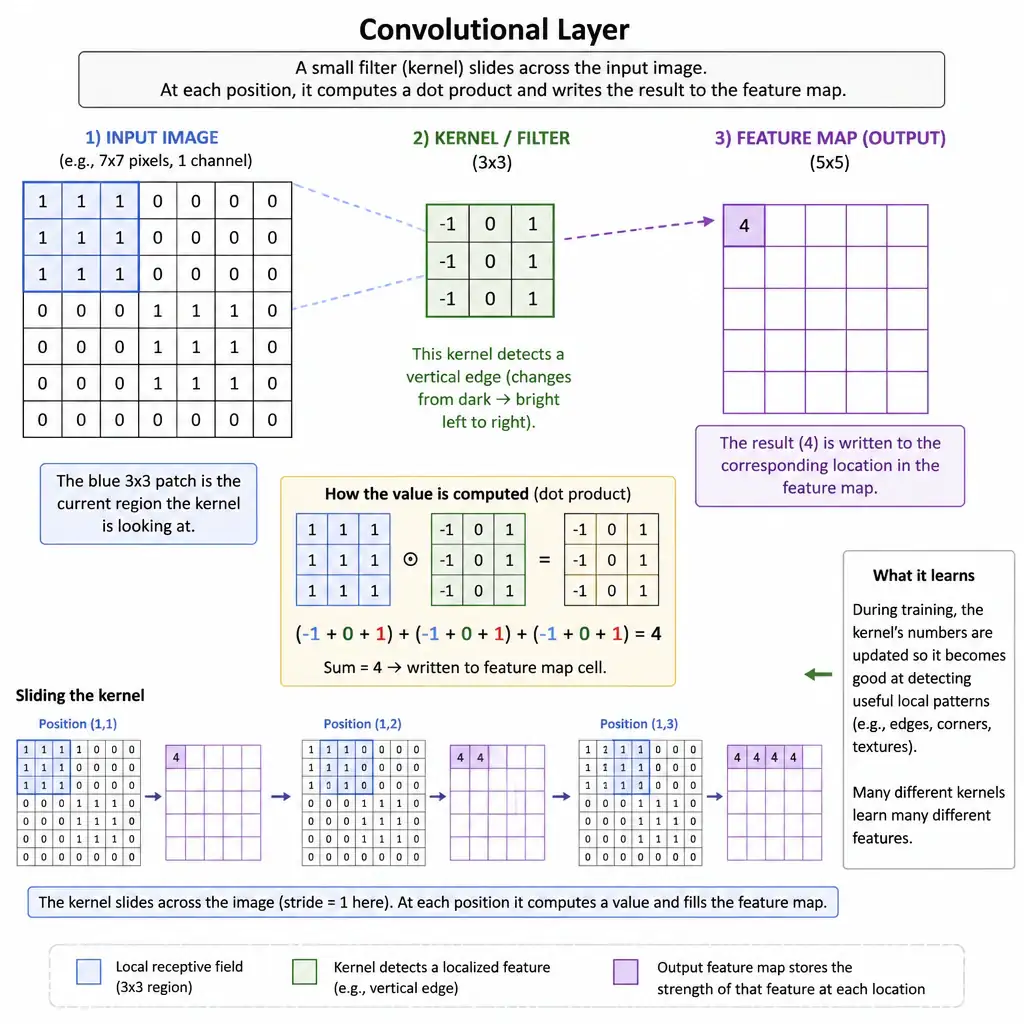
Think of a convolutional layer as a digital magnifying glass sliding across an image to spot clues like edges, lines, or textures. You use learnable filters to detect and extract localized patterns, and deeper layers combine them into shapes and objects. That feature extraction is how a CNN learns to see.
Full Explanation
In computer vision tasks, Convolutional Neural Networks (CNNs) are highly effective because they exploit the spatial correlation of local pixels. The fundamental purpose of a convolutional layer is feature extraction.
A convolutional layer accomplishes this by convolving one or more learnable filters, also called kernels, across the input space. A filter is a small matrix of weights, such as 3x3 or 5x5, that slides across the width and height of the input image, performing element-wise multiplications and summing the results to create a two-dimensional feature map, also called an activation map. As the network learns during training, these filters adapt to detect specific patterns. The initial convolutional layers learn to extract low-level features such as edges, corners, and color gradients. Deeper convolutional layers combine these basic shapes to extract high-level semantic features, such as textures, parts of objects, and eventually complete objects.
Let's review why the other choices are incorrect: - The choice describing compression of spatial dimensions and reduced feature-map resolution is incorrect because spatial dimensionality reduction is primarily the job of pooling layers, such as Max Pooling or Average Pooling, or strided convolutions, rather than the core convolution operation itself. - The choice describing a regularization mechanism that prevents memorizing training samples is incorrect because convolutional layers are not regularization tools; regularization to prevent overfitting is handled by techniques like dropout, weight decay, or data augmentation. - The choice describing non-linear decision boundaries introduced through the convolution operation itself is incorrect because the convolution operation is mathematically linear, a series of multiplications and additions. Non-linearity is introduced by applying a separate, non-linear activation function, such as the Rectified Linear Unit (ReLU), directly after the convolutional layer's output.
For the exam, make sure you associate the convolutional layer with feature extraction and filter application, keeping it distinct from pooling for dimensionality reduction and activation functions for non-linearity.