
When building infrastructure to train deep learning models at scale, engineers almost universally choose Graphics Processing Units (GPUs) over standard Central Processing Units (CPUs). What is the primary hardware advantage that makes GPUs so superior for this task?
Select an answer to reveal the explanation.
Short Explanation
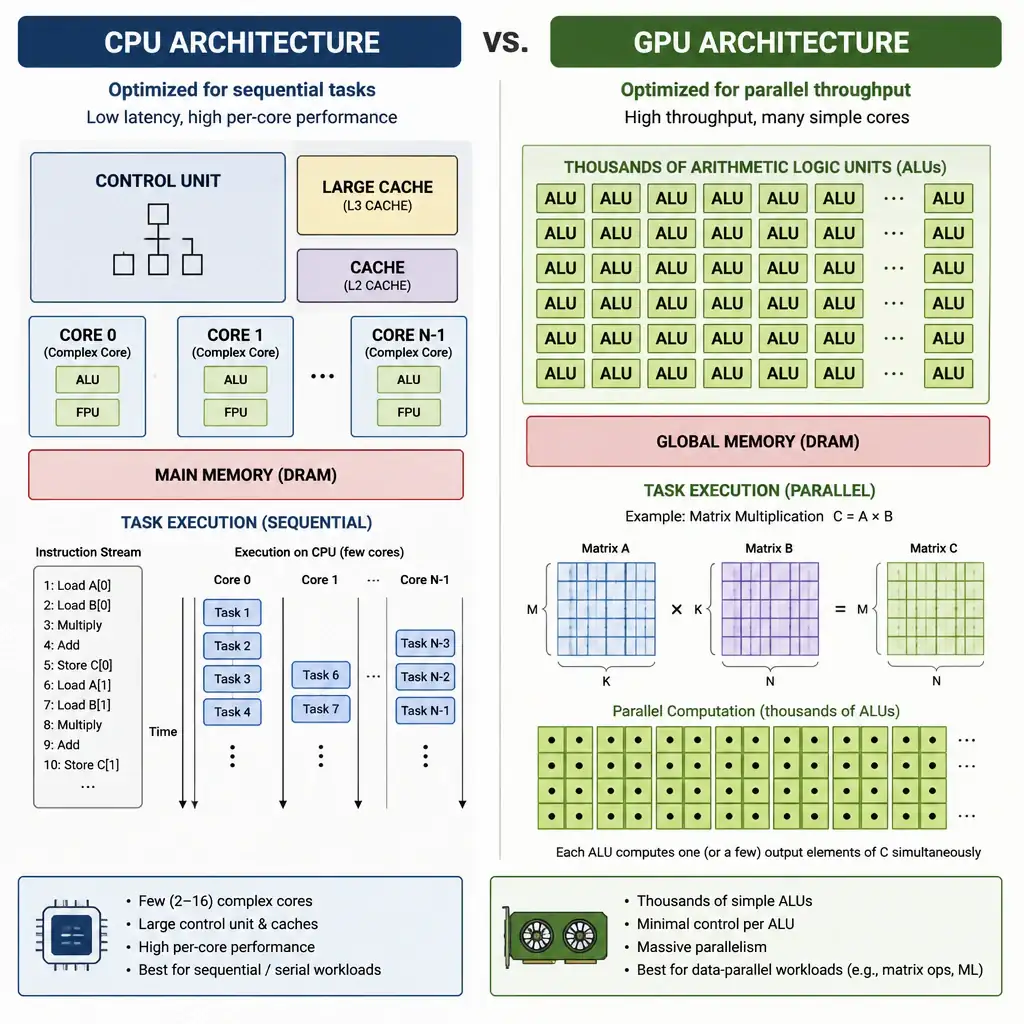
You're not buying GPUs because they're efficient or smart; you're buying them because they're massively parallel. When training a model, you're doing billions of simple matrix and tensor calculations, and thousands of GPU cores can chew through that math at once.
Full Explanation
Deep learning models, particularly large convolutional neural networks or transformers, are mathematically dominated by linear algebra operations. Forward propagation and backpropagation require performing billions of matrix multiplications, vector additions, and tensor transformations.
The correct choice is the ability to perform highly parallelized execution of massive matrix and tensor calculations. A Central Processing Unit (CPU) is built for general-purpose sequential processing. It contains a small number of cores optimized for single-threaded performance and low-latency execution of complex logic branches. Conversely, a Graphics Processing Unit (GPU) is designed with a highly parallel architecture consisting of thousands of smaller, simpler cores. These cores are optimized to perform identical mathematical operations on multiple data points simultaneously (Single Instruction, Multiple Data, or SIMD). Consequently, when a training job is offloaded to a GPU, the massive matrices representing model weights and training activations can be multiplied in parallel rather than sequentially, reducing training times from weeks to hours.
Here is why the other choices are distractors: - The highly efficient cooling architecture that dramatically reduces overall electricity and energy consumption is incorrect because GPUs are highly power-hungry components that draw significant wattage (often 300W to 700W+ per card) and generate substantial heat, thereby increasing rather than reducing energy consumption. - The hardware-level optimization that automatically simplifies the mathematical structure of the neural network is incorrect because hardware accelerators have no impact on the complexity or architecture of the neural network model; model architecture is determined purely by the design choices in software. - The specialized memory compression techniques that minimize the physical RAM footprint of large datasets is incorrect because deep learning on GPUs actually requires significant memory allocations (VRAM or HBM) to hold model weights and gradients, and does not compress or reduce overall memory requirements.
For the exam, remember that the core benefit of a GPU in deep learning is the acceleration of linear algebra and matrix operations via parallel computation.