
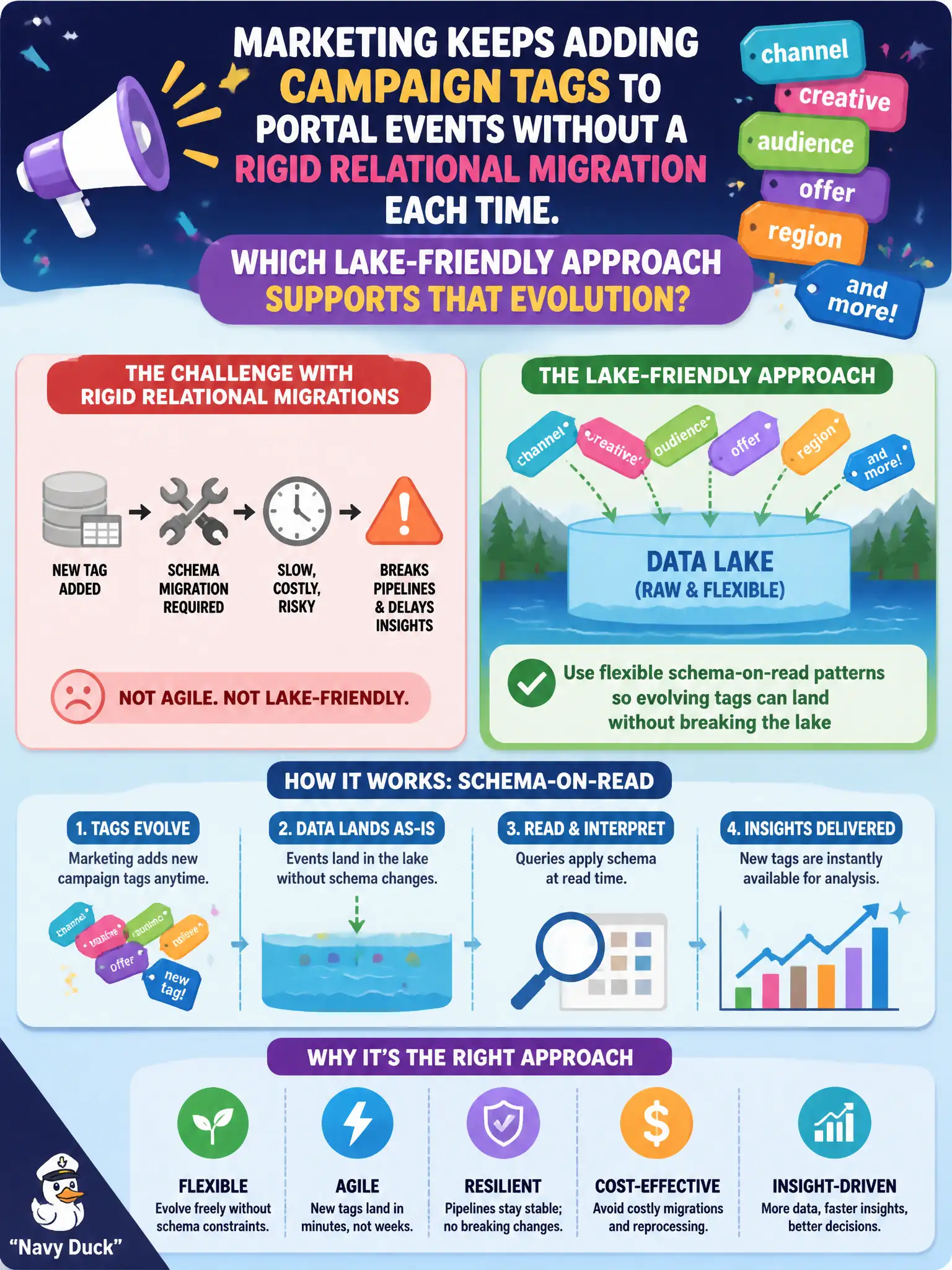
Marketing keeps adding campaign tags to portal events without a rigid relational migration each time. Which lake-friendly approach supports that evolution?
Select an answer to reveal the explanation.
Short Explanation
Campaign tags multiply like sticky notes on a fridge. Schema-on-read lets new fields show up in the lake without smashing yesterday’s data. Flexible event payloads keep marketing agile while engineers still query what matters.
Full Explanation
Flexible schema-on-read patterns let evolving campaign tags land in the lake without a months-long relational lockstep redesign each time marketing adds parameters. Lake-friendly evolution keeps civic web analytics agile while historical events remain queryable. That approach connects Cap. 10 tagging realities to earlier schema-on-read teaching in BDPC.
Rejecting any new tag until a warehouse lockstep redesign finishes stalls campaign learning across seasons. Storing campaign tags only on hallway sticky notes outside the analytics platform loses evidence. Wiping historical events whenever a new UTM-style parameter appears destroys trend lines municipalities need for accountability and year-over-year comparison.
Exam caveat: schema-on-read still needs governance—unbounded tag chaos creates unusable variety; publish allowed tag namespaces and validate at collection when possible. Operational check: add a new approved campaign parameter on staging, confirm events land without pipeline failure, and query both old and new events successfully under schema-on-read. Document the verified decision in the municipal architecture runbook so future on-call and audit staff inherit the same standard. Document the verified decision in the municipal architecture runbook so future on-call and audit staff inherit the same standard.