
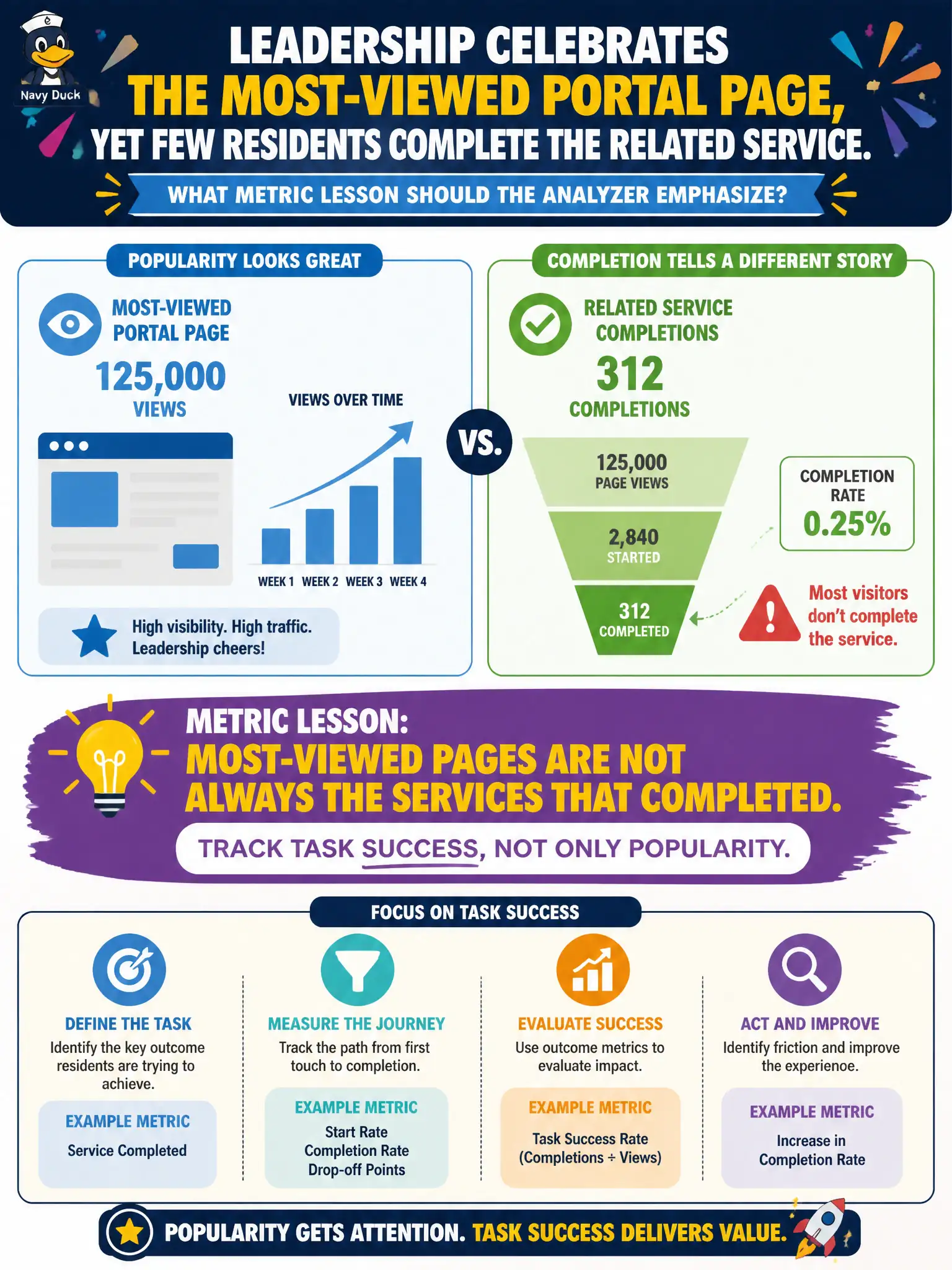
Leadership celebrates the most-viewed portal page, yet few residents complete the related service. What metric lesson should the analyzer emphasize?
Select an answer to reveal the explanation.
Short Explanation
A crowded hallway is not the same as a finished errand. Top pages can be confusion magnets while quiet flows actually complete renewals. Pair popularity with task-success metrics so civic teams chase outcomes, not applause meters.
Full Explanation
Most-viewed pages are not always the services that completed; analyzers should track task success, not only popularity. Crowded confusion pages can dominate rankings while quieter flows actually finish renewals or applications. Cap. 10 metric literacy steers civic teams toward outcomes residents care about rather than applause meters alone.
Page-view rank alone does not prove which municipal service delivered citizen outcomes. Task completion metrics are not irrelevant merely because a page appears in a top-ten list. Deleting funnel and completion events whenever a page becomes popular destroys the evidence needed to interpret that popularity honestly for program owners.
Exam caveat: task success definitions must be agreed with service owners—soft goals like “visited FAQ” differ from hard completions like “permit submitted.” Operational check: place a popular informational page beside a lower-traffic completion funnel on one dashboard and confirm product prioritization uses both popularity and completion, not page-views alone. Document the verified decision in the municipal architecture runbook so future on-call and audit staff inherit the same standard. Document the verified decision in the municipal architecture runbook so future on-call and audit staff inherit the same standard.