
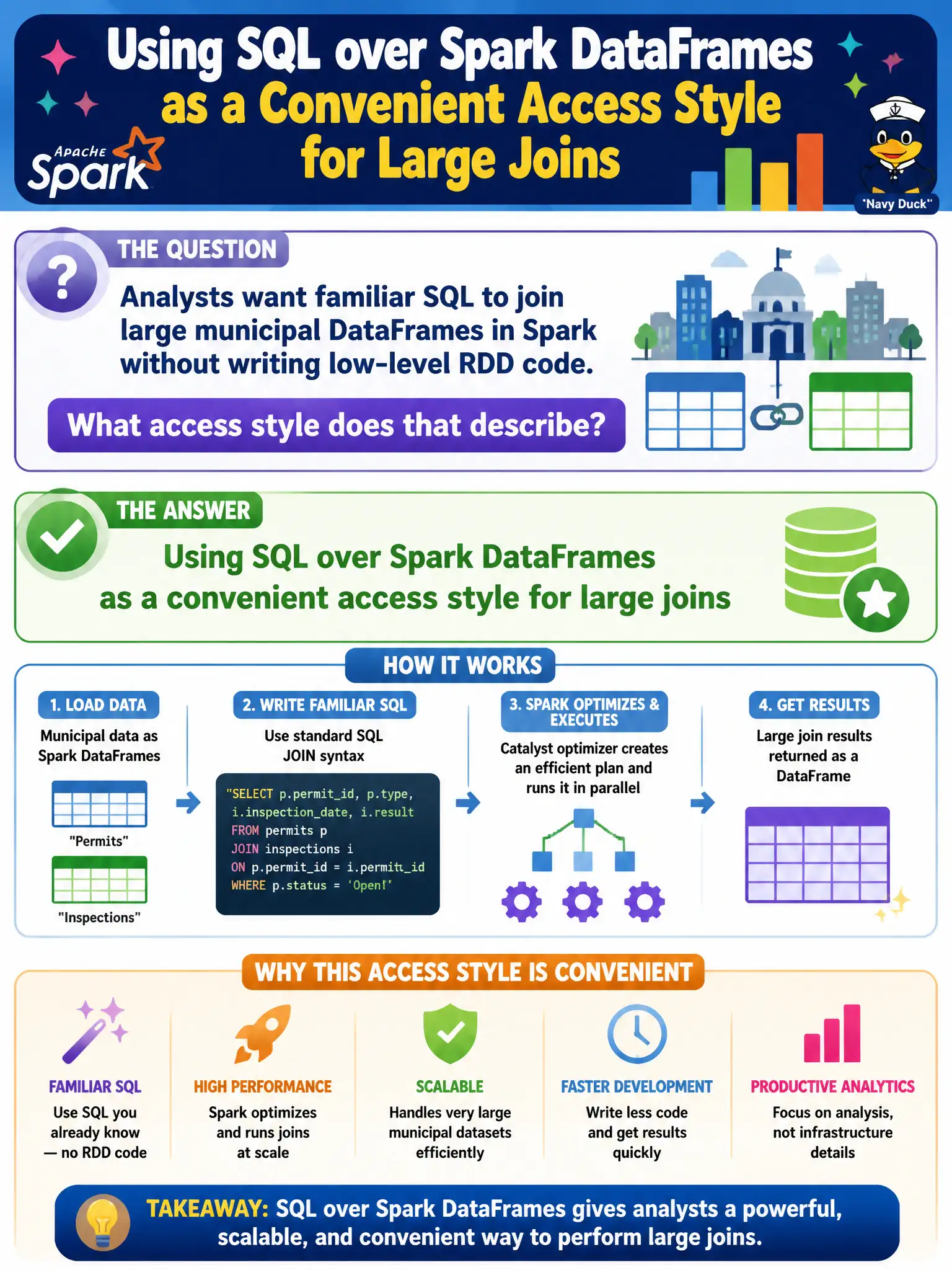
Analysts want familiar SQL to join large municipal DataFrames in Spark without writing low-level RDD code. What access style does that describe?
Select an answer to reveal the explanation.
Short Explanation
Analysts already speak SQL. Spark SQL lets them ask big-table questions in that language while Spark handles the heavy lifting underneath. It is like ordering dinner in plain English while the kitchen runs industrial gear.
Full Explanation
Analysts wanting familiar SQL to join large municipal DataFrames in Spark without writing low-level RDD code are using SQL over Spark DataFrames as a convenient access style for large joins. That style improves productivity while still executing distributed plans. Insisting only handwritten MapReduce Java is allowed for any Spark join ignores Spark SQL/DataFrame APIs. Banning SQL because Spark cannot express relational operations is false. Requiring every join to run inside a desktop spreadsheet instead abandons cluster scale. Exam caveat: Spark SQL still needs partition-aware join strategies; familiar SQL syntax does not remove shuffle cost on huge civic tables. Operational check: express the municipal join in Spark SQL, review the physical plan for broadcast versus shuffled hash joins, and validate row counts against a trusted sample before promoting to production. In production terms for Spark SQL over DataFrames, assign an owning team, wire a dashboard that shows the pattern is healthy under peak civic load, and require a staging drill that rehearses failure and recovery before resident impact. Revisit the choice when traffic shape, retention, or integrity needs change, and keep a named rollback owner on the change record. Re-test both the happy path and the failure path for Spark SQL over DataFrames after material dependency upgrades so regressions are caught before the next public release.