
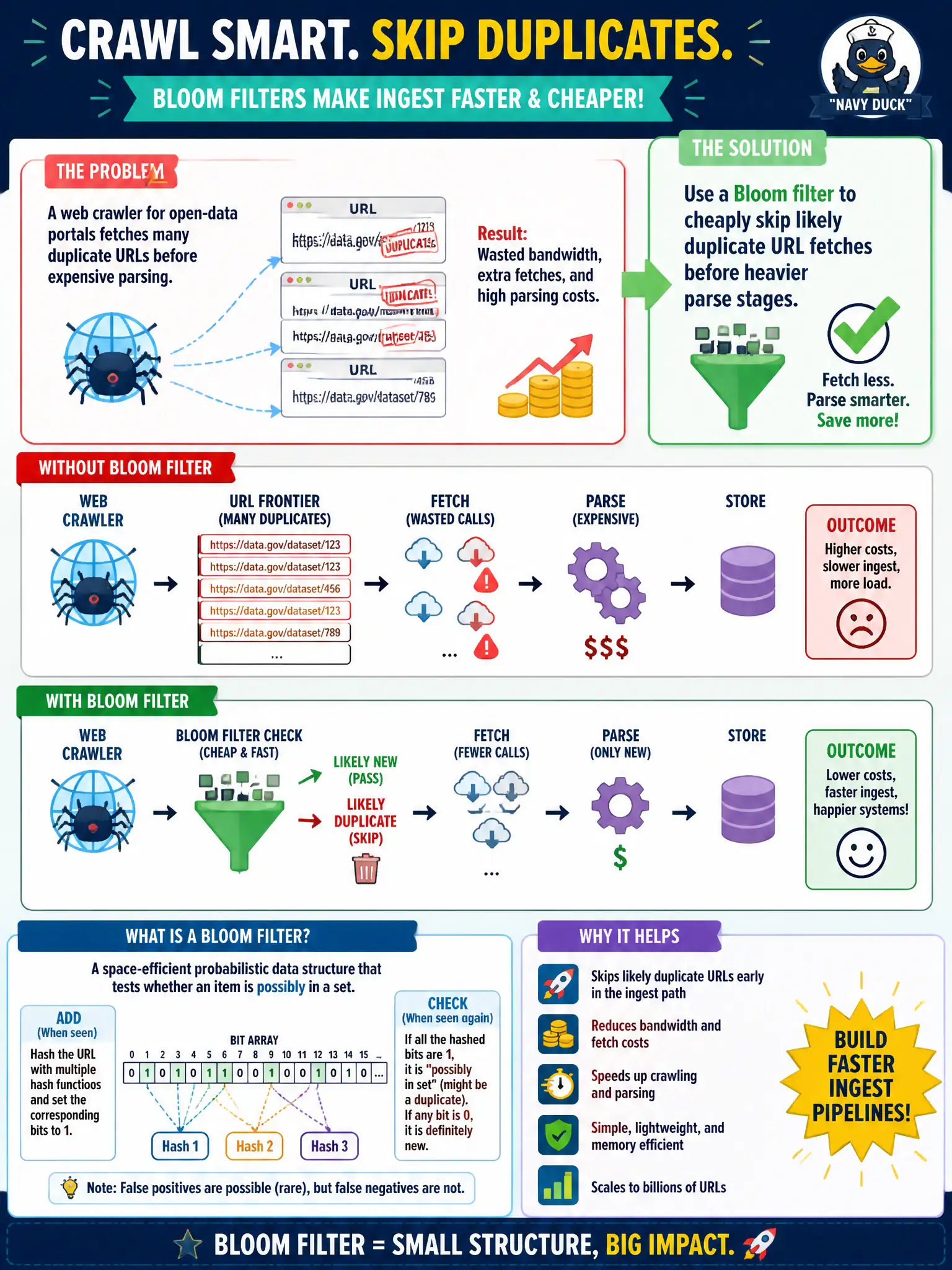
A web crawler for open-data portals fetches many duplicate URLs before expensive parsing. What lightweight structure can help dedupe early in the ingest path?
Select an answer to reveal the explanation.
Short Explanation
A Bloom filter is like a quick doorman who says we already saw that guest without digging through the whole guest book. You skip obvious repeats before the expensive kitchen work of parsing.
Full Explanation
A web crawler for open-data portals that sees many duplicate URLs before expensive parsing can use a Bloom filter to cheaply skip likely duplicate fetches early in the ingest path, saving bandwidth and CPU. Full relational joins on every URL against a multi-year warehouse before each fetch are too heavy for high-rate crawl loops. Printing each URL on paper and sorting by hand nightly cannot keep up. Disabling all deduplication so every duplicate is parsed twice wastes capacity. Exam caveat: Bloom false positives may skip a URL that was not actually fetched—accept that risk or confirm positives against an exact cache when completeness is critical. Operational check: enable a Bloom filter on the crawler, measure fetch reduction and false-positive skips on a sample portal list, and tune bit size to the daily unique URL estimate. In production terms for Bloom dedupe on open-data crawls, assign an owning team, wire a dashboard that shows the pattern is healthy under peak civic load, and require a staging drill that rehearses failure and recovery before resident impact. Revisit the choice when traffic shape, retention, or integrity needs change, and keep a named rollback owner on the change record. Re-test both the happy path and the failure path for Bloom dedupe on open-data crawls after material dependency upgrades so regressions are caught before the next public release.