
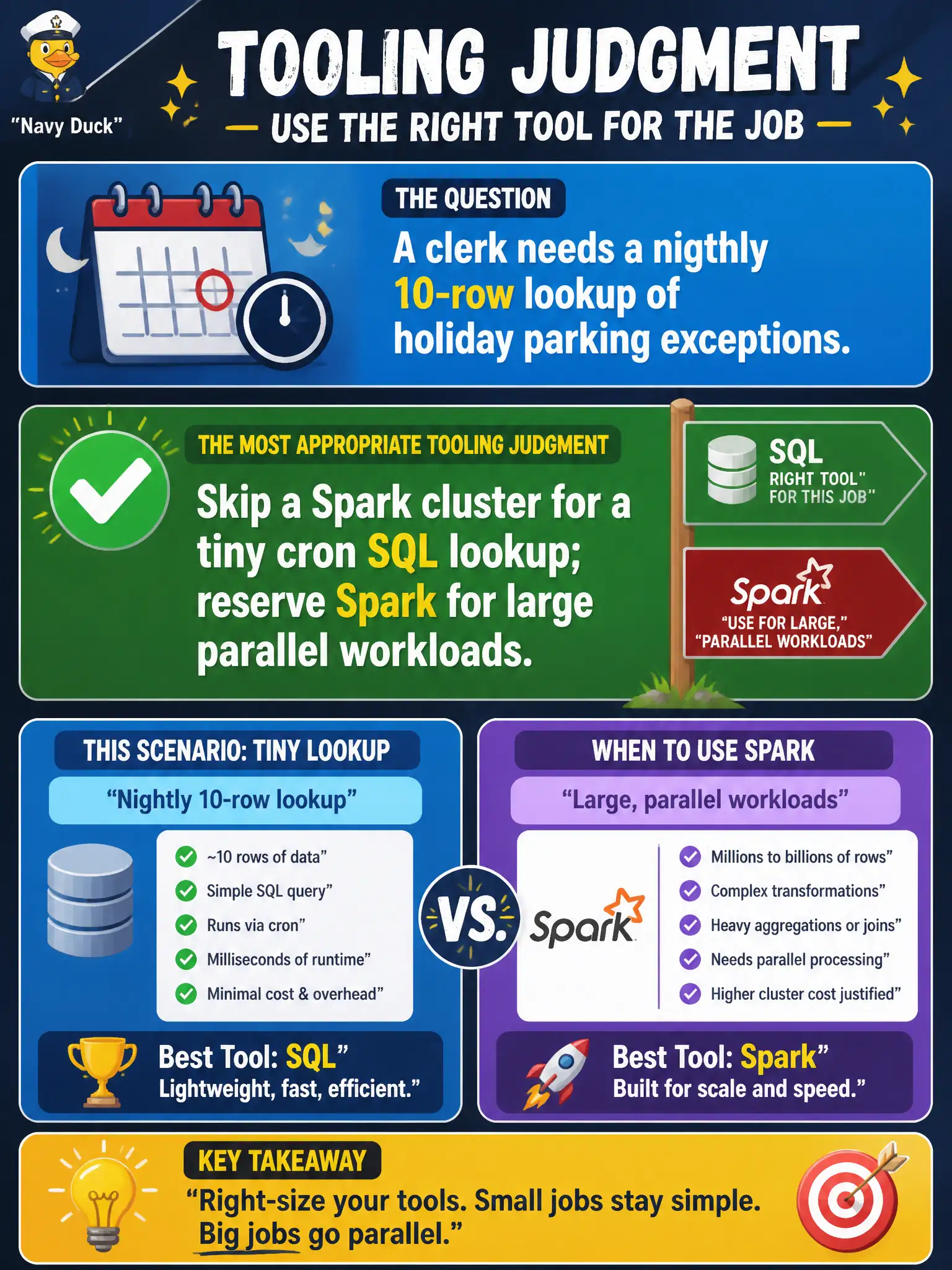
A clerk needs a nightly 10-row lookup of holiday parking exceptions. What is the most appropriate tooling judgment?
Select an answer to reveal the explanation.
Short Explanation
You do not call the fire department to change a light bulb. A ten-row holiday list is a small cron SQL job, not a reason to spin up a Spark cluster.
Full Explanation
A nightly 10-row lookup of holiday parking exceptions does not justify allocating a full Spark cluster; reserve Spark for large parallel workloads and use ordinary SQL or a small scheduled query for tiny lookups. Always allocating a full Spark cluster for every municipal SQL task wastes cost and operational attention. Requiring HDFS replication before any ten-row query can run confuses durability policy with query engine choice. Using Kafka partitions solely to store ten exception rows misuses an event log as a miniature database. Exam caveat: right-sizing tools is an exam and real-world skill—Big Data engines are for volume/velocity that needs them. Operational check: time the exception lookup on a lightweight SQL path, compare cost to a Spark job spin-up, and document that Spark is reserved for jobs above an agreed data-volume threshold. In production terms for right-sizing away from Spark for tiny lookups, assign an owning team, wire a dashboard that shows the pattern is healthy under peak civic load, and require a staging drill that rehearses failure and recovery before resident impact. Revisit the choice when traffic shape, retention, or integrity needs change, and keep a named rollback owner on the change record. Re-test both the happy path and the failure path for right-sizing away from Spark for tiny lookups after material dependency upgrades so regressions are caught before the next public release.