
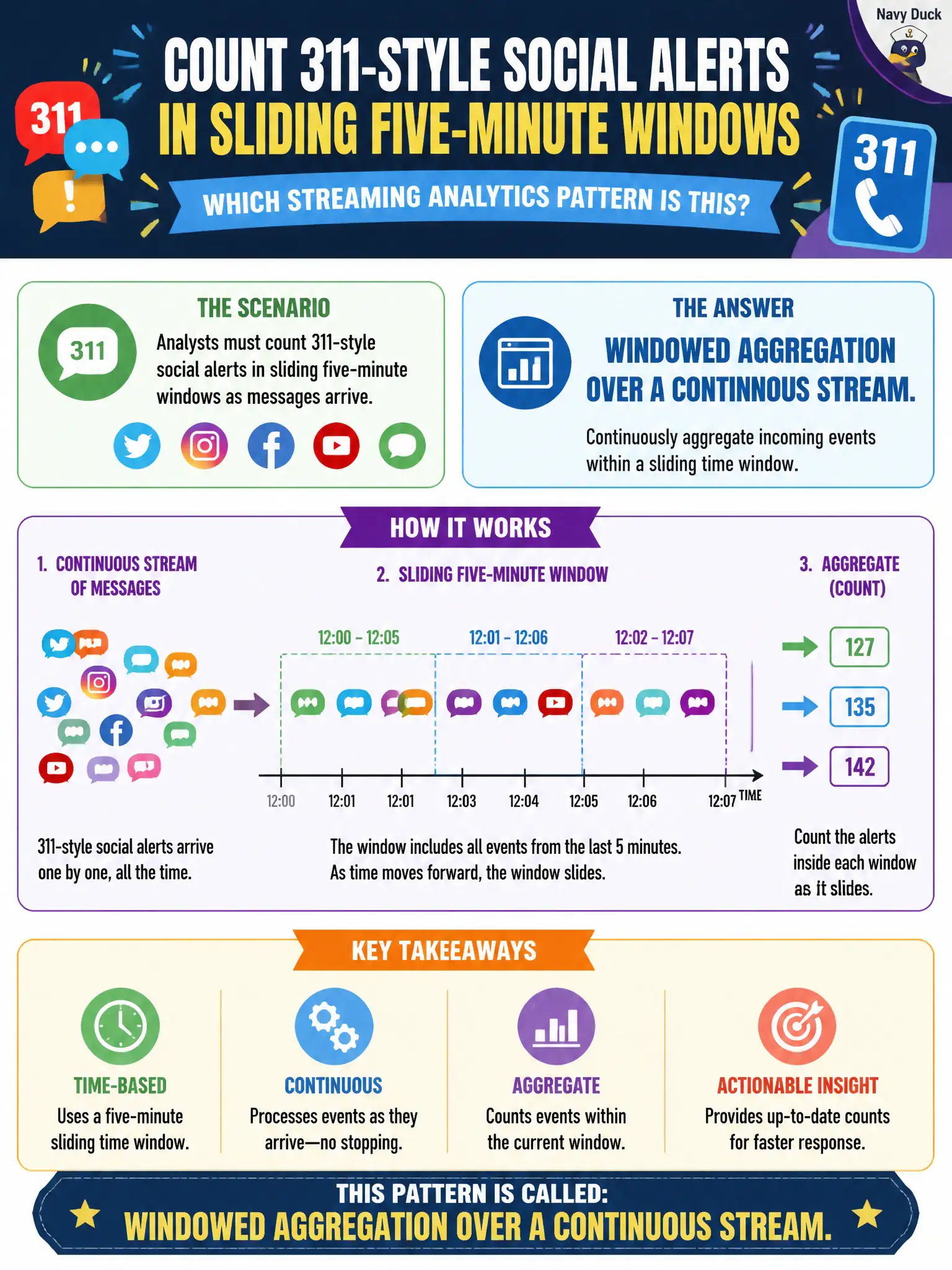
Analysts must count 311-style social alerts in sliding five-minute windows as messages arrive. Which streaming analytics pattern is this?
Select an answer to reveal the explanation.
Short Explanation
Five-minute sliding counts on live 311-style alerts are windowed aggregation—tally what showed up in each moving time box. A once-a-year total or a frozen PDF is not that pattern.
Full Explanation
Counting 311-style social alerts in sliding five-minute windows as messages arrive is windowed aggregation over a continuous stream: events are grouped by time windows and aggregated while the feed continues. That pattern powers near-real-time civic situation awareness. A one-shot yearly total with no time windows is batch summarization, not sliding-window streaming. Schema registry deletion as the only metric is unrelated to counting alerts. Static PDF publication that never refreshes counts cannot reflect arriving messages. Exam caveat: define window type (tumbling vs sliding), watermarking, and late-data policy so delayed 311 posts do not silently vanish or double-count. Operational check: produce test alerts with known timestamps, advance event time across window boundaries, and verify counts match expectations for overlapping five-minute slides including a late event under the chosen policy. In production terms for sliding-window stream aggregations, assign an owning team, wire a dashboard that shows the pattern is healthy under peak civic load, and require a staging drill that rehearses failure and recovery before resident impact. Revisit the choice when traffic shape, retention, or integrity needs change, and keep a named rollback owner on the change record. Re-test both the happy path and the failure path for sliding-window stream aggregations after material dependency upgrades so regressions are caught before the next public release.