
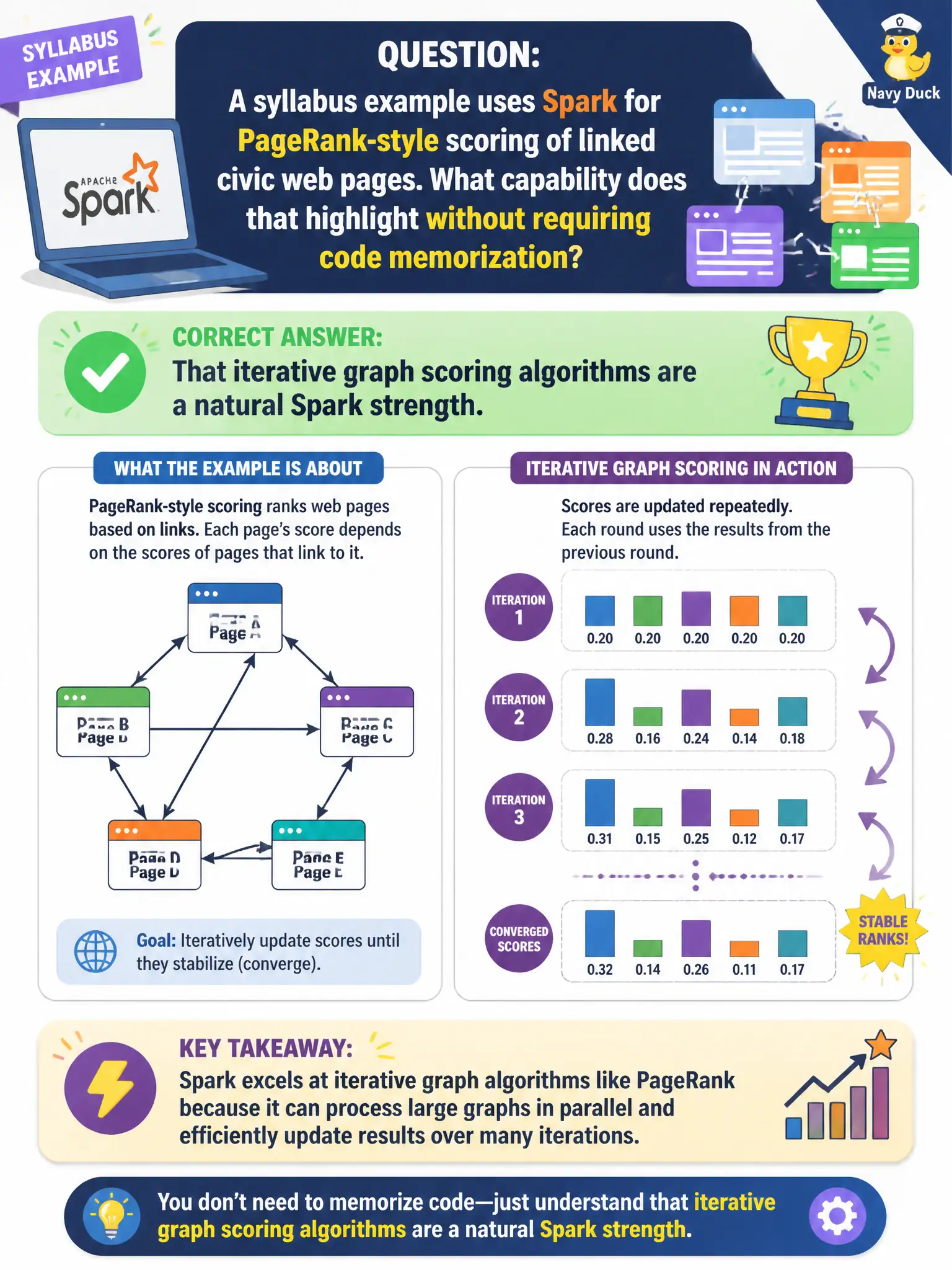
A syllabus example uses Spark for PageRank-style scoring of linked civic web pages. What capability does that highlight without requiring code memorization?
Select an answer to reveal the explanation.
Short Explanation
PageRank-style scoring is the “keep refining the rankings” workout—and Spark is built to sweat those iterative loops. You do not need to memorize the sample code; remember that iteration on graphs is a Spark sweet spot. COBOL-on-tape-only rules are not the lesson.
Full Explanation
Using Spark for PageRank-style scoring of linked civic web pages highlights that iterative graph scoring algorithms are a natural Spark strength, without requiring candidates to memorize code. Repeated passes over linked structures benefit from Spark’s iterative, in-memory-friendly model. Claiming Spark cannot run more than one map step ever is false. Saying graph scores must be computed only in nightly COBOL on tape is an anachronistic false constraint. Asserting RDDs forbid any iterative algorithm by design contradicts a primary teaching motivation for Spark over classic MapReduce. Exam caveat: iterative graph jobs still need careful checkpointing and memory planning on large municipal link graphs. Operational check: run a small PageRank-style scoring job on a sample of linked open-data pages, verify multiple iterations complete faster with caching than with full disk rematerialization each round, and record resource use for capacity planning. In production terms for iterative graph scoring on Spark, assign an owning team, wire a dashboard that shows the pattern is healthy under peak civic load, and require a staging drill that rehearses failure and recovery before resident impact. Revisit the choice when traffic shape, retention, or integrity needs change, and keep a named rollback owner on the change record. Re-test both the happy path and the failure path for iterative graph scoring on Spark after material dependency upgrades so regressions are caught before the next public release.