
Duplicate curb-sensor events could inflate occupancy counts if the streaming job treats every delivery as unique. What concern does that raise?
Select an answer to reveal the explanation.
Short Explanation
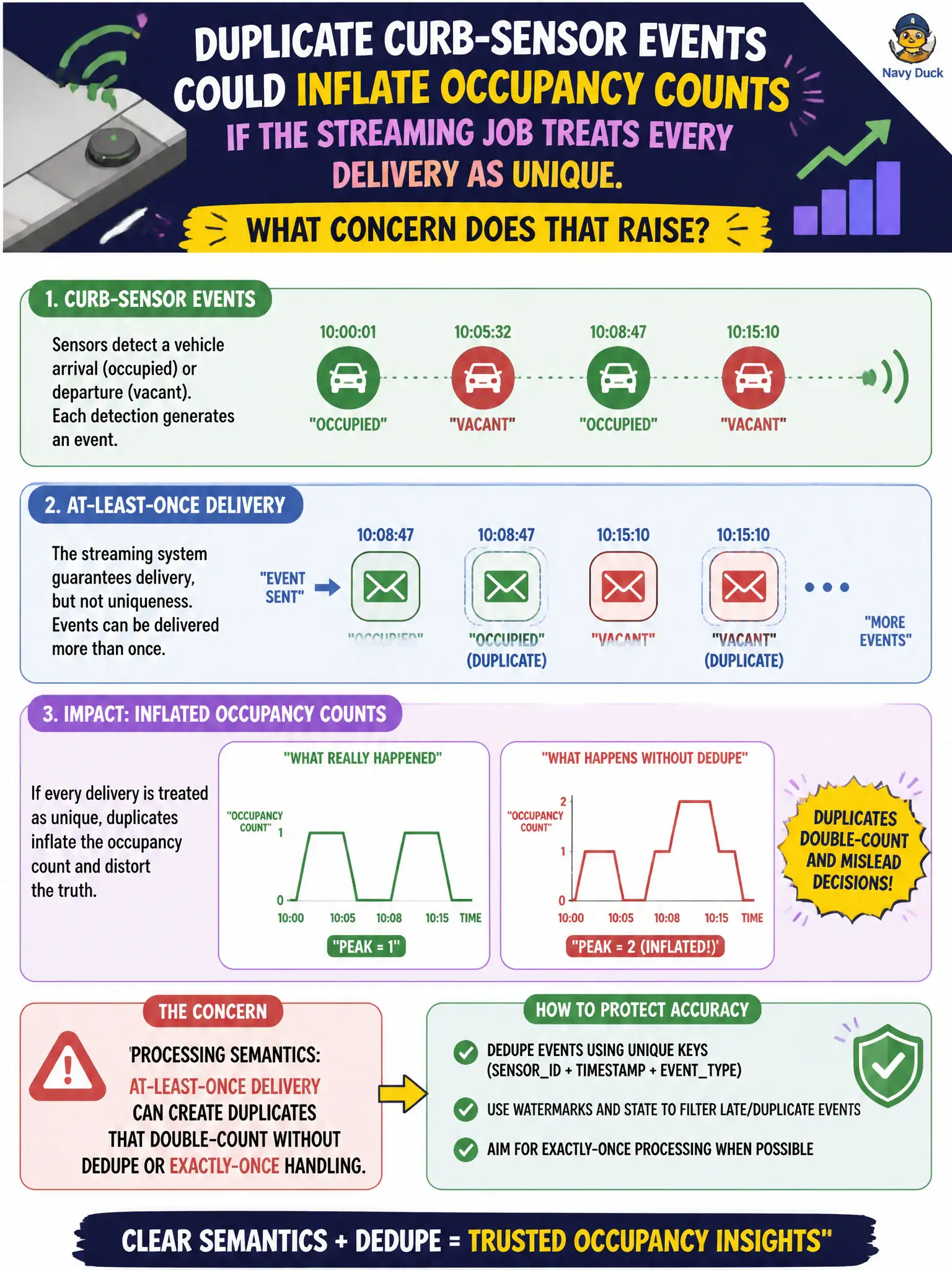
If the pipe can hand you the same curb ping twice, naïve counting throws a party for ghosts. That is the at-least-once versus exactly-once conversation—dedupe or stronger semantics keep occupancy honest. Voltage-versus-block-size myths are a distraction.
Full Explanation
Duplicate curb-sensor events that could inflate occupancy counts raise processing-semantics concerns: at-least-once delivery can create duplicates that double-count without idempotent dedupe or exactly-once handling. Streaming jobs must plan for replay and retry. Saying HDFS block size must equal sensor voltage is a nonsensical pairing of unrelated concepts. Claiming Kafka topics cannot exist in any city network is false. Asserting Spark drivers refuse all numeric counters by design is incorrect. Exam caveat: “exactly-once” is end-to-end—source, compute, and sink must cooperate; claiming the engine logo alone guarantees correct occupancy is risky. Operational check: replay a curb-sensor segment with intentional duplicates, confirm raw counts inflate, then enable dedupe keys or transactional sinks and re-verify occupancy metrics match the physical ground truth sample. In production terms for at-least-once duplicates and idempotent sinks, assign an owning team, wire a dashboard that shows the pattern is healthy under peak civic load, and require a staging drill that rehearses failure and recovery before resident impact. Revisit the choice when traffic shape, retention, or integrity needs change, and keep a named rollback owner on the change record. Re-test both the happy path and the failure path for at-least-once duplicates and idempotent sinks after material dependency upgrades so regressions are caught before the next public release.