
A Spark job on neighborhood sensor partitions runs as pipelined work across the cluster. How is that execution commonly described at a high level?
Select an answer to reveal the explanation.
Short Explanation
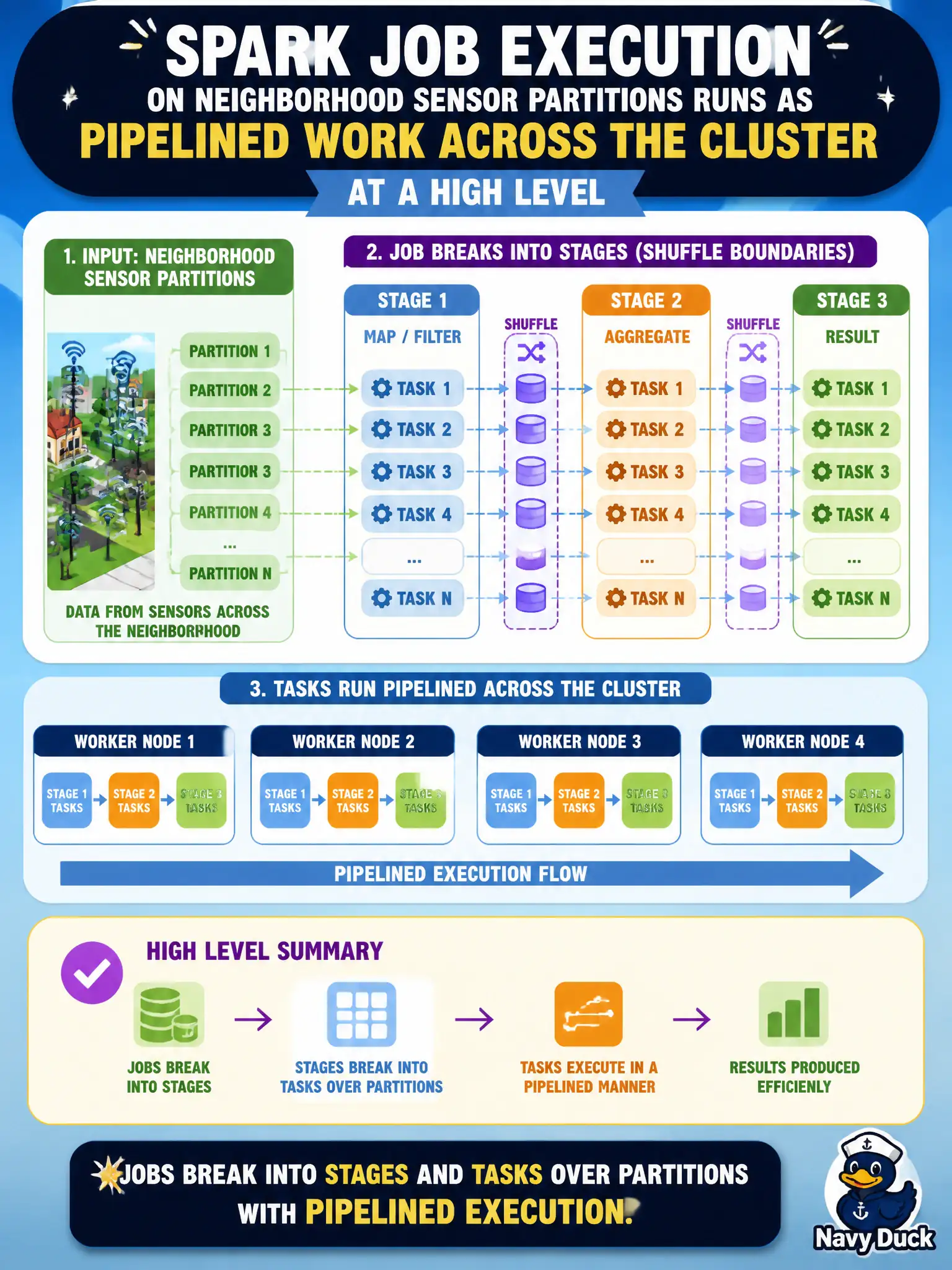
Spark chops a job into stages, then tasks that chew partitions—like a relay with lanes. It is not one lonely loop on a laptop or NameNode gossip alone. Pipeline the stages and the cluster earns its keep.
Full Explanation
At a high level, a Spark job on neighborhood sensor partitions runs as pipelined work broken into stages and tasks over partitions across the cluster. Shuffle boundaries define stages; tasks execute on partitions. One single-threaded loop on the mayor’s laptop with no tasks is not cluster execution. Random SQL cursors that ignore partitioning entirely miss how Spark parallelizes. Only NameNode block reports with no executor tasks describe HDFS metadata activity, not Spark task execution. Exam caveat: skewed partitions create straggler tasks—monitor stage skew on civic datasets with uneven neighborhood event density. Operational check: open the Spark UI for a sensor job, identify stages and tasks, and confirm partition counts align with expected parallelism; remediate any single task that dominates stage time. In production terms for stages and tasks over partitions, assign an owning team, wire a dashboard that shows the pattern is healthy under peak civic load, and require a staging drill that rehearses failure and recovery before resident impact. Revisit the choice when traffic shape, retention, or integrity needs change, and keep a named rollback owner on the change record. Re-test both the happy path and the failure path for stages and tasks over partitions after material dependency upgrades so regressions are caught before the next public release.