
Training material describes Resilient Distributed Datasets for a flood-sensor analytics job. What core idea should staff take away?
Select an answer to reveal the explanation.
Short Explanation
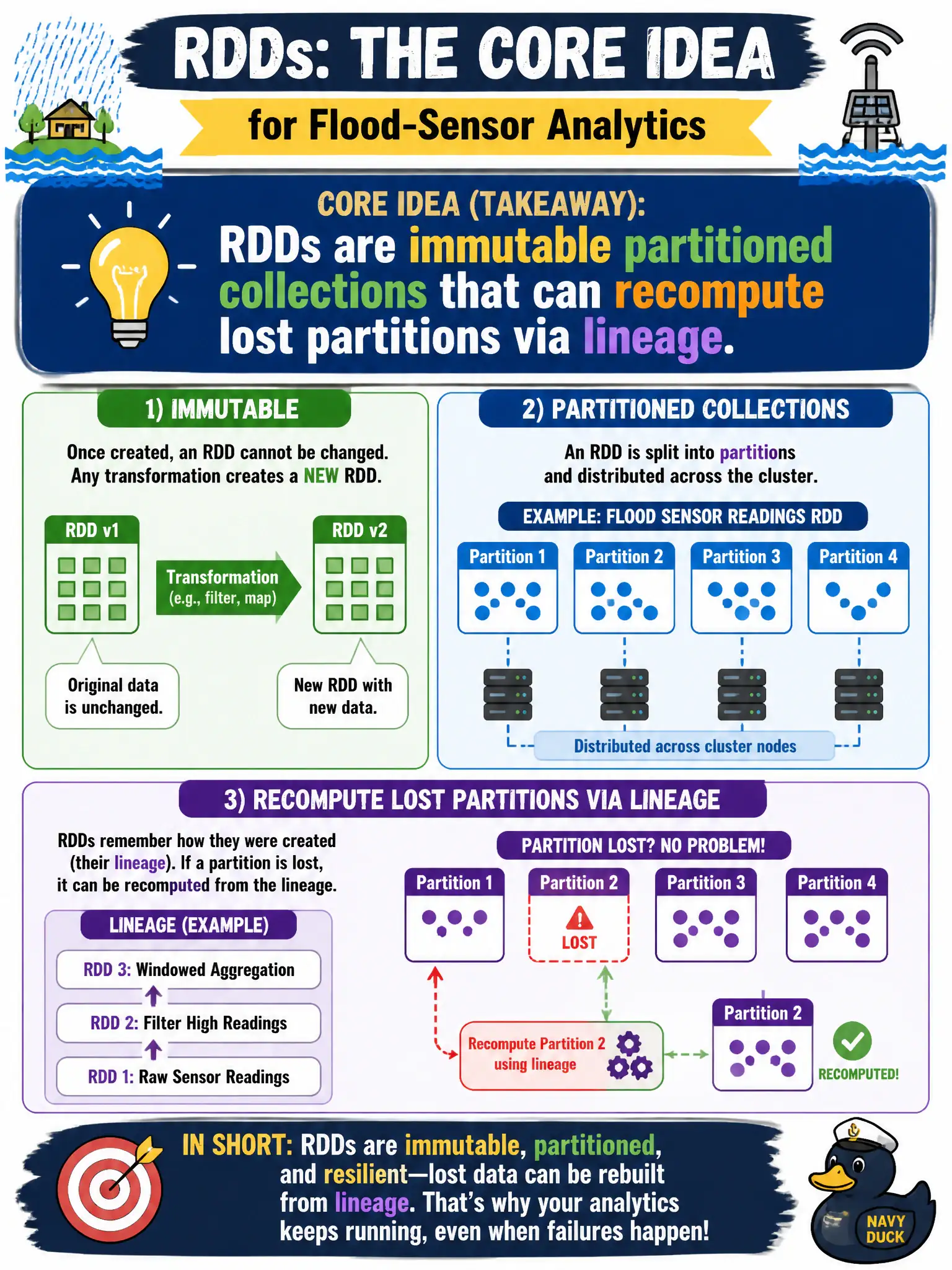
An RDD is like a sealed, sliced deck of data cards: you do not scribble on the cards in place, and if a slice vanishes, lineage tells Spark how to rebuild it. Mutable free-for-all rows and printed-only sheets miss that resilience story.
Full Explanation
Resilient Distributed Datasets (RDDs) are immutable partitioned collections that can recompute lost partitions via lineage—the core resilience idea staff should take from flood-sensor training material. Immutability plus lineage enables recovery without mutable shared rows. Describing RDDs as mutable shared rows updated in place by every concurrent writer contradicts the model. Saying RDDs exist only as printed spreadsheets outside the cluster is absurd relative to distributed runtime collections. Claiming RDDs replace CAP theorem and remove the need for any storage layer confuses an in-cluster abstraction with consistency theory and durable storage. Exam caveat: modern APIs emphasize DataFrames, but lineage/resilience concepts still matter when explaining fault recovery. Operational check: kill an executor during a flood-sensor RDD/DataFrame job and verify partitions recompute from lineage or checkpoint rather than permanently losing that sensor slice. In production terms for RDD immutability and lineage, assign an owning team, wire a dashboard that shows the pattern is healthy under peak civic load, and require a staging drill that rehearses failure and recovery before resident impact. Revisit the choice when traffic shape, retention, or integrity needs change, and keep a named rollback owner on the change record. Re-test both the happy path and the failure path for RDD immutability and lineage after material dependency upgrades so regressions are caught before the next public release.