
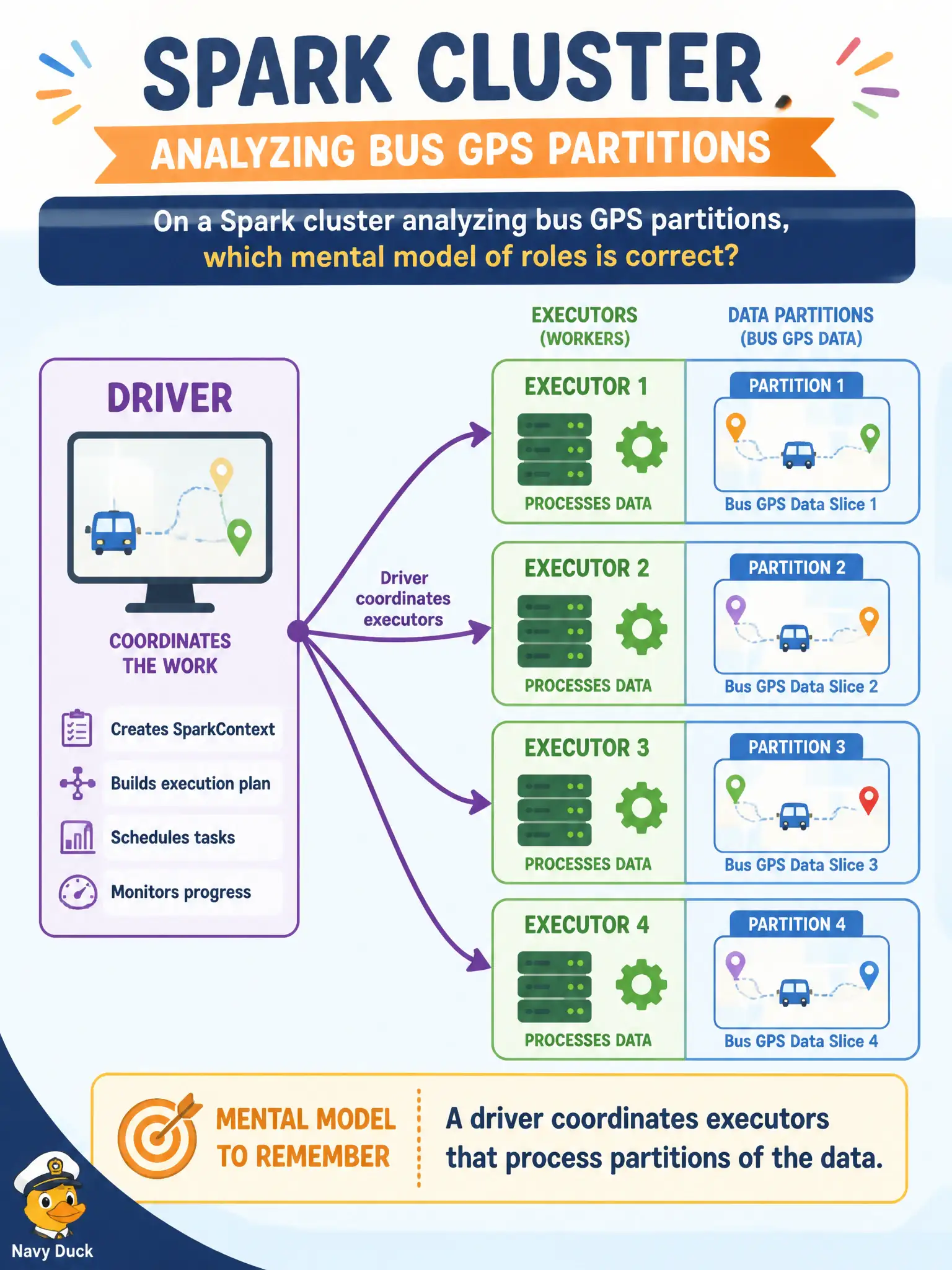
On a Spark cluster analyzing bus GPS partitions, which mental model of roles is correct?
Select an answer to reveal the explanation.
Short Explanation
Picture a conductor and the players: the Spark driver coordinates, and executors work the partitions. Executors do not invent the whole app alone, and partitions do not magically run with zero processes. That driver/executor sketch is the map to keep.
Full Explanation
On a Spark cluster analyzing bus GPS partitions, the correct mental model is that a driver coordinates executors that process partitions of the data. The driver orchestrates the application; executors run tasks on partitions. Claiming every executor independently invents the application without a driver drops the control plane. Saying the driver only prints banners while executors ignore assigned partitions trivializes scheduling. Asserting partitions process themselves with no JVM processes involved denies the runtime model taught in syllabi. Exam caveat: driver failure fails the app; executor loss can often be retried—design cluster sizing and checkpointing accordingly for civic jobs. Operational check: in the Spark UI for a bus GPS job, identify the driver, executor list, and tasks per partition, and confirm lost executor tasks are rescheduled without silently dropping an entire district’s data. In production terms for Spark driver and executor roles, assign an owning team, wire a dashboard that shows the pattern is healthy under peak civic load, and require a staging drill that rehearses failure and recovery before resident impact. Revisit the choice when traffic shape, retention, or integrity needs change, and keep a named rollback owner on the change record. Re-test both the happy path and the failure path for Spark driver and executor roles after material dependency upgrades so regressions are caught before the next public release.