
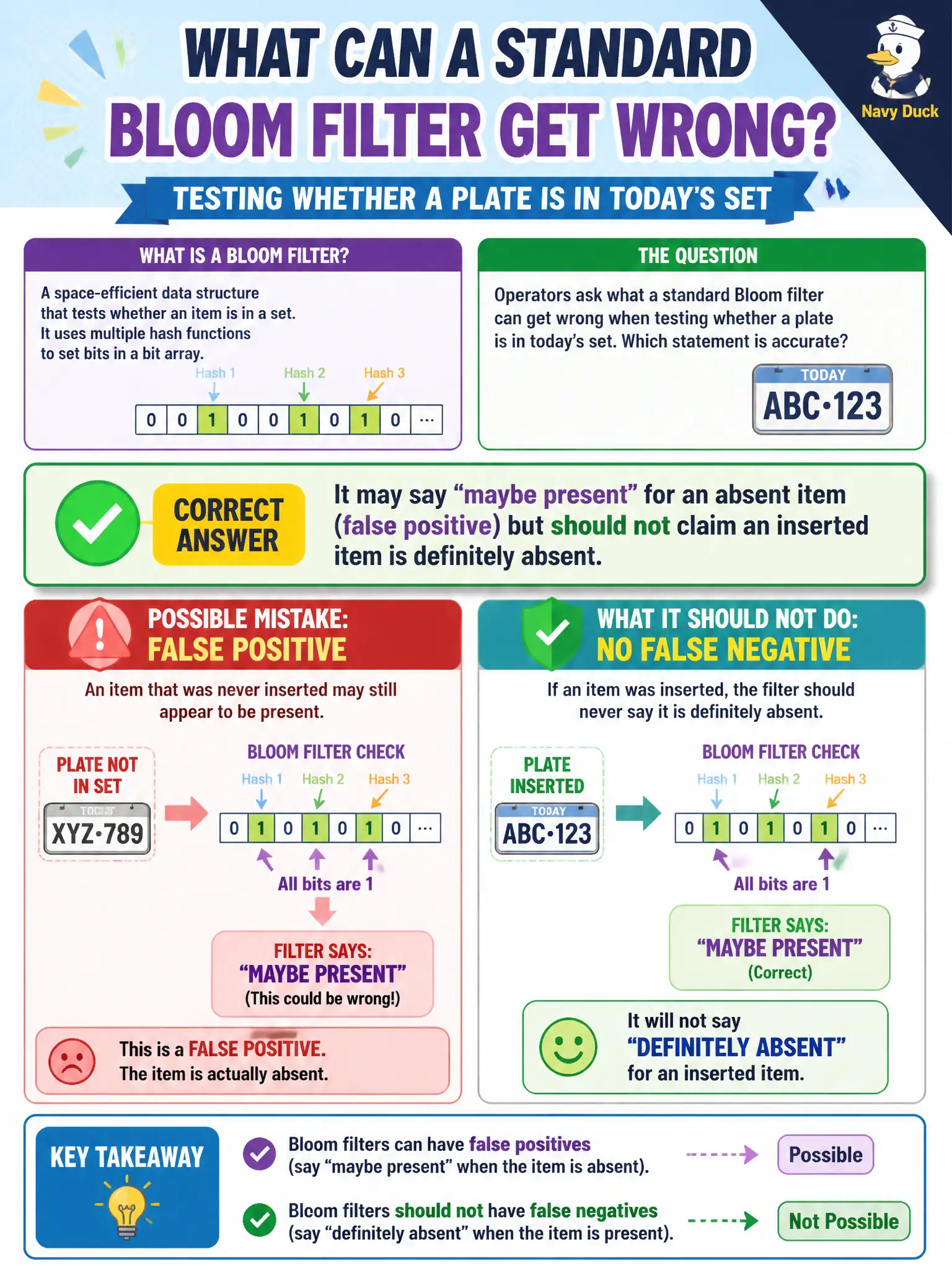
Operators ask what a standard Bloom filter can get wrong when testing whether a plate is in today’s set. Which statement is accurate?
Select an answer to reveal the explanation.
Short Explanation
Standard Bloom filters can cry wolf—“maybe it’s here”—for something that never arrived. What they should not do is swear an inserted plate is gone. Exact crypto answers and full-string storage are not how classic Bloom filters work.
Full Explanation
A standard Bloom filter may report a false positive—“maybe present”—for an item that was never inserted, but it should not claim that an inserted item is definitely absent (no false negatives in the classic construction). That asymmetric error model is what operators must remember for plate checks. Claiming it never errs, or that every answer is cryptographically exact, overstates the structure. Saying it may return false negatives for inserted items reverses the standard guarantee. Asserting it always stores the full plate string so false answers are impossible confuses Bloom filters with exact sets and defeats the memory savings. Exam caveat: if false positives are operationally costly (for example wrongful stops), follow positive Bloom results with an exact lookup or tighten parameters. Operational check: insert a known plate set, query inserted and never-seen plates, confirm inserted plates never return definite absence, and measure the observed false-positive rate against the design target. In production terms for Bloom false-positive asymmetry, assign an owning team, wire a dashboard that shows the pattern is healthy under peak civic load, and require a staging drill that rehearses failure and recovery before resident impact. Revisit the choice when traffic shape, retention, or integrity needs change, and keep a named rollback owner on the change record. Re-test both the happy path and the failure path for Bloom false-positive asymmetry after material dependency upgrades so regressions are caught before the next public release.