
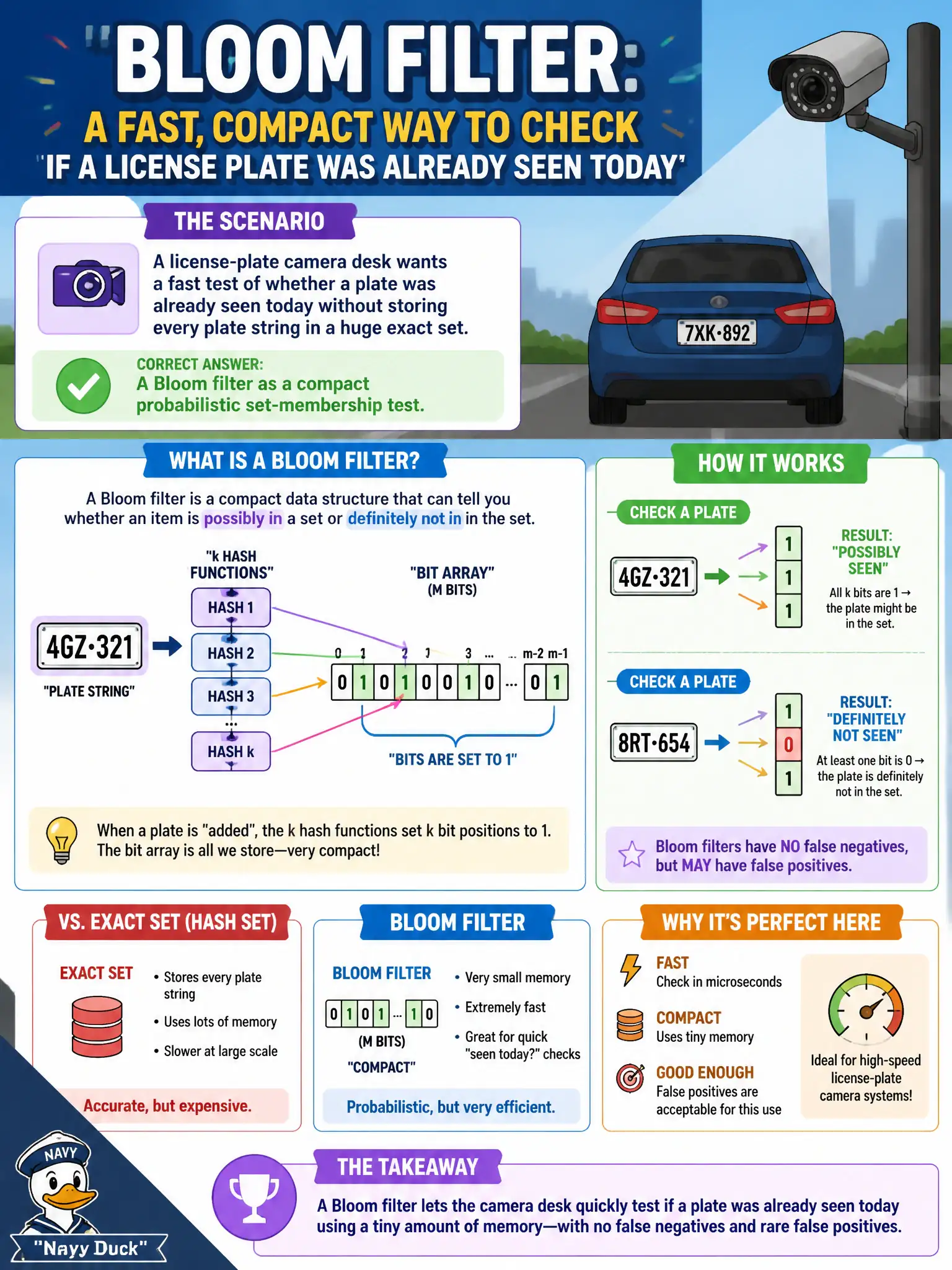
A license-plate camera desk wants a fast test of whether a plate was already seen today without storing every plate string in a huge exact set. Which structure fits?
Select an answer to reveal the explanation.
Short Explanation
Need a quick “have we seen this plate today?” without hauling a giant exact list? A Bloom filter is the pocket-sized maybe/no gadget for membership checks. Nightly full outer joins and paper NameNode lists are not that tool.
Full Explanation
A fast test of whether a license plate was already seen today without storing every plate string in a huge exact set is the classic use of a Bloom filter: a compact probabilistic set-membership structure. It trades a controlled false-positive rate for memory efficiency on civic camera desks. A full outer join of every municipal RDBMS nightly before any check is far too heavy for per-sighting decisions. An HDFS NameNode checklist printed on paper is not an online membership structure. A mandatory CAP-unavailable flag that blocks all plate queries confuses consistency trade-offs with membership testing. Exam caveat: Bloom filters can say “maybe” for absent items; exact confirmation may still need a backing store when the filter returns positive. Operational check: size a Bloom filter for expected daily unique plates and target false-positive rate, insert morning sightings, and verify memory stays within the camera desk’s budget while negatives are skipped cheaply. In production terms for Bloom filters for plate membership, assign an owning team, wire a dashboard that shows the pattern is healthy under peak civic load, and require a staging drill that rehearses failure and recovery before resident impact. Revisit the choice when traffic shape, retention, or integrity needs change, and keep a named rollback owner on the change record. Re-test both the happy path and the failure path for Bloom filters for plate membership after material dependency upgrades so regressions are caught before the next public release.