
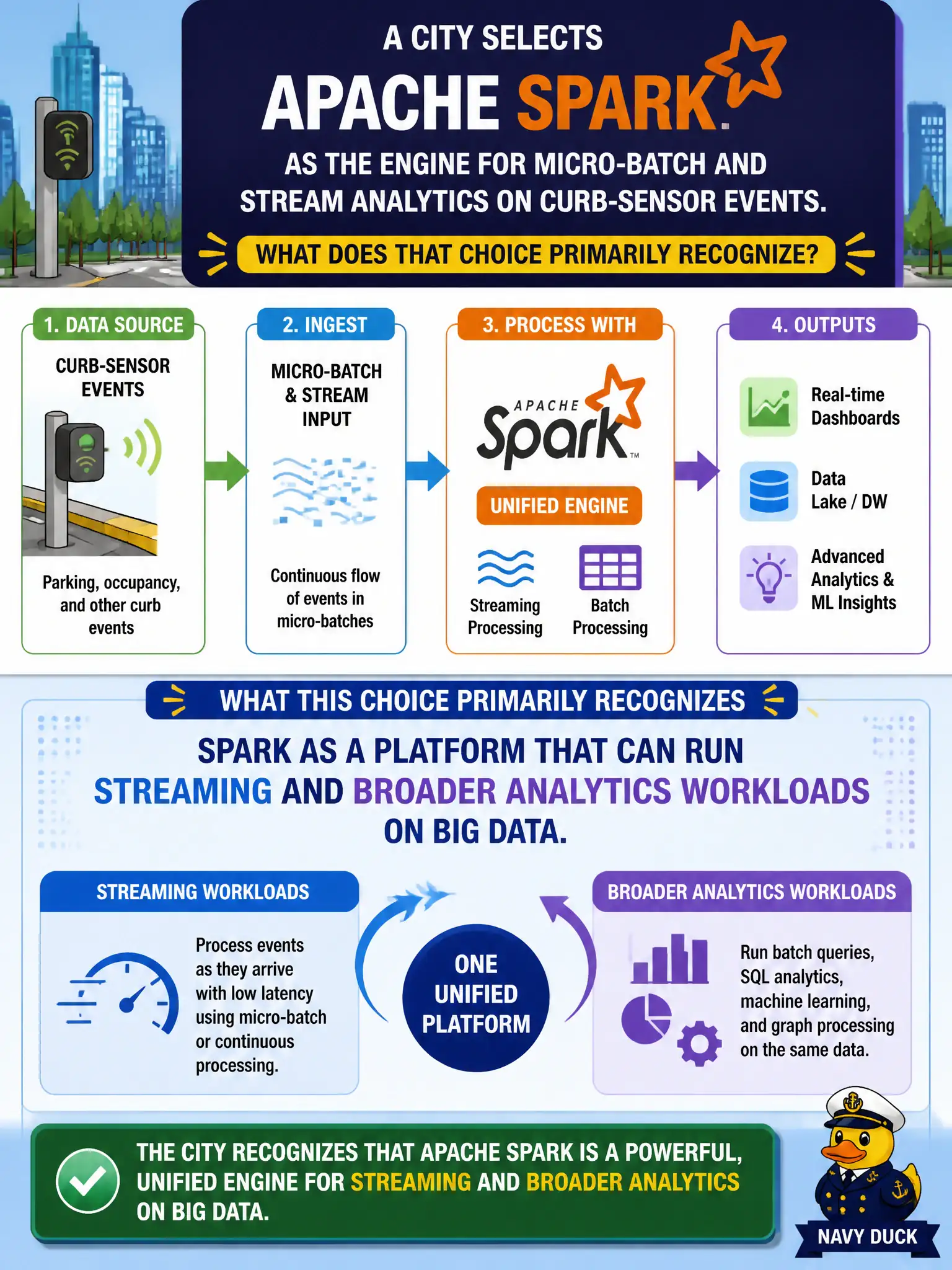
A city selects Apache Spark as the engine for micro-batch and stream analytics on curb-sensor events. What does that choice primarily recognize?
Select an answer to reveal the explanation.
Short Explanation
Picking Spark for curb-sensor streams means the city wants one engine that can chew live-ish micro-batches and related analytics. It is not the new home for every ledger or a paper-form toy. Think analytics platform, not CAP courtroom.
Full Explanation
Selecting Apache Spark for micro-batch and stream analytics on curb-sensor events primarily recognizes Spark as a platform that can run streaming and broader analytics workloads on Big Data—not as a universal replacement for every city system. It is a compute engine in the civic analytics stack. Treating Spark as a replacement for every relational ledger and CAD drawing vault overreaches far beyond analytics. Calling Spark only a paper form designer with no compute runtime is nonsense relative to its role. Framing Spark as a CAP proof that streams are illegal invents a non sequitur. Exam caveat: BDPC items emphasize Spark’s place among Hadoop/Kafka ecosystem tools and its strength for iterative and streaming analytics, not deep API memorization. Operational check: run a small curb-sensor streaming job on Spark in a lab cluster, confirm it consumes the live topic and writes aggregates, and document adjacent systems (HDFS/Kafka) it depends on rather than claiming Spark stands alone. In production terms for Spark as streaming/analytics platform, assign an owning team, wire a dashboard that shows the pattern is healthy under peak civic load, and require a staging drill that rehearses failure and recovery before resident impact. Revisit the choice when traffic shape, retention, or integrity needs change, and keep a named rollback owner on the change record. Re-test both the happy path and the failure path for Spark as streaming/analytics platform after material dependency upgrades so regressions are caught before the next public release.