
Street-sensor analytics must run with limited memory while seeing only one pass or a sliding window of events. What trait should streaming algorithms accept?
Select an answer to reveal the explanation.
Short Explanation
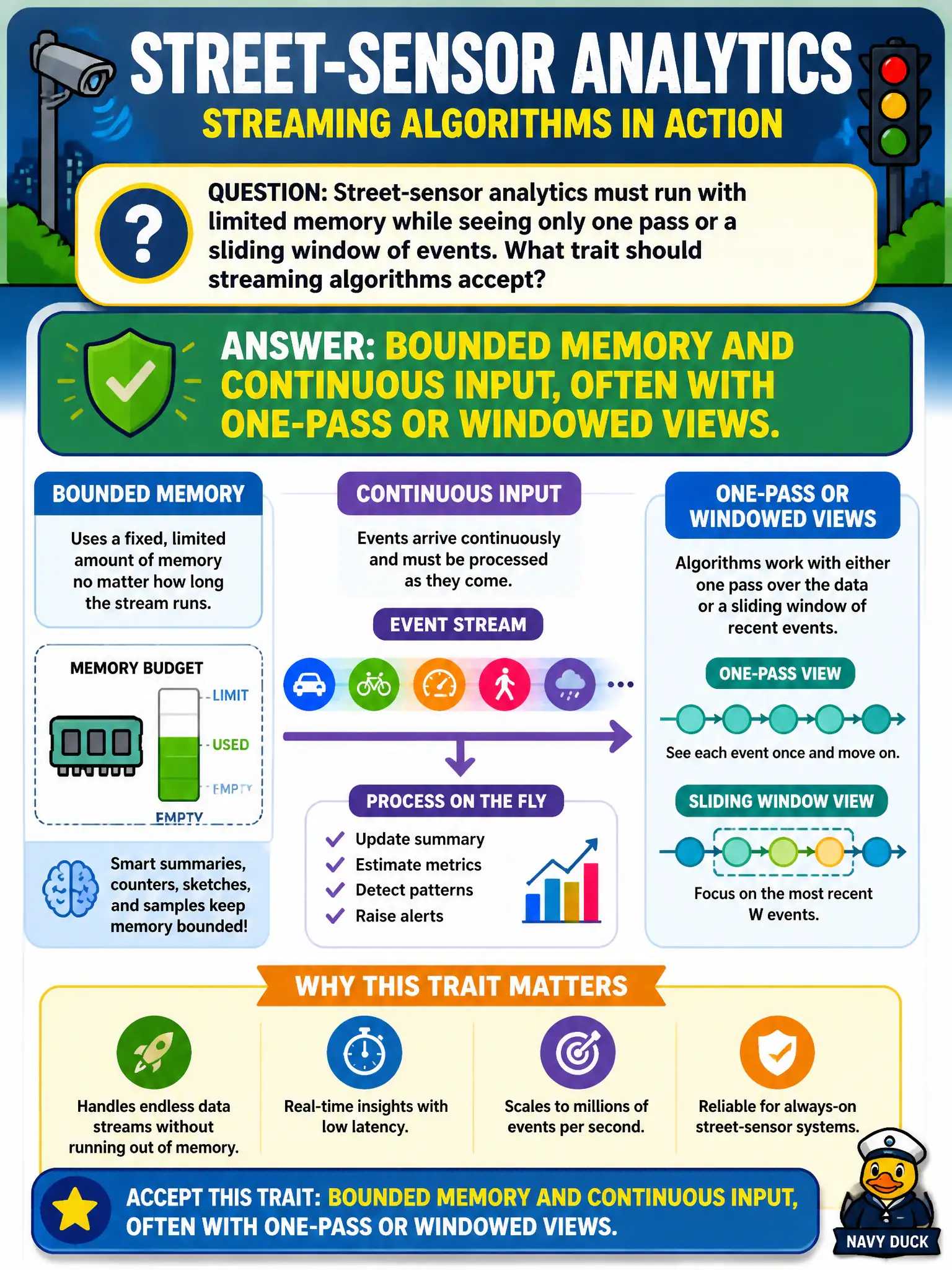
Streaming math travels light: limited RAM, events that will not wait for a second full tour. One pass or a window is the deal, not “reload the whole lake first.” If the recipe needs the stream to end forever, it is not a streaming recipe.
Full Explanation
Street-sensor analytics on streams must accept bounded memory and continuous input, often with one-pass or sliding-window views, because the feed never “finishes” for a full historical multi-pass scan in the streaming path. Algorithms are designed for limited state and incremental updates. Unlimited multi-pass scans of the entire historical lake before any answer describe batch analytics, not streaming constraints. Mandatory full materialization of every event on a single laptop disk forever neither scales nor matches streaming memory bounds. Algorithms that refuse any data until the stream is permanently closed never produce online civic insights. Exam caveat: when full-history multi-pass work is required, run it as batch on the lake; do not pretend the hot stream job can retain everything. Operational check: profile the streaming job’s state size under peak sensor rates, set explicit window bounds, and alert if state growth approaches executor memory limits. In production terms for bounded-memory windowed stream algorithms, assign an owning team, wire a dashboard that shows the pattern is healthy under peak civic load, and require a staging drill that rehearses failure and recovery before resident impact. Revisit the choice when traffic shape, retention, or integrity needs change, and keep a named rollback owner on the change record. Re-test both the happy path and the failure path for bounded-memory windowed stream algorithms after material dependency upgrades so regressions are caught before the next public release.