
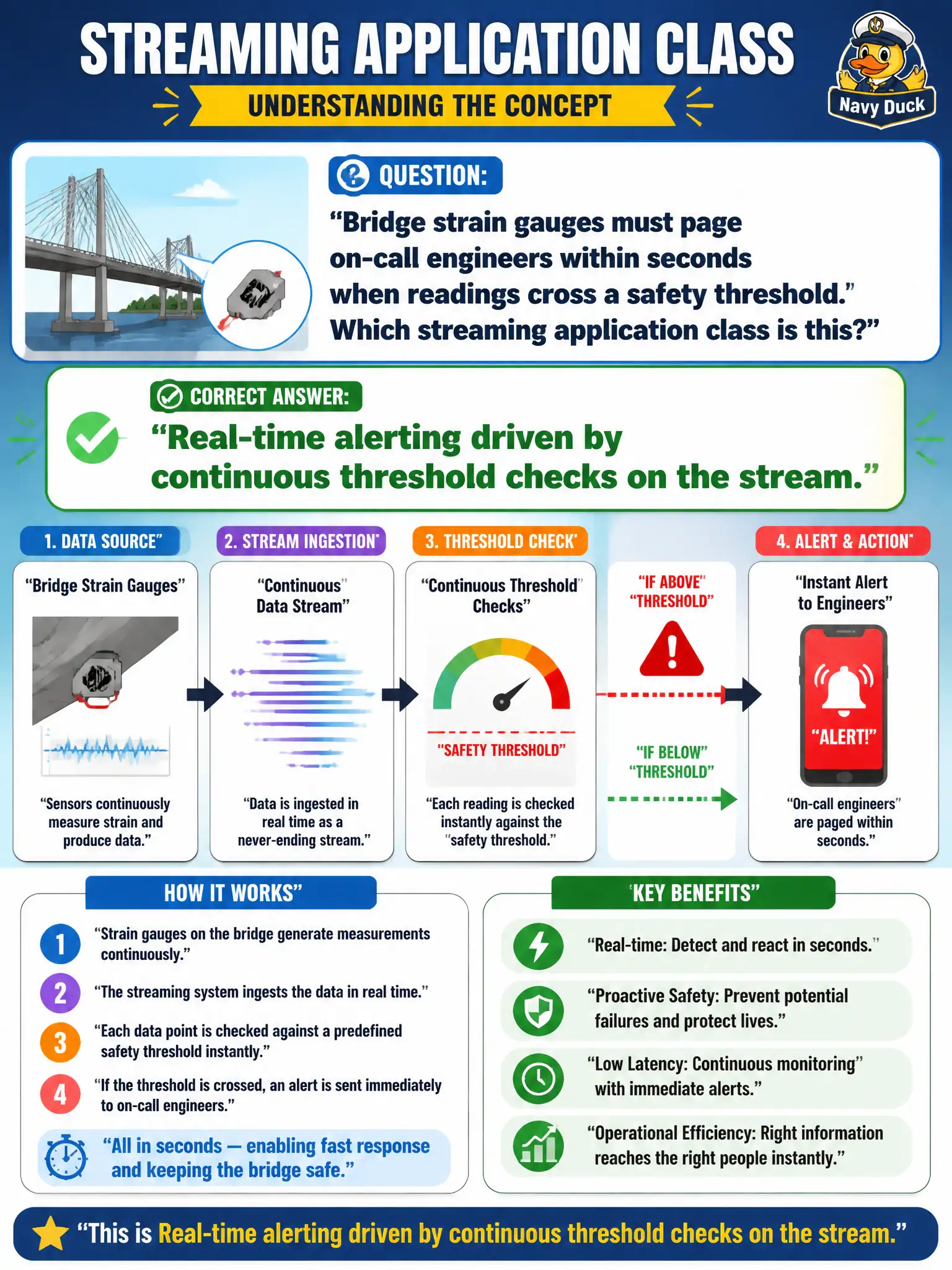
Bridge strain gauges must page on-call engineers within seconds when readings cross a safety threshold. Which streaming application class is this?
Select an answer to reveal the explanation.
Short Explanation
When the bridge numbers go red, somebody’s phone should buzz now—not next week’s courier run. That is classic stream alerting: watch the live feed and fire when a threshold trips. Cold archives and holiday scripts do not page engineers in seconds.
Full Explanation
Bridge strain gauges that must page on-call engineers within seconds when readings cross a threshold illustrate real-time alerting driven by continuous threshold checks on a stream. The civic value is fast detection on unbounded sensor input, not deferred reporting. Offline census microfiche scanning with weekly courier pickup is archival batch work with multi-day latency. A one-time schema migration script run only during holidays is operational maintenance, not continuous alerting. Pure archival cold storage with no notification path retains data but never pages humans when safety limits are crossed. Exam caveat: alerting streams need reliable delivery, dedupe, and escalation policy—false positives can fatigue on-call staff as badly as missed alarms. Operational check: inject a synthetic strain spike in staging, measure time-to-page, and confirm alerts suppress correctly when values return below threshold. In production terms for real-time threshold alerting, assign an owning team, wire a dashboard that shows the pattern is healthy under peak civic load, and require a staging drill that rehearses failure and recovery before resident impact. Revisit the choice when traffic shape, retention, or integrity needs change, and keep a named rollback owner on the change record. Re-test both the happy path and the failure path for real-time threshold alerting after material dependency upgrades so regressions are caught before the next public release.